Jharkhand's Distinctive Development Vision Takes Center Stage at Davos 2026
At the prestigious World Economic Forum in Davos 2026, the Indian state of Jharkhand distinguished itself by presenting a forward-thinking development agenda that diverges from conventional economic models. The state's blueprint uniquely intertwines the enhancement of women's economic participation with a strategic pivot from raw mineral extraction to sophisticated processing industries. This dual approach aims to foster more equitable and resilient growth.
Women's Entrepreneurship as a Cornerstone for Sustainable Growth
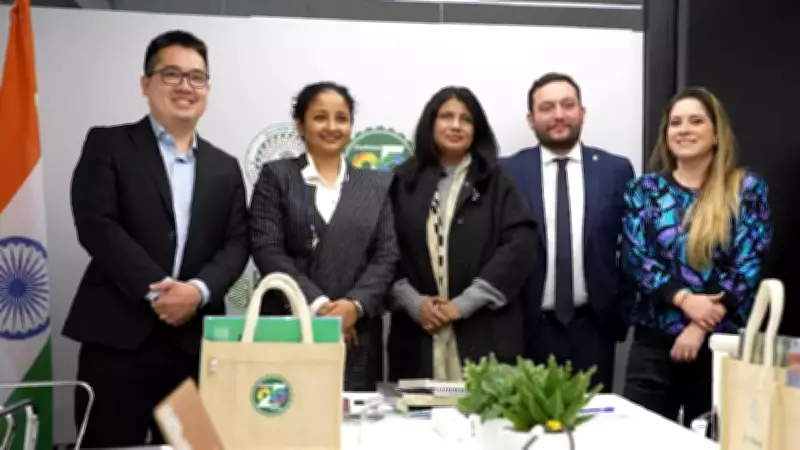
During a specially convened panel titled 'Women Entrepreneurship: Driving Growth and Building a Sustainable Economy' at the Jharkhand Pavilion, MLA Kalpana Murmu Soren eloquently articulated the state's foundational philosophy. "When women are supported with care, resources and trust, growth becomes deeper, more stable and more equitable," she asserted. Soren, who chairs the Jharkhand Legislative Committee on Women and Child Development, emphasized that empowering women is not merely a social objective but an economic imperative essential for building strong families, resilient communities, and a sustainable state.
Soren explained that Jharkhand's approach is deeply rooted in its rich tribal and indigenous heritage, which views development through the lens of stewardship rather than mere resource extraction. In this worldview, women hold a central position, having historically sustained families and local economies through often unrecognized and underpaid care work. The empowerment framework extends beyond traditional welfare schemes to focus on restoring dignity, agency, and opportunity for all women, including homemakers, caregivers, and informal workers who are frequently overlooked in standard economic metrics.

The session, organized in collaboration with the BRICS Chamber of Commerce & Industry's Women Empowerment vertical, featured a diverse array of international voices. Panellists included:
- Ruby Sinha from BRICS CCI-WE
- Geovana Quadros from Brazil's Mulheres Inspiradoras
- Representatives from financial and business sectors across multiple continents
Concrete Initiatives and a Lifecycle Approach to Empowerment
Through the Jharkhand State Livelihood Promotion Society, women-led self-help groups have already enabled thousands to engage in productive activities such as local production, food processing, and value-added enterprises. These collectives do more than create livelihoods; they foster discipline, self-belief, and leadership among participants, fundamentally strengthening women's positions within households and the broader economy. The state adopts a comprehensive lifecycle approach, supporting girls and women from early education through adulthood, recognizing that empowerment is a continuous process rather than a one-time intervention.
Soren extended an invitation to global partners to collaborate with Jharkhand, positioning the state as a living laboratory for demonstrating how women-led, community-rooted development can drive truly inclusive and sustainable growth. This vision, advanced under the leadership of Chief Minister Hemant Soren, prioritizes people over resources and quality of life over narrow economic output.
Transforming Mineral Wealth Through Strategic Processing
Complementing its focus on women's empowerment, Jharkhand unveiled ambitious plans to revolutionize its mineral sector during a separate roundtable discussion. Government officials presented a draft integrated mineral processing policy designed to reshape the state's economic trajectory. "We are preparing a draft of a policy for mineral processing with specific incentives," announced Arava Rajkamal, Secretary of the Department of Mines & Geology in Jharkhand.
This announcement is particularly significant given Jharkhand's geological endowment: the state holds 22 of India's 24 notified critical minerals within its borders. Historically, however, these resources have been exported in raw form, with the state capturing minimal value through processing. The proposed policy seeks to correct this imbalance by offering targeted incentives, financing support, and regulatory clarity to encourage companies to establish local processing and refining capacities.

"We have to get these minerals to the market as soon as possible, especially because of the geopolitical situation and for the country's economic security," noted Prashant Kumar, the state's Finance Secretary. Former Minister of State for Finance Jayant Sinha framed this shift as essential for Jharkhand's future, stating, "The state has historically been oriented towards mining and extraction. The future lies in inclusion, value addition and productive jobs for our youth, and that requires processing and downstream industries."
Building an Integrated and Sustainable Ecosystem
The new policy addresses past distortions, such as higher royalty burdens on processed minerals, that previously made value addition economically unattractive. By aligning the mines and industry departments, Jharkhand aims to create a cohesive ecosystem where mining, processing, and manufacturing develop synergistically rather than in isolation. Environmental sustainability is a core anchor of this approach.
Key components of the strategy include:
- Establishing a dedicated critical minerals research centre in Ranchi to bridge technological gaps in processing capabilities.
- Drafting a joint venture policy to facilitate partnerships between public sector enterprises and private players for capital-intensive projects.
- Prioritizing brownfield mining areas, where land and clearances already exist, for faster implementation of processing facilities.
The roundtable attracted considerable international interest, with attendees including representatives from Germany's DMT Group and Sinomine Resources, signaling global confidence in Jharkhand's transformative potential.
A Unified Vision for Inclusive Prosperity
Together, these dual announcements at Davos 2026 outline an ambitious and holistic shift in Jharkhand's development paradigm. The state is recasting resource-led growth by placing women's agency at the center and ensuring its mineral wealth generates local value through advanced processing and manufacturing, not just extraction. These initiatives underscore Jharkhand's commitment to pursuing a model where economic growth and social inclusion advance hand in hand, setting a new benchmark for sustainable development in India and beyond.