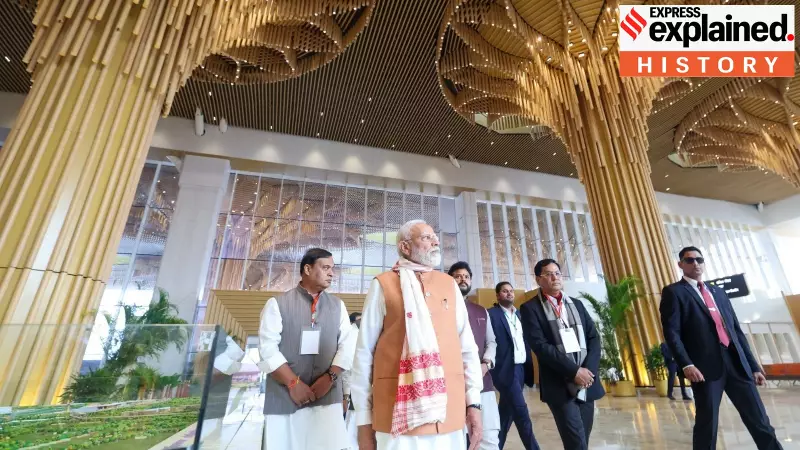
Prime Minister Narendra Modi recently ignited a historical debate by crediting Assam's first Chief Minister, Gopinath Bordoloi, with single-handedly saving the state from being separated from India during the tumultuous pre-Independence era. Speaking in Guwahati, PM Modi alleged that the Congress party of the time was part of a "conspiracy" that could have seen Assam become part of East Pakistan.
The Allegation and the Historical Context
On December 20, while unveiling a statue of Bordoloi, PM Modi made a striking historical assertion. He claimed that when the Muslim League and the British were preparing to divide India, a plan existed to include Assam in East Pakistan. According to the Prime Minister, the Congress was complicit in this move, and it was only due to the defiance of Bordoloi, who "stood against his own party," that Assam's identity and place in India were preserved.
This claim refers to a critical juncture in 1946, involving the controversial Cabinet Mission Plan. As World War II ended, British withdrawal from India became imminent. In March 1946, a delegation of three British ministers—Lord Pethick-Lawrence, Sir Stafford Cripps, and A.V. Alexander—arrived in India under Viceroy Lord Wavell to devise a framework for transfer of power.

The Cabinet Mission Plan and Assam's Fears
The core of the Cabinet Mission Plan was a three-tier structure for a united India: a central Union, provinces, and intermediary groupings. These groupings were the most contentious part. The plan proposed three Groups: Group A (Madras, Bombay, United Provinces, Bihar, Central Provinces, and Orissa), Group B (Punjab, North-West Frontier Province, Sind, and Baluchistan), and Group C (Bengal and Assam).
For Assam's leaders, particularly Congress Chief Minister Gopinath Bordoloi, this grouping was a direct threat. They feared that being clubbed with Muslim-majority Bengal in Group C would inevitably lead to Assam's absorption into a future East Pakistan, overriding the wishes of its predominantly non-Muslim population. The Assam Provincial Congress Committee vehemently rejected this grouping.
Facing pressure from the national Congress leadership to accept the plan for the sake of a united front, Bordoloi sought the counsel of Mahatma Gandhi. He sent two emissaries, Bijaychandra Bhagawati and Mahendra Mohan Choudhury, to meet the Father of the Nation.
Gandhi's Unwavering Support and Nehru's Stance
Gandhi's advice to the Assam leaders was unequivocal and fierce. In a meeting documented in the Collected Works of Mahatma Gandhi, Gandhi told them, "If you do not act correctly and now, Assam will be finished." He urged them to reject the plan outright, even if it meant rebelling against the Congress high command.
Gandhi famously stated, "Assam must not lose its soul. It must uphold it against the whole world... It is an impertinent suggestion that Bengal should dominate Assam in any way." This powerful backing from Gandhi provided Bordoloi with the moral authority to hold his ground.
Jawaharlal Nehru's position, while supportive of Assam, was more nuanced. He believed the grouping plan was a British tactic to appease Muhammad Ali Jinnah. In letters to Bordoloi in July and September 1946, Nehru affirmed that deciding against the Group was "right and proper" and assured that "in no event are we going to agree to a province like Assam being forced against its will."
Earlier, in an April 1946 BBC interview, Nehru had argued that Assam was "obviously opposed to Pakistan." His famous press conference on July 10, 1946, which signaled the Congress's effective rejection of the Cabinet Mission Plan, sealed the issue. Nehru declared, "I can say... that there is going to be, finally, no grouping there, because Assam will not tolerate it under any circumstances whatever."
The firm resistance led by Bordoloi, bolstered by Gandhi's staunch support and Nehru's eventual firm stance, ensured that Assam remained a distinct entity. The Cabinet Mission Plan ultimately collapsed, and Assam's territorial integrity within the Indian Union was secured, a historical moment that continues to resonate in the state's political discourse today.