

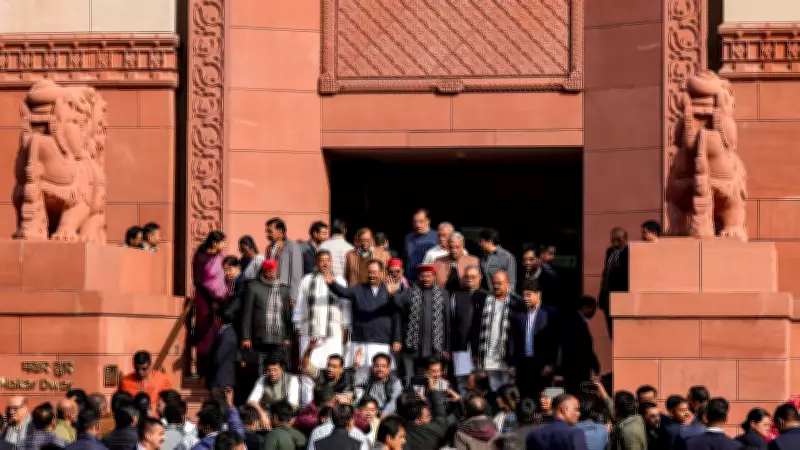
Opposition members have launched a sharp critique against the government for its decision to announce the landmark India-US trade deal on the social media platform X, rather than on the floor of Parliament during an ongoing session. The controversy has sparked a heated debate about parliamentary decorum and the precedence of digital platforms over traditional democratic institutions.
Parliament Versus X Platform: A Question of Priority
During a discussion on the Motion of Thanks on the President's Address, CPI-M Rajya Sabha member John Brittas raised pointed questions about the government's approach. He directly challenged the administration, asking whether Parliament had become "inferior to Elon Musk's X platform." This rhetorical question highlighted growing concerns about the diminishing importance of parliamentary proceedings in favor of social media announcements.
Timing and Protocol Concerns
Brittas specifically criticized the timing of the announcement, which occurred at 9 PM on the X platform. He noted that this unconventional timing forced Prime Minister Narendra Modi to be "alert and awake at 11 PM at night to respond to his (US President) teasers," while Cabinet ministers took to the same platform to "shower compliments on Donald Trump." This sequence of events, according to the opposition, represents a departure from established democratic conventions.

The healthy convention of this country is that any policy decision during a Parliament session, any important decision, should be announced on the floor of the House, rather than on X platform, Brittas emphasized during his parliamentary address. His remarks underscore a broader concern about maintaining the sanctity of parliamentary procedures in an increasingly digital age.
Broader Criticism of Government Policies
The opposition member extended his criticism beyond the announcement method to address substantive policy issues. Referring to US claims that India would stop buying oil from Russia, Brittas asserted, "We were the leader of the non-aligned nation. We never bowed to anybody." This statement reflects ongoing tensions about India's foreign policy autonomy in the context of international trade agreements.
On economic matters, Brittas delivered a scathing assessment of currency depreciation, stating, "When it was Rs 60 (exchange rate), who said that the rupee was in the ICU, the rupee lost its voice, mute like the PM... If the rupee was in the ICU when it was Rs 60, then at Rs 92 it should be in the mortuary or graveyard." His colorful language painted a grim picture of economic management under the current administration.
Budget Implementation Concerns
Further expanding his critique, Brittas highlighted implementation gaps in government programs. He pointed to the last Union Budget's allocation of Rs 10,831 crore for a PM internship program, of which only Rs 526 crore or 4% was actually utilized. "This shows the real picture of your performance. The vast gap between words and deeds is like the Pacific Ocean," he remarked, emphasizing what he perceives as significant discrepancies between government promises and actual delivery.
Agricultural Implications of the Trade Deal
Congress MP Ranjeet Ranjan joined the criticism by expressing specific concerns about the trade deal's potential impact on Indian farmers. She warned that the agreement could open markets to US agricultural produce while crucial recommendations from the Swaminathan Commission remain unimplemented. This perspective adds another layer to the opposition's multifaceted critique of the government's approach to both announcement protocols and substantive policy decisions.
The parliamentary exchange reflects deepening tensions between the government and opposition regarding communication strategies, policy implementation, and respect for institutional norms. As digital platforms increasingly influence political communication, debates about proper channels for official announcements are likely to continue shaping India's democratic discourse.






