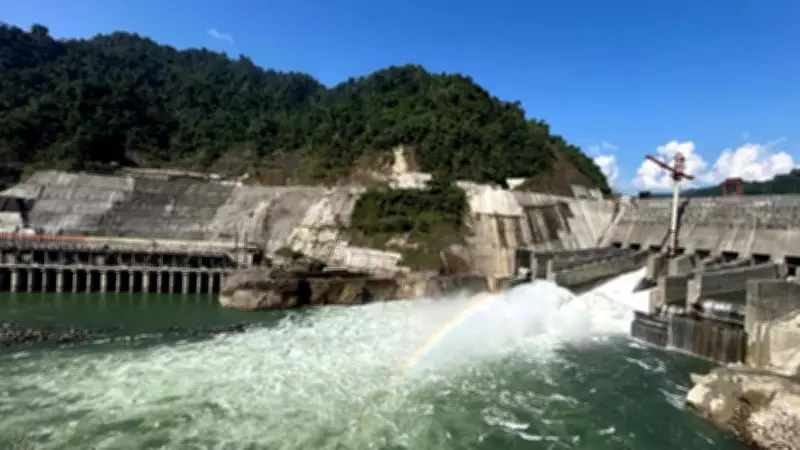
Arunachal Pradesh's Prolonged Delay in Subansiri Hydel Project Plantation Raises Concerns
The much-delayed Subansiri Lower hydel project, located at Gerukamukh on the Assam-Arunachal Pradesh border, has been operational since December 2025 after a protracted 21-year journey since its forest clearance in 2004. However, a critical condition of this clearance remains unfulfilled, casting a shadow over the project's environmental compliance.
Compensatory Afforestation: A Two-Decade Wait
Despite six reminders from the Environment Ministry, Arunachal Pradesh has yet to establish plantations on 31.83 square kilometers to compensate for the forest land lost to the project. In its latest communication dated May 15, 2025, the ministry expressed serious concern, noting that compensatory afforestation (CA) had not been implemented even after more than 20 years.
The ministry's letter highlighted several unresolved issues:

- Identification of compensatory afforestation sites with geo-coordinates and KML files
- Justification for the prolonged delay in carrying out CA
- Current status of implementation
- Details of funds received for the purpose
Arunachal Pradesh has remained unresponsive to multiple reminders sent in October 2022, April 2022, December 2021, August 2020, and March 2020. A senior official from the ministry's north-eastern regional office in Guwahati confirmed that a response from the state is still pending.
Project Timeline and Operational Status
The Subansiri Lower project faced significant delays due to local resistance in Assam and court cases concerning dam safety and downstream ecological impacts, leading to a construction stoppage between 2011 and 2019. Following resumption:
- Clear felling of trees in the submergence area began in October 2021 and concluded by September 2023
- Three of the eight 250MW units underwent mechanical runs during October-November 2025
- These units were synchronized with the national grid on December 2, 2025, January 21, and January 31
- The second unit commenced commercial operations on February 1, 2026
Elephant Corridor Concerns and Hydro-Peaking Risks
In April 2023, the Standing Committee of the National Board for Wildlife (SC-NBWL) commissioned the Wildlife Institute of India (WII) to study the elephant corridor across the Subansiri river between Panir Reserved Forest in Arunachal Pradesh and Dulung Reserved Forest in Assam.
The WII report, submitted in January 2024, identified significant risks associated with the project's hydro-peaking operations:
- Water level rises of approximately 2 meters with increased velocity
- Potential to resemble flash floods affecting the crucial elephant corridor
- Risk of sweeping away or separating young elephants and calves from herds
- Impact on vegetation of river islets that serve as stepping-stones for elephant movement
The WII recommended that project proponent NHPC refrain from hydro-peaking operations until a multi-seasonal hydrological modeling study assesses impacts on elephants and their habitat. Two years later, this study has not been commissioned.
Expert Perspectives and Official Silence
During the SC-NBWL meeting on January 30, 2024, expert member ecologist Dr. Raman Sukumar emphasized the importance of the east-west corridor for elephant populations. He noted that the WII report clearly highlighted the peaking issue, which should not be permitted during animal crossings.
When questioned about whether NHPC would avoid hydro-peaking operations pending the multi-season study, an NHPC official declined to comment. Similarly, attempts to reach the Principal Chief Conservator of Forests and principal secretary of Arunachal Pradesh's Forests and Environment department through email and phone calls received no response.
The situation underscores the ongoing tension between infrastructure development and environmental conservation in ecologically sensitive regions of Northeast India.