European Council President's OCI Card: A Crucial Topic for UPSC Aspirants
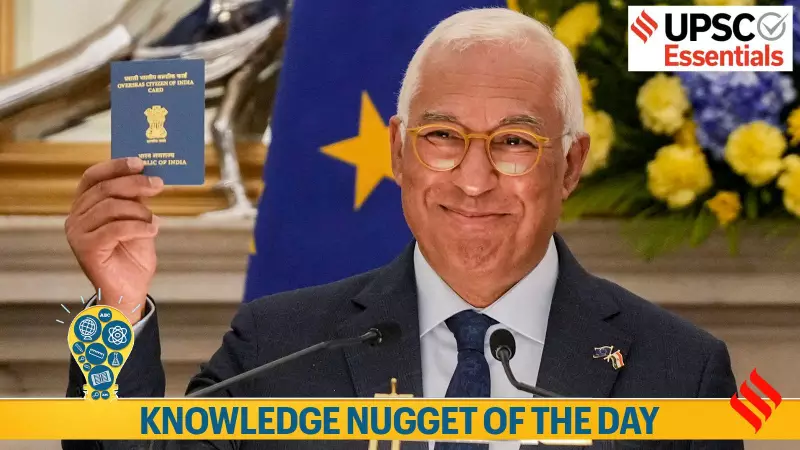
The recent spotlight on European Council President António Costa's Overseas Citizen of India (OCI) card has brought this significant scheme to the forefront, especially for UPSC candidates. During a joint press conference in New Delhi, Costa, who has Goan ancestry, displayed his OCI card, emphasizing the personal and strategic ties between India and the European Union. This event coincides with the conclusion of a major free trade agreement, underscoring the growing importance of diaspora connections in international relations.
Who is António Costa and Why is His OCI Card Significant?
António Costa, described by Prime Minister Narendra Modi as representing the best of the Indian diaspora, holds ancestral links to Goa through his father's family. His grandfather was born in the former Portuguese colony, and his father, Orlando da Costa, was a noted writer with strong Goan influences. Costa, affectionately known as "Babush" in Konkani, meaning a beloved young one, has deep-rooted connections to India.
In 2017, Costa visited his ancestral home in Goa and was honored with the Pravasi Bharatiya Samman, the highest award for the Indian diaspora. Later that year, he hosted PM Modi in Lisbon, where he was conferred the OCI card. His role as a skilled negotiator, earning him the nickname "the Gandhi of Lisbon" for transforming a crime-ridden neighborhood, further highlights his impactful profile.

What is the Overseas Citizen of India (OCI) Scheme?
Introduced in August 2005 through an amendment to the Citizenship Act, 1955, the OCI scheme provides a registration framework for Persons of Indian Origin (PIOs). It was launched during the Pravasi Bharatiya Divas convention in 2006. In 2015, the government discontinued the PIO scheme, requiring PIO cardholders to convert to OCI.
Eligibility Criteria: The scheme is open to PIOs who were citizens of India on January 26, 1950, or thereafter, or were eligible to become citizens on that date. However, applicants are ineligible if their parents or grandparents have ever been citizens of Pakistan or Bangladesh. An exception is made for spouses of foreign origin of Indian citizens or OCIs, provided the marriage has been registered and subsisted for at least two years.

Benefits Available to OCI Cardholders
- Lifelong Visa: OCI cardholders are eligible for a lifelong visa for multiple entries into India for any purpose, though special permission is required for research, missionary, Tablighi, or journalistic activities, or visits to protected areas.
- Registration Exemptions: They are not required to register with Foreigners Regional Registration Officer (FRRO) or Foreigners Registration Officer (FRO), regardless of the length of stay.
- Parity with Indian Residents: OCIs enjoy parity in domestic airfare tariffs and entry fees for national parks and wildlife sanctuaries.
- Inter-country Adoption: They are treated at par with Non-Resident Indians (NRIs) in matters of inter-country adoption of Indian children.
- Educational and Professional Opportunities: OCIs have parity with NRIs in entry fees for monuments, pursuing certain professions, and appearing for all India entrance tests like NEET and JEE, but only for NRI or supernumerary seats.
- Property Rights: They can purchase and sell immovable properties, excluding agricultural land, farmhouses, or plantation properties.
Restrictions on OCI Cardholders
- No Voting Rights: OCI cardholders cannot vote in Indian elections.
- Constitutional Posts: They are ineligible for positions such as President, Vice President, or Judge of the Supreme Court or High Court.
- Public Office: OCIs cannot be members of Legislative Assemblies, Legislative Councils, or Parliament.
- Public Services: They are not entitled to public service appointments, except for special cases specified by the Central Government.
- Article 16 Rights: OCIs do not have the rights under Article 16 of the Constitution regarding equality of opportunity in public employment.
- Agricultural Land: They cannot acquire agricultural land, farmhouses, or plantation properties.
- Foreign Exchange Management Act (FEMA): As of March 2021, OCIs are treated as "foreign nationals" in economic, financial, and educational fields under FEMA, reversing previous parity with NRIs.
Beyond the OCI: Understanding the Citizenship Act, 1955
The Citizenship Act, 1955, outlines the acquisition, determination, and termination of Indian citizenship after the Constitution's commencement. Indian citizenship can be acquired through birth, descent, registration, and naturalisation, as per Sections 3, 4, 5(1), and 5(4). Importantly, the Act does not provide for dual citizenship; thus, OCI is not a form of dual citizenship, as the Indian Constitution prohibits holding Indian and foreign citizenship simultaneously.
Why is This Relevant for UPSC?
For UPSC aspirants, understanding the OCI scheme is crucial, especially in the Polity section. The exam has previously included questions on citizenship, making a holistic grasp of OCI essential for Prelims 2026. This topic ties into broader themes of diaspora engagement, constitutional provisions, and India's international relations, all of which are key areas in the UPSC syllabus.
Key Takeaway: The OCI card facilitates stronger ties with the Indian diaspora while maintaining clear distinctions from full citizenship, reflecting India's nuanced approach to global engagement.