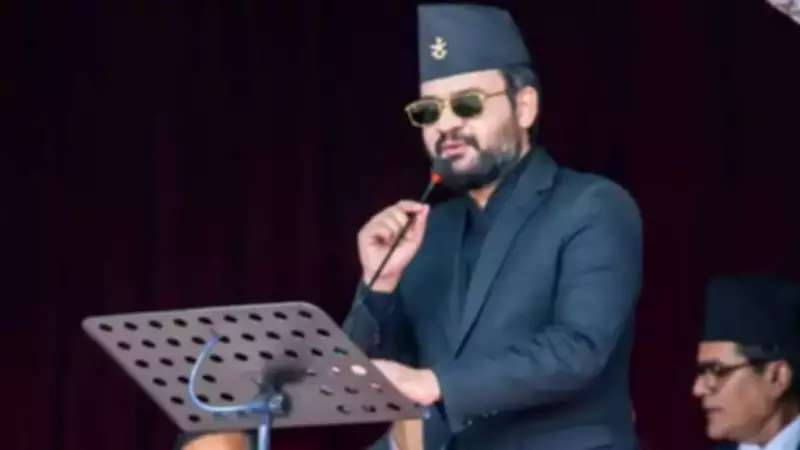
Nepal's Political Landscape Transformed as Balen Shah's RSP Sweeps Parliamentary Elections
In a stunning political upheaval, Nepal's established political order has been decisively overturned as the Rastriya Swatantra Party (RSP), propelled by a wave of support for leader Balen Shah, has either won or established commanding leads in at least 115 of the 165 first-past-the-post parliamentary seats. This dramatic shift follows the September 2025 Gen Z uprising and represents a comprehensive rejection of the country's traditional political establishment.
Major Upsets for Political Veterans
Former Prime Ministers KP Sharma Oli and Madhav Kumar Nepal are facing significant electoral defeats as results continue to be tallied. Gagan Thapa of the Nepali Congress, who recently emerged as the party's new leadership figure after displacing five-time Prime Minister Sher Bahadur Deuba, is also trailing in his constituency. Among the old guard, only Pushpa Kamal Dahal, widely known as Prachanda, appears poised to retain his parliamentary seat. However, even his potential victory carries a symbolic blow, as his daughter, Renu Dahal, is currently trailing in the Chitwan constituency.
Path to Parliamentary Majority
With vote counting still ongoing for most first-past-the-post seats and the 110 proportional representation seats yet to be calculated, any party or coalition will require 138 seats in the 275-member House of Representatives to secure a governing majority. Although final results are not expected until Saturday afternoon, the overwhelming trend has already become unmistakably clear, pointing toward a fundamental realignment of Nepal's political landscape.

Urban Electorate Embraces New Political Force
The electoral sweep across the Kathmandu Valley has been particularly striking. In the capital city and its adjoining suburbs of Lalitpur and Bhaktapur, the Rastriya Swatantra Party is leading in 14 of the 15 available seats. This demonstrates how decisively the urban electorate has swung behind this emerging political movement. If current trends hold, Balen Shah, aged 35, is positioned to become Nepal's next Prime Minister, marking one of the most rapid generational shifts in the nation's recent political history.
Balen Shah's Unconventional Political Journey
Balen Shah, a former rapper and structural engineer who first gained public recognition through music before serving as Kathmandu's mayor, has become the embodiment of anti-establishment sentiment that erupted during last September's protests. Born and raised in a lower middle-class Kathmandu household, his father worked as a government Ayurveda practitioner while his mother was a homemaker. Shah studied civil engineering at Himalayan WhiteHouse International College in Putalisadak, Kathmandu, before earning a Master of Technology degree in structural engineering from Visvesvaraya Technological University in Karnataka, India.
Shah initially entered national consciousness as a rapper whose lyrics targeted corruption, political stagnation, and inherited power structures. By the time of this election, he had developed a rockstar-like popularity that effectively drowned out all other political voices and figures.
Political Veterans Recognize Changing Landscape
The rejection of politicians targeted by the Gen Z protests has been particularly stark. In Jhapa-5, former Prime Minister KP Sharma Oli was trailing so significantly that Balen Shah had accumulated at least four times his vote tally. Another veteran of Nepal's coalition era, Madhav Kumar Nepal, was similarly swept aside by the electoral tide.
Baburam Bhattarai, a former Prime Minister who withdrew from the Gorkha-2 constituency at the last moment, had apparently sensed the shifting political mood early. Explaining his exit in January, he stated he would assume "an advisory role beyond party politics" and continue supporting progressive and emerging forces from outside Parliament. He also emphasized that Nepal's democracy would remain incomplete unless it created "dignified, productive jobs at home" and accelerated economic reforms. In light of Friday's results, his withdrawal appears as an early recognition that the political ground had fundamentally shifted.

Silence from the Victorious Camp
Neither Balen Shah nor party leader Rabi Lamichhane issued any statements, made announcements, or posted on social media platforms on Friday as the scale of RSP's electoral sweep became increasingly apparent. Shah's last public remark came after polling concluded on Thursday, when he praised interim Prime Minister Sushila Karki and wrote: "Under your leadership, democracy has triumphed today."
A Double Political Breakthrough
For many Nepali voters, Balen Shah's rise represents a dual departure—from both the traditional political parties and their established modes of operation. His campaign successfully channeled widespread frustration with political stagnation, corruption, and inherited privilege into a powerful electoral movement that has fundamentally reshaped Nepal's political landscape.