President Murmu Sets Reform Agenda for Parliament Session
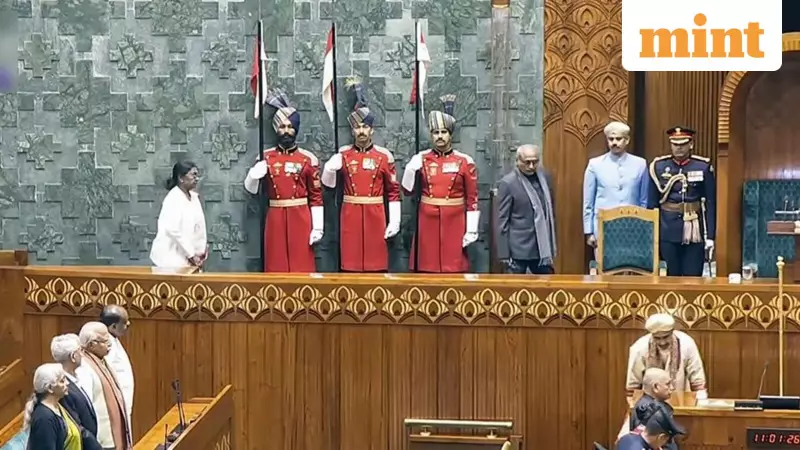
New Delhi: President Draupadi Murmu on Wednesday delivered a comprehensive address to the joint sitting of Parliament, establishing a clear reform-oriented agenda for the upcoming budget session. Her speech emphasized economic resilience, structural reforms, and India's evolving position within the rapidly shifting global trade and geopolitical environment. This address effectively served as the government's pre-budget report card, outlining key achievements and future priorities.
Economic Resilience and Global Trade Integration
President Murmu underscored India's strategic push towards deeper integration into global value chains. She specifically highlighted the recent conclusion of negotiations for the much-anticipated free trade agreement with the European Union, announced just a day prior. This FTA holds immense significance as the EU stands as India's second-largest trading partner, with bilateral trade reaching $136.54 billion in the fiscal year 2025.
"Such agreements will provide fresh impetus to India's manufacturing and services sectors, creating new employment opportunities for our youth," the President stated. She positioned these trade pacts as crucial instruments to bolster domestic manufacturing at a time of rising global protectionism, notably referencing prohibitory tariffs imposed by the United States.

Echoing this sentiment, Rahul Mehta, Chief Mentor of the Clothing Manufacturers Association of India, remarked that the India-EU deal could be a game-changer for the stressed textile sector. He projected that with proper alignment to EU compliance standards, Indian exports could see growth of approximately 25% in the coming years.
The 'Reform Express' and Technological Advancement
Labeling the government's approach as the 'Reform Express', President Murmu detailed initiatives reshaping India's growth trajectory. These range from boosting local manufacturing through Production-Linked Incentive (PLI) schemes to the widespread adoption of deep technologies. She pointed to record growth in electronics manufacturing and the establishment of semiconductor units in states like Assam as tangible outcomes.
The President also spotlighted India's growing leadership in emerging technologies, referencing the upcoming AI Summit and plans to host a global AI impact summit. However, she issued a cautionary note on the risks posed by technologies like deepfakes, calling for collective responsibility to safeguard democracy, social harmony, and public trust in the digital realm.
Internal Security and Welfare Achievements
On the internal security front, President Murmu reported a decisive shift in the fight against left-wing extremism. Maoist influence has reportedly shrunk from 126 districts to just eight, with only three remaining severely affected. Over 2,000 individuals associated with Maoist groups have surrendered, reflecting visible change on the ground, particularly in regions like Bastar where tribal youth are increasingly engaged in sports and constructive livelihood initiatives.
The address also celebrated the strengthening of household finances through economic reforms and welfare measures. Key highlights included GST registrations for two-wheelers crossing two crore, tax-free income up to ₹12 lakh, and the widening of financial access through schemes like Jan Dhan and Mudra. The expansion of Direct Benefit Transfers was particularly emphasized, with over ₹6.75 trillion transferred directly to beneficiaries in the past year alone.
Labour, Energy, and Infrastructure Reforms
President Murmu highlighted the consolidation of labour laws into four comprehensive codes as a major reform step designed to protect workers' interests, maximize benefits for women and youth, and ensure ease of compliance and fair wages.

On energy transition, she described nuclear energy as a vital component of India's future power mix, terming the target of 100 GW by 2047 a historic reform. Progress in renewables was also noted, including over two million rooftop solar installations under the PM Surya Ghar Muft Bijli Yojana and advancements toward the 500 GW non-fossil fuel capacity goal. "India is pursuing green growth alongside economic expansion," she affirmed.
Infrastructure expansion and new opportunities in states like Arunachal Pradesh and Tripura, alongside ongoing work on Mission Sudarshan Chakra, were cited as further markers of the government's reform agenda. The speech also noted rising defence production, which has crossed ₹1.5 trillion, increasing defence exports, and India's push for self-reliance in critical minerals and shipping.
India's Bridging Role on the Global Stage
Stressing India's amplified global role, President Murmu stated that the country has become a vocal advocate for the Global South, positioning itself as a bridge between developed and developing economies amid rising geopolitical and economic fragmentation.
"India has forged new partnerships and reinforced long-standing relationships across regions such as Africa and Latin America," she said, adding that the nation has consistently expanded its presence on key international platforms including BIMSTEC, the G20, BRICS, and the SCO to advance development-oriented priorities.
She noted that even nations engaged in conflict repose trust in India on important issues, underscoring the country's balanced, independent foreign policy guided by the principle of 'India First' while prioritizing impartiality and humanitarian considerations.
A Decade of Inclusive Growth
Reflecting on the past ten years, President Murmu described the period as a cornerstone of India's development journey, marked by a commitment to inclusive growth. She reported that around 250 million citizens have emerged from poverty over the past decade. During this time, 40 million permanent houses have been built for the poor, with 3.2 million houses handed over to beneficiaries in the last year alone.
Her address set a confident and reform-driven tone for the parliamentary budget session, outlining a vision of economic resilience, technological leadership, and a strengthened global footprint for India.