Kolkata's Youth Living the Constitution Beyond Textbooks This Republic Day
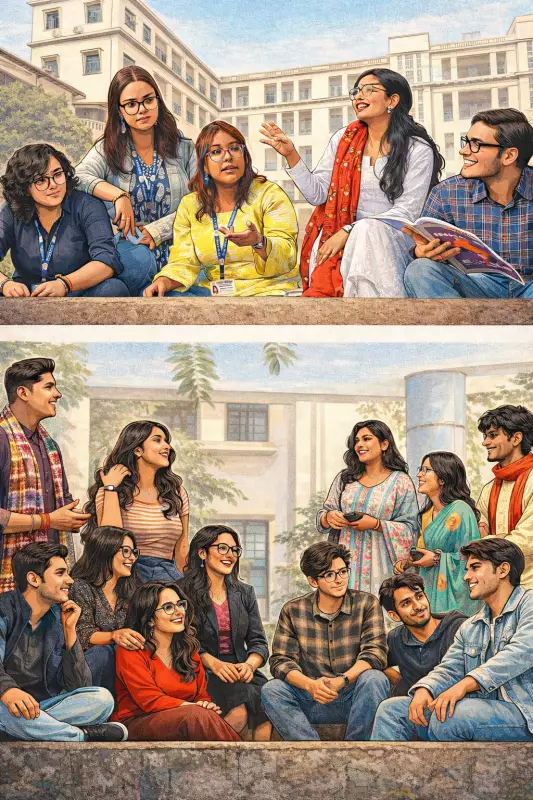
This Republic Day, the spotlight turns to a generation that embodies the Constitution through daily actions rather than mere academic study. From Article 19's guarantee of free speech to Article 21's protection of personal liberty, young voices across Kolkata articulate their understanding of freedom, equality, and choice in an era dominated by hashtags, moral policing, and relentless public opinion. For the college students interviewed, liberty transcends textbook definitions, manifesting in clothing choices, social media posts, dietary preferences, and career aspirations. Between asserting the right to dissent and claiming the right to simply exist, these students are actively redefining constitutional freedom in 2026 as thoughtful, vocal, and unapologetically authentic.
The Nuanced Reality of Free Speech in a Hyper-Connected World
In today's digitally saturated environment, students perceive free speech not as an absolute right but as a complex interplay of context, consequence, and control, particularly online. Chirag Kalyani, a second-year BCom student at Techno India University, defines freedom of speech as "the ability to express my thoughts, ideas, and plans without the fear of being punished or socially excluded." While he feels secure among friends, on social media platforms he admits to often holding back due to fear of repercussions.
Soumiki Ganguly from Loreto College describes free speech as both "empowering and tricky," noting that she thinks twice before posting online not out of fear but because "one post can be taken out of context or judged harshly." At Jadavpur University, Neel Mitra observes that in an increasingly polarized society, even minor disagreements can lead to reputational damage or ostracization, causing people to become overly cautious in sharing genuine opinions, which he views as damaging to the social fabric.

Some students frame this caution as responsibility rather than self-censorship. Tirtharaj Bardhan emphasizes that freedom of speech requires "the courage to be authentic while remaining responsible," pausing online to ensure his words add value rather than noise. Saranya Chattopadhyay from St Xavier's College echoes this sentiment, stating that on social media she pauses "not because I'm silenced, but because every sentence carries consequences."
Campus Versus City: Where Freedom Feels Authentic Versus Conditional
A consistent theme emerges across Kolkata colleges: students describe campus environments as spaces where questioning is encouraged and freedom feels genuine, while the city imposes invisible social boundaries. Sharanya Sinha, a final-year legal science student at Techno India University, calls campus a place "where questioning is encouraged and disagreement is respected," essential for constitutional democracy. She contrasts this with the city, where freedom often operates within unspoken rules shaped by public opinion and moral expectations.
Mehuli Rudra from Loreto College feels most free on campus because she doesn't have to "explain or defend my choices" and can voice opinions, experiment with style, and engage in open conversations without judgment. Outside campus gates, she encounters "unspoken rules and expectations." Devasmita Dutta from Jadavpur University poetically describes campus as "a free space of reasoned exchange," where ideas circulate freely, unlike the judgmental gaze prevalent in the city.
However, perceptions of safety vary. Anwesha Pal associates freedom not with location but with the people around her, emphasizing the importance of having physical and emotional boundaries honored. Adrija Saha from St Xavier's College highlights practical concerns, noting that the city feels safe only when she can return home at night without causing parental anxiety.

Personal Liberty in Everyday Choices: Clothing, Food, and Careers
When discussing constitutional freedom, students frequently highlight personal choices as indicators of true liberty. Swapnil Roy, a second-year BTech student, describes choice as "breathing room"—the space to be oneself without external editing of decisions. He chooses clothes based on mood rather than rulebooks, eats what brings happiness, and prioritizes passion over pressure in career decisions.
Sagnik Ghosh, a third-year student, views freedom as "being the editor of my own rulebook," encompassing cultural expression like dancing in the rain, financial independence through earning his own money, and social autonomy to speak up without being labeled. Hifza Shahnawaz from Loreto College frames cultural freedom as the ability to blend multiple traditions into a unique identity, while seeking to be valued for potential rather than appearance.
Equality Versus Equity: The Gap Between Constitutional Promise and Lived Reality
Students consistently emphasize that equal rights on paper do not guarantee equal experiences in practice. Nilanjana Malakar describes the Constitution's promise as both "empowering and challenging," noting that equality depends on implementation in classrooms, streets, and homes. She views the Constitution as a blueprint requiring active effort to realize.
Aankita Roy Chowdhury argues that "equality on paper doesn't always translate to equality in practice," advocating for equity—creating systems that provide everyone a genuine chance to enjoy their rights. Shruti Bose from St Xavier's College points to structural inequalities and uneven resource access as factors shaping how rights are experienced, emphasizing the need for continuous interpretation and enforcement of constitutional principles.
Ramaditya Ganguly encapsulates the Republic Day challenge succinctly: "The real work begins where the text ends." This sentiment is echoed by Nandini Mukherjee from Jadavpur University, who notes that democratic constitutional rights remain unrealized for many, including queer communities living in fear of persecution.
Student Voices: Defining Freedom in Their Own Words
- Chirag Kalyani, Techno India University: "I hold back on social media out of fear of the consequences."
- Ramaditya Ganguly, St Xavier's College: "Equal rights are not just written down, but lived out by everyone."
- Nandini Mukherjee, Jadavpur University: "Our democratic constitutional rights are yet to be actualised; queer people live with fear of persecution."
- Hifza Shahnawaz, Loreto College: "Freedom is to be present at a table where I am valued for my potential and not for my looks or attire."
- Saranya Chattopadhyay, St Xavier's College: "The Constitution promises that questioning is the foundation of a thinking republic."
- Swapnil Roy, Techno India University: "Freedom is ability to choose passion over pressure."
- Devasmita Dutta, Jadavpur University: "Dr Ambedkar called the Constitution a 'vehicle of life'; its spirit lives when citizens uphold these values."
- Mehuli Rudra, Loreto College: "It's only on campus and among friends, I can speak my mind without fear."
As Kolkata's youth navigate the complexities of constitutional freedoms in a digital age, their reflections offer a powerful reminder that the Constitution's vitality depends not on passive study but on active, daily engagement by citizens committed to building a more equitable and free society.