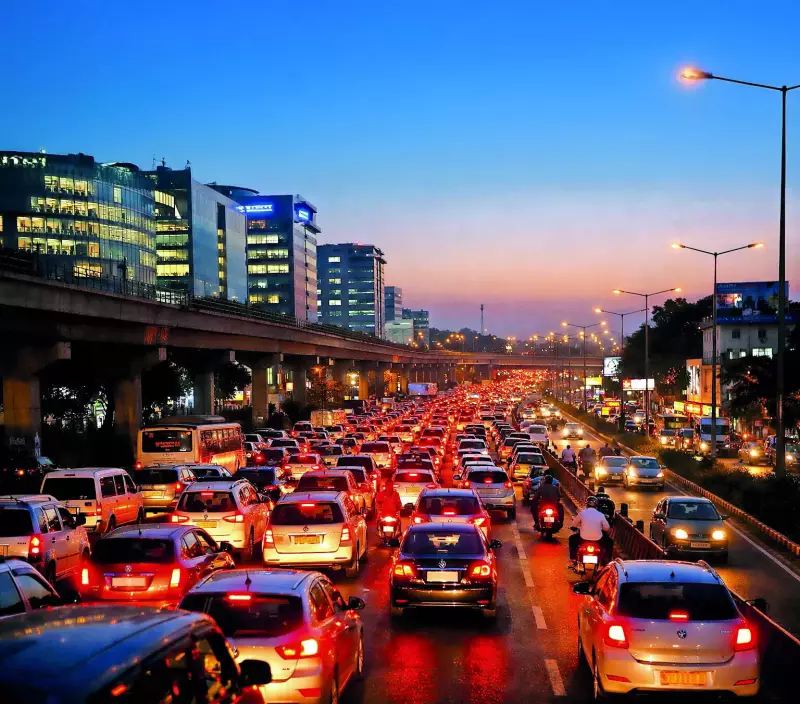
Bengaluru Climbs to Second Spot in Global Traffic Congestion Rankings
According to the latest TomTom 2025 data, Bengaluru has secured the unenviable position of being the second most congested city in the world, with Mexico City holding the top rank. This statistical ranking translates into a tangible reality for the city's residents, who collectively lose approximately 168 hours every year to traffic delays. This staggering amount of time is equivalent to an entire week spent navigating through gridlocked streets, staring at endless lines of brake lights, constantly consulting navigation apps, and frequently reconsidering social engagements.
Daily Life Reconfigured by Unpredictable Commutes
In Bengaluru, where traffic congestion has become a constant companion, it has done more than merely slow down movement; it has fundamentally reshaped how people live, meet, and socialize. Even covering short distances now requires strategic planning and careful consideration. The city has effectively been carved into compact, self-contained ecosystems where individuals eat, exercise, socialize, and even form romantic relationships within narrowly defined geographical boundaries.
"Traffic here is so unpredictable that even if my office is just seven kilometres away, it could take 20 minutes one day and over an hour the next," explains Shreya, a content writer based in the city. Social interactions have also transformed into carefully negotiated affairs. Entrepreneur Sangeet Ram notes, "My closest circle lives a bit far, so we take turns choosing areas that are convenient for us. A well-planned trip usually makes the hassle worth it."

Making the Most of Traffic-Induced Downtime
With so many hours spent immobilized in vehicles, Bengalureans have developed creative ways to utilize this forced downtime productively. Common activities while stuck in traffic include:
- Catching up on reading books or articles
- Listening to educational or entertaining podcasts
- Discovering new music and creating playlists
- Finishing pending office work remotely
- Engaging in personal reflection and contemplation
Traffic Influences Major Lifestyle and Housing Decisions
The impact of Bengaluru's traffic extends beyond daily inconveniences to influence significant long-term decisions. A recent real estate industry report revealed that 52% of home-seekers in Bengaluru prioritize proximity to their workplace above other factors when choosing residential locations.
"Work-from-home is a true blessing in a city like this," shares Pournami K, a UX researcher. "The time I save by not commuting every day is incredible." Entrepreneur Abhishek Iyer admits that traffic has considerably narrowed his world: "There's so much to explore in Bengaluru, but because of traffic, I'd rather stay home or visit the same café or restaurant near my place. Convenience trumps experiences now."
Over time, this trend has led neighborhoods to evolve into self-sufficient bubbles containing favorite cafés, gyms, salons, and social circles all within a few kilometers. Crossing the city now feels less like a casual plan and more like a significant commitment requiring substantial time investment.
Reclaiming Lost Time: What 168 Hours Could Achieve
If Bengaluru residents could reclaim those 168 hours lost annually to traffic congestion, they could potentially:
- Take a complete one-week vacation to rejuvenate
- Learn a valuable new skill or language
- Catch up on much-needed sleep and rest
- Explore Bengaluru's diverse neighborhoods on foot
- Pursue personal hobbies and creative projects
The TomTom 2025 data underscores how urban congestion in Bengaluru has transcended being merely a transportation issue to become a defining factor shaping the city's social fabric, economic patterns, and quality of life for its millions of residents.