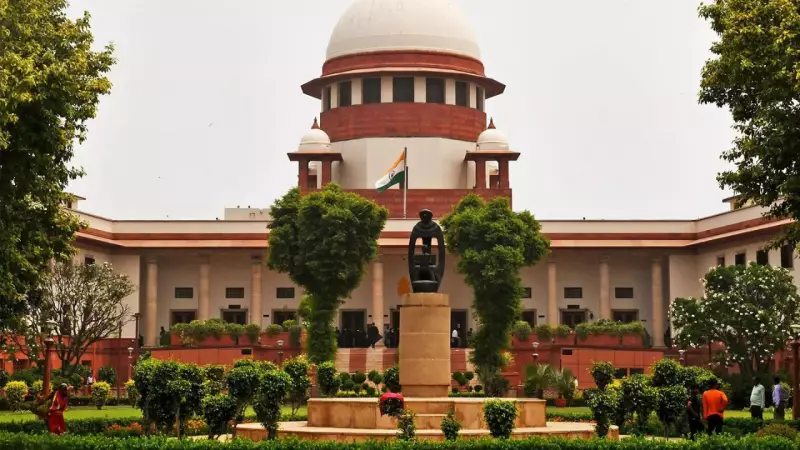
In a landmark judgment reinforcing the primacy of personal liberty, the Supreme Court of India has ruled that the government cannot deny the renewal of a passport to an individual facing criminal charges if the concerned trial court has issued a no-objection certificate (NOC). The apex court emphasized that the right to travel abroad is a fundamental facet of personal liberty under Article 21 of the Constitution.
Court's NOC Overrides Adverse Police Report
A bench comprising Justices Vikram Nath and A G Masih delivered the verdict while hearing the plea of Mahesh Kumar Agrawal. Agrawal, who is convicted in one case in Delhi and is also being prosecuted by a special NIA court in Ranchi in a coal mining case, had been denied passport renewal by the passport authority. The bench clarified that where criminal cases are pending, a no-objection certificate or permission from the criminal court may override an adverse police report submitted for passport renewal.
The court noted that Agrawal had challenged his conviction in the Delhi High Court, where his appeal is pending. He had been granted bail in both cases and had successfully obtained no-objection certificates from both the Delhi High Court and the Ranchi NIA court for the renewal of his passport, subject to the condition that he would seek prior permission before any foreign travel.

Liberty is the State's First Obligation, Says SC
Quashing the passport authority's rejection order, the bench articulated a powerful principle. "Liberty, in our constitutional scheme, is not a gift of the State but its first obligation," the court stated. It elaborated that the freedom of a citizen to move, travel, and pursue livelihood, subject to law, is an essential guarantee under Article 21.
The judgment acknowledged that the state may regulate this freedom in the interest of justice, security, or public order, as provided by statute. However, it stressed that any such restraint must be "narrowly confined to what is necessary, proportionate to the object sought to be achieved, and clearly anchored in law."
Judicial Supervision Addresses Statutory Concerns
The Supreme Court addressed the provision of the Passports Act, 1967 – Section 6(2)(f) – which allows for denial of a passport when a criminal case is pending. The bench found that the method adopted by the criminal courts in Agrawal's case satisfactorily addressed the law's underlying concern.
"In our view, once criminal courts, with full knowledge of the pending proceedings, consciously allowed renewal subject to the condition that the appellant shall not travel abroad without their permission... the underlying concern of Section 6(2)(f) stood adequately addressed under judicial supervision," the court observed.
It further explained that by allowing renewal while insisting on prior approval for each instance of foreign travel (and in the NIA court's case, requiring the redeposit of the renewed passport), the courts retained complete control. This method, the bench said, is a legitimate way to secure the accused's presence while upholding their right to personal liberty.
The ruling serves as a crucial reminder that any restriction on the right to travel must be fair, just, reasonable, and must bear a rational nexus with a legitimate purpose. The court warned that disturbing the balance between the power of the State and the dignity of the individual puts the Constitution itself at risk.