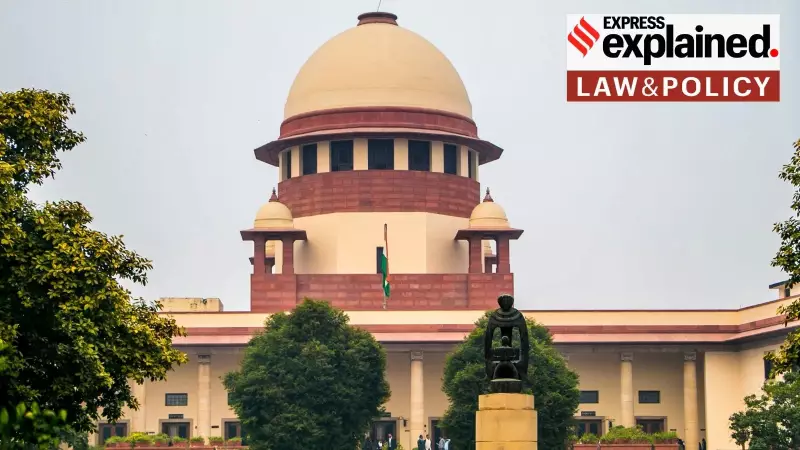
In a landmark judgment that reinforces the constitutional principle of equality, the Supreme Court of India has ruled that the open or general category in government recruitment is not a closed compartment reserved for any particular social group. The apex court clarified that it is a pool open to all candidates solely on the basis of merit.
The Core of the Judgment: Open Category is Not a Quota
The Supreme Court bench, comprising Justices Dipankar Datta and A G Masih, delivered a significant verdict last month, upholding a previous ruling by the Rajasthan High Court. The court emphatically stated that the open category is not a 'quota'. It is available to every candidate, with merit being the only qualifying condition.
The judgment stemmed from a recruitment controversy in Rajasthan. In August 2022, notifications were issued for 2,756 vacancies for the posts of Junior Judicial Assistant and Clerk Grade II under the Rajasthan High Court and district courts. The selection process involved a written exam of 300 marks, followed by a typing test of 100 marks.

The problem arose when the recruiting authority prepared category-wise shortlists after the written exam results in May 2023. While the general category cut-off was around 196 marks, the cut-offs for several reserved categories were set much higher, sometimes exceeding 220 marks. This led to an anomalous situation where reserved category candidates who scored above the general cut-off but below their own category's higher cut-off were excluded entirely. They were denied a chance to appear for the typing test, despite outperforming many who were shortlisted in the general category.
Rejecting the 'Double Benefit' Argument
The Supreme Court firmly rejected the argument presented by the High Court administration that allowing reserved category candidates into the open category shortlist would grant them a "double benefit." The court provided a crucial clarification on what constitutes availing reservation.
A candidate is considered to have availed reservation only when a specific concession or relaxation is applied to them, such as lower qualifying marks or age limits. The court held that the mere fact of belonging to a reserved category does not mean a candidate is using reservation benefits at every stage.
When a reserved category candidate secures marks above the general cut-off without any relaxation, their inclusion in the open category list is a result of their merit, not reservation. The bench observed that the 'double benefit' argument is based on the erroneous assumption that a reserved category candidate automatically gets reservation benefits at every stage of a multi-tier process.
Constitutional Principles and the Path Forward
The court grounded its decision in the fundamental guarantees of the Constitution. It stated that excluding a candidate from consideration for open category posts solely because of their reserved category status, when they have scored above the general cut-off, offends the guarantees of equality under Articles 14 and 16.
Article 16(1) guarantees equality of opportunity in public employment, while Article 16(4) permits reservation as an exception to address historical disadvantage. The court warned that treating the open category as an exclusive compartment for non-reserved candidates risks turning affirmative action into a form of exclusion and amounts to "communal reservation."
The Supreme Court endorsed the Rajasthan High Court's corrective directions. It mandated that at the shortlisting stage, all candidates must be assessed together purely on marks. A general/open category merit list should be prepared first, including reserved category candidates who crossed the general cut-off. Only after this should the reserved category lists be drawn from the remaining candidates.
The court also introduced a vital safeguard: a meritorious reserved category candidate cannot be forced into an open slot if that action would cost them a better post or posting available under their reserved quota. This ensures that reservation functions as a means of inclusion rather than an instrument of disadvantage.

While acknowledging that reworking the selection lists could affect appointments already made, the Supreme Court stressed that any correction must be carried out with minimal administrative disruption. The judgment reinforces that in the open category, merit is the sole king, and social identity cannot be a barrier to equal opportunity.