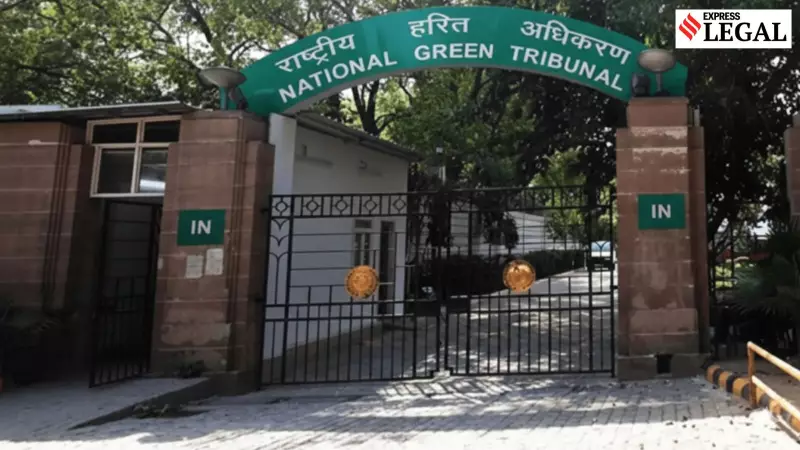
Orissa High Court Quashes Rs 96 Crore NGT Penalty, Cites 'Manifest Arbitrariness'
The Orissa High Court has delivered a significant ruling by setting aside an environmental compensation order of over Rs 96 crore imposed by the National Green Tribunal (NGT) on a mining lease holder. The court emphasized that its intervention is justified in cases involving violations of natural justice, manifest arbitrariness, or lack of proportionality.
Court's Rationale and Key Observations
Justice Sanjeeb K Panigrahi, while hearing a plea filed by Prahallad Biswal, observed that the NGT order suffered from critical flaws. The court stated, "Interference by the high court is justified where the challenge goes to the root of the decision-making process, including cases involving violation of the principles of natural justice, non-consideration of relevant material, manifest arbitrariness, or lack of proportionality." This order was passed on January 9, 2026.
The High Court highlighted that the NGT order did not disclose any reasoned consideration of proportionality and failed to adequately address the petitioner's contentions. It noted that while environmental compensation need not directly correlate to royalty paid, the doctrine of proportionality requires the quantum to be proportionate to the damage caused and supported by a rational methodology.
Striking Disparity in Figures: The court pointed out a glaring discrepancy: the total royalty paid by the petitioner was approximately Rs 12.6 lakhs, whereas the environmental compensation imposed was approximately Rs 96 crore. Even under the polluter pays principle, the doctrine of proportionality cannot be ignored, the court asserted.
Violation of Natural Justice and Procedural Lapses
The High Court found that the NGT's decision-making process was fundamentally flawed. The record revealed that while the final report of a private consultant was furnished to the petitioner, the raw data and methodology forming the basis of such assessment were not supplied. "A meaningful opportunity of hearing is not satisfied by the mere communication of conclusions," the court remarked. It added that where a decision is founded on technical material, fairness requires disclosure of the material relied upon to enable effective rebuttal.
Furthermore, the NGT order did not adequately address the petitioner's contentions relating to third-party illegal mining in the area. This omission assumed significance given the magnitude of the penalty imposed. The petitioner had argued that large-scale illegal mining was carried out by third parties, a fact acknowledged by revenue authorities and supported by FIRs registered in June 2022 under the Mines and Minerals (Development and Regulation) Act.
Background of the Case
The case originates from mining operations at the Damanbhuin laterite stone quarry in Khordha district, Odisha. The petitioner was selected as the preferred bidder pursuant to an auction notice issued by the Tahasildar, Tangi, and was directed to deposit royalty on August 12, 2021. Environmental clearance for the quarry was granted on July 6, 2021, and subsequently transferred in favour of the petitioner on March 15, 2022.
A formal mining lease deed was executed on April 25, 2022, covering an area of 4.139 hectares. The petitioner was granted consent to establish on June 29, 2022, and consent to operate on July 15, 2022, permitting extraction of 1,500 cubic metres of laterite stone per annum. Mining operations commenced in July 2022.
In August 2023, one Ajay Behera filed a plea before the NGT, alleging that the petitioner had engaged in excess and illegal mining beyond the permitted area and quantity. The NGT directed the constitution of a joint committee, which undertook inspections with the assistance of the Odisha Space Application Centre (ORSAC) and a private consultancy using satellite imagery, DGPS, and drone surveys.
Relying on these assessments, the NGT, on February 11, 2025, concluded that the petitioner had mined in excess of the consent to establish and imposed environmental compensation of Rs 96,28,50,175.
Petitioner's Arguments and State's Stand
The petitioner contended that statutory measurements conducted by the geologist in the office of the Tahasildar had already resulted in levy and payment of royalty and minor penalties amounting to around Rs 21 lakh, and that excess mining attributable to the petitioner was limited. He also questioned the reliance on a private consultancy report, arguing that while conclusions were shared, the raw data and methodology were never disclosed, thereby denying an effective opportunity to rebut the findings.
Additionally, the petitioner submitted that the application of the net present value (NPV) concept, traditionally used in forest and tree-felling cases to a mineral resource like laterite stone, was fundamentally misconceived.
Opposing the petition, the state argued that the NGT order was appealable under Section 22 of the NGT Act, 2010, and that the petitioner had bypassed the statutory remedy. The authorities maintained that scientific assessment revealed excess extraction of over 79,000 cubic metres of laterite stone, far exceeding permissible limits, and that environmental compensation need not correspond to royalty paid.
Court's Final Decision and Directions
Concluding that the NGT's order suffered from non-consideration of relevant material, lack of proportionality, and violation of natural justice, the High Court set aside the impugned order dated February 11, 2025, insofar as it related to computation and imposition of environmental compensation.
The matter was remitted to the competent authority for fresh consideration, with directions to:
- Furnish all relied-upon material to the petitioner.
- Afford the petitioner a meaningful hearing.
- Pass a reasoned order in accordance with law.
The writ petition was accordingly disposed of on January 9, 2026, and all interim orders stood vacated. This ruling underscores the judiciary's role in ensuring that environmental penalties are imposed fairly and proportionately, adhering to the principles of natural justice.