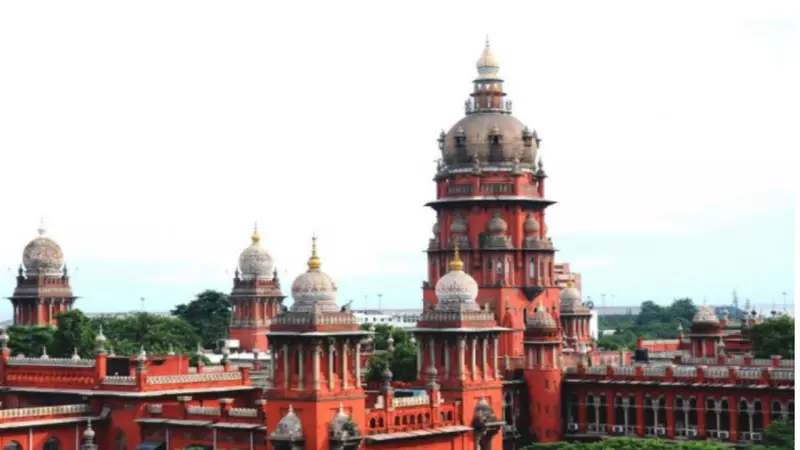
In a significant ruling, the Madras High Court has emphasized that roads and streets inherently lack any religious character, and encroachments on such public spaces must be removed regardless of their nature. The court made this observation while ordering the demolition of a long-standing shrine dedicated to Mother Velankanni in Chennai.
Court's Firm Stance on Public Road Encroachments
Justice V Lakshminarayanan of the Madras High Court delivered this verdict on Tuesday, directing the Greater Chennai Corporation (GCC) commissioner to take immediate action. The shrine, located on SRP Kovil Street (North) in Thiru Vi Ka Nagar, Kolathur, Chennai, was found to be illegally constructed on a public road.
The court firmly stated that whether a structure is religious or secular, if it encroaches upon a street, public place, or land belonging to a local body, the commissioner is legally obligated to remove it after issuing due notice. This mandate is enshrined under the Tamil Nadu Urban Local Bodies Act, which empowers local authorities to clear such obstructions.
Rejection of Longevity as a Defense
One of the key arguments presented in defense of the shrine was its existence for over three decades. However, the court categorically rejected this plea, asserting that the duration of an illegal structure does not legitimize its presence on public property.
"The plea that the idol has been in existence for more than 30 years is no defence at all," Justice Lakshminarayanan remarked. "Every minute, nay, second that an illegal superstructure is on a public road or a street gives a fresh cause of action to the commissioner to invoke his power under the Tamil Nadu Urban Local Bodies Act."
Background of the Case
The court's order came in response to a petition filed by A Sarath, a resident of Thiru Vi Ka Nagar. According to Sarath, while undertaking repairs to his property and preparing for a housewarming ceremony, he noticed that a statue of Mother Mary had been installed in a temporary structure near his premises.
Concerned about the obstruction caused to the public road, Sarath sought the intervention of authorities to remove the encroachment. In opposition, a man named Daniel contended that he, along with his friends, had constructed the shrine in 1995, and it had been a fixture in the neighborhood for over 30 years.
Court's Directive and Compliance Deadline
Despite the defense's arguments, the court remained unwavering in its decision. It directed the GCC commissioner to ensure the removal of the structure on or before February 10 and submit a compliance report by February 11.
This ruling underscores the judiciary's commitment to upholding public space regulations and ensuring that roads remain free from unauthorized constructions, irrespective of their religious or cultural significance.
Implications for Urban Governance
The Madras High Court's verdict serves as a crucial reminder of the statutory responsibilities of local bodies in managing urban spaces. It reinforces the principle that public roads and streets are meant for communal use and cannot be appropriated for private or religious purposes without proper authorization.
This case also highlights the ongoing challenges faced by cities like Chennai in balancing religious sentiments with urban planning and legal frameworks. The court's firm stance is expected to set a precedent for similar encroachment disputes across Tamil Nadu and beyond.