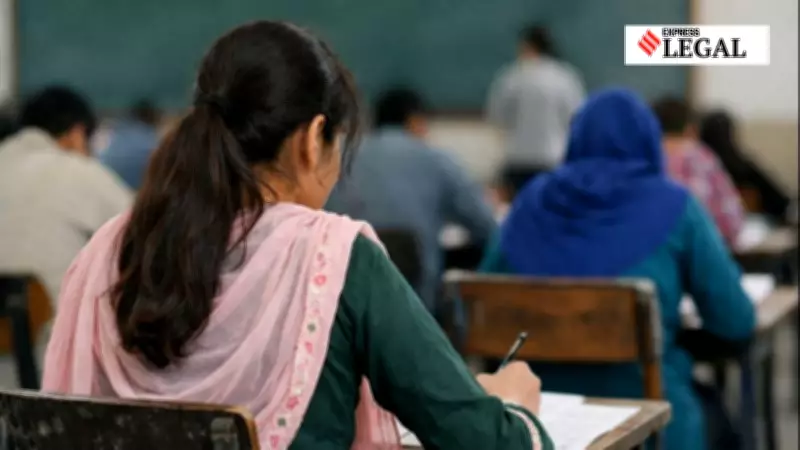
The Punjab and Haryana High Court has issued a landmark directive to Panjab University, mandating a special examination for an LLB student who was erroneously given an incorrect question paper during a re-attempt. The court emphasized that a student's academic future must take precedence over administrative hurdles, marking a significant ruling in educational justice.
Court's Emphasis on Student Welfare Over Administrative Convenience
Justice Kuldeep Tiwari, presiding over the case, observed that the petitioner is suffering solely due to irregularities committed by the university. The court stated, "The academic future of a student deserves precedence over the administrative inconvenience of the Panjab University." This principle guided the decision to order a special exam, highlighting the judiciary's role in safeguarding student rights.
Details of the Examination Error
The incident involved an LLB student from Panjab University who had cleared all papers except one, Law of Crimes-II (Old), which she was re-taking in May 2025. During the exam, the invigilator mistakenly handed her the question paper for "The Bharatiya Nyaya Sanhita-II (New)" instead of the correct one. With no alternatives, she attempted the wrong paper, leading to her being marked "absent" when results were declared in October 2025.

Arguments Presented in Court
Advocate Talim Hussain, representing the petitioner, argued that his client suffered due to no fault of her own, as the error originated from the university-appointed invigilator. He pointed out that the university failed to take corrective steps despite immediate notification of the mistake. Additionally, the petitioner lost the chance to re-appear in the regular schedule since her result was declared after the re-appear exam dates were finalized.
In contrast, advocate Akshay Kumar Goel, representing the state, contended that Panjab University is bound by strict regulations governing exam schedules. He noted that odd semester exams are held in November and even semester exams in May, making a special exam in January 2026 non-compliant with these rules. Goel also mentioned that out of three students at the exam center, two attempted the correct paper, while only the petitioner received the wrong one.
Court's Findings and Directives
The court found that the university's lapse caused undue hardship to the student. It noted that if the university conducts combined exams for old and new courses, invigilators must exercise due diligence in distributing question papers. The ruling emphasized that regulations should not hinder rectifying mistakes, especially when a student's academic career is at stake.
As a result, the court directed Panjab University to conduct a special examination of Law of Crimes-II (Old) for the petitioner in January 2026. This decision underscores the need for mechanisms to address exam errors promptly, ensuring fairness in academic evaluations.
Background and Implications
The student had initially failed the Law of Crimes-II (Old) paper and applied for a re-examination. After the blunder, she made several representations to the university, only to be informed that the next re-appear exam would be in May 2026, potentially delaying her academic progress by a year. The court's intervention prevents this setback, setting a precedent for handling similar cases in the future.
This ruling highlights the importance of accountability in educational institutions and the judiciary's commitment to protecting students from administrative oversights. It serves as a reminder that procedural regulations should not override fundamental rights to education and fair treatment.