

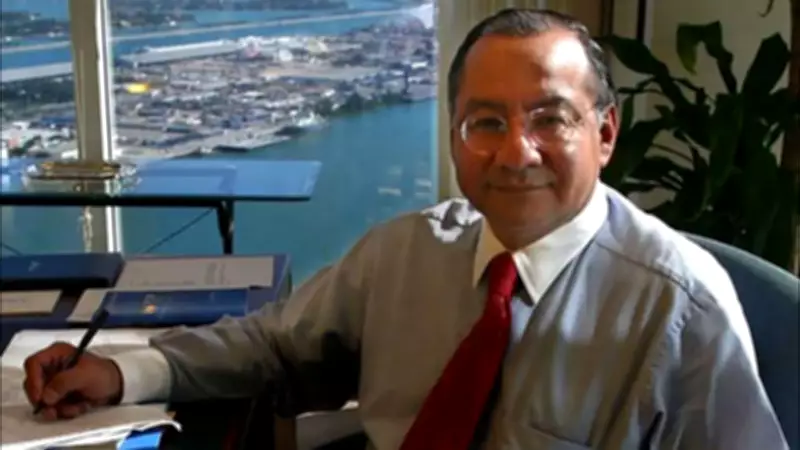
The Donald Trump administration has intensified its crackdown on individuals who fraudulently obtained US citizenship, publishing a list of 12 such individuals. Among them, one name stands out: Victor Manuel Rocha, a former US ambassador to Bolivia. Rocha was arrested in 2023 and admitted to having acted as a secret agent for Cuba for 40 years.
Background and Career
Rocha, a native of Colombia, grew up in New York City. He graduated from Yale University and earned a master's degree from Harvard University. He became a US citizen in 1978. Three years later, in 1981, he began working for the US State Department. His first posting was as a political officer at the US embassy in the Dominican Republic, followed by Honduras, and then as First Secretary of the US Embassy in Mexico City. In 2000, President Bill Clinton appointed Rocha as the US ambassador to Bolivia.
Denaturalization Complaint
The Department of Justice, in its denaturalization complaint, alleged that Rocha lied during his citizenship process because he was already working as an agent for Cuba since 1973. Assistant Attorney General Brett Shumate stated, "Under no circumstances should an agent of a foreign adversary be permitted to hold the title of American citizen. Our mission is clear: to root out these fraudsters and preserve the sanctity of the naturalization process for those who adhere to our laws. Any individual who lied during the naturalization process to gain a foothold in this country will be met with the full weight of the Department of Justice."

US Attorney Jason A. Reding Quiñones for the Southern District of Florida added, "Victor Manuel Rocha was not a low-level operative. He was a former United States Ambassador and senior government official who admitted he secretly served the Cuban regime for decades. The Southern District of Florida helped take down one of the most prolific Cuban spies ever uncovered in the United States. This civil denaturalization case is about finishing the job. The complaint alleges that Rocha obtained American citizenship through lies, concealment, and betrayal. A person who secretly serves communist Cuba should not keep the privilege of United States citizenship, even while in prison."
Unregistered Agent of Cuba
Rocha was serving as an unregistered agent for the Republic of Cuba. When he applied for naturalization, he represented under penalty of perjury that he had not committed crimes for which he had not been arrested; he was not affiliated with the Communist Party of Cuba; he had not advocated, believed in, or knowingly supported and furthered the interests of Communism; and he believed in the US Constitution and the form of government of the US. None of these statements were true.
Legal Grounds for Denaturalization
The DoJ asserted that Rocha was not qualified for naturalization for several reasons, including that he committed unlawful acts, gave false testimony during his naturalization examination, was not attached to the principles of the US Constitution and not well-disposed to the good order and happiness of the US, was affiliated with the Communist Party of Cuba, and advocated for communism. The US will also seek the revocation of his naturalization because he procured his citizenship by concealing material facts or willfully misrepresenting several facts in naturalization proceedings related to spying for Cuba.






