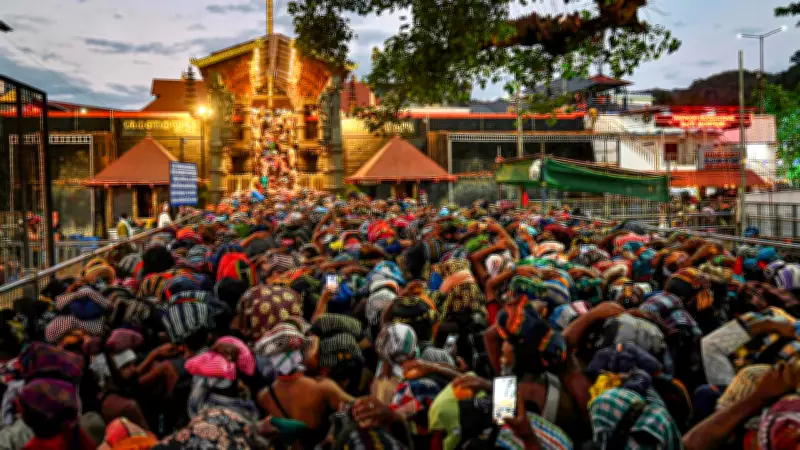
Centre Defends Sabarimala Restrictions in Supreme Court, Cites Religious Customs
The Centre on Thursday presented arguments in support of the restrictions on the entry of women of menstruating age into Kerala's Sabarimala temple. Solicitor General Tushar Mehta, representing the government, contended before the Supreme Court that the 2018 verdict which lifted the ban was predicated on an erroneous assumption of male superiority over women.
Constitutional Bench Hears Broader Religious Freedom Issues
A nine-judge Constitution bench, led by Chief Justice Surya Kant, is currently adjudicating a series of petitions that address the entry of women into various places of worship and explore the wider implications of religious freedom across different faiths in India. This significant legal proceeding aims to delineate the intersection between constitutional equality and the right to practice religion.
Mehta emphasized that religious practices should not be evaluated exclusively through a gender-based lens. He provided examples where men are also subject to specific prohibitions or required to adhere to particular customs in certain temples, illustrating the diversity of religious traditions.

Rooted in Faith, Not Discrimination
Referring to the traditions associated with the deity at Sabarimala, Mehta argued that the practice is fundamentally grounded in faith rather than constituting discrimination. He highlighted the case of Kerala's Kottankulangara Sree Devi Temple, where men dress as women during the Chamayavilakku festival, to underscore the varied and complex nature of religious customs across the country.
"It is not a question of male-centric or female-centric beliefs. In this case, it happens to be women-centric," Mehta informed the bench. The bench includes Justices B V Nagarathna, M M Sundresh, Ahsanuddin Amanullah, Aravind Kumar, Augustine George Masih, Prasanna B Varale, R Mahadevan, and Joymalya Bagchi.
Debate Over Morality and Constitutional Principles
Additional Solicitor General K M Nataraj further argued that the court's approach should be guided by "public morality" rather than the "constitutional morality" interpretation applied in previous rulings. This contention introduces a nuanced perspective into the legal discourse surrounding religious practices and societal norms.
The matter originates from the Supreme Court's 2018 ruling, where a 4:1 majority struck down the ban on the entry of women aged 10 to 50 at the Sabarimala Ayyappa temple, declaring the practice unconstitutional. In 2019, a subsequent five-judge bench led by former Chief Justice Ranjan Gogoi referred broader questions regarding gender discrimination in places of worship across religions to a larger bench, noting that such issues necessitate deeper examination beyond individual cases.
The ongoing hearings are anticipated to provide crucial clarity on how the constitutional principles of equality interact with the right to practice religion, potentially setting a precedent for similar disputes in the future.