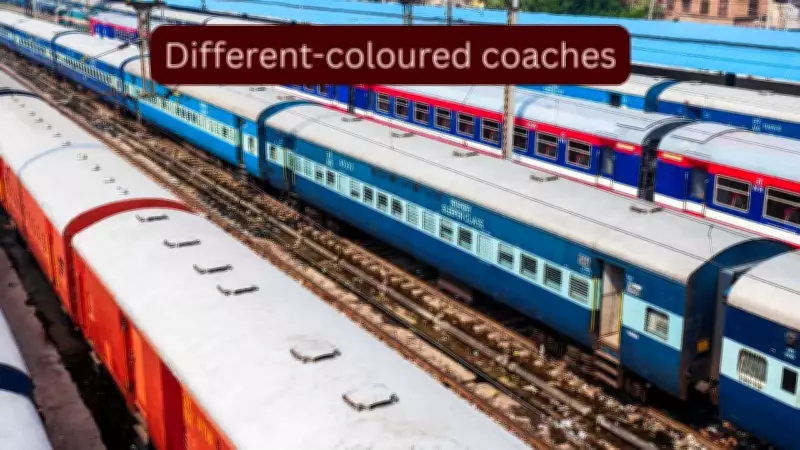
Train colours are not random. The deep blue and bright red coloured coaches you see are far more than aesthetic choices. For travellers, they act as a quick visual language. Not only in India but railways across the world use colours as a practical and visual guide that helps passengers understand the type, comfort, and purpose of a train.
Global Use of Train Colour Codes
While this is especially noticeable on Indian Railways, the same logic applies globally. Across nations, train travel works on colour schemes, making it easier for travellers to navigate busy stations. Instead of relying only on signage and announcements, passengers can use colour as their first guide.
As per railway explanations, these colours help differentiate train types, coach categories, and technology, among others. For travellers running through crowded stations, this becomes a useful tool. Instead of reading long coach lists, a simple glance at colour can tell them whether a train is standard, premium, or modern.

Indian Railways Colour Code
A major contributor to this colour-code system is the Integral Coach Factory (ICF) in Chennai, which is among the largest rail coach manufacturers in the world.
- Blue: Blue coaches are the most common. These usually represent regular Sleeper and General category or class trains.
- Red: Red means that these are fitted with safer LHB (Linke Hofmann Busch) coaches and often indicate a better ride experience. These coaches have upgraded safety features, making them comfortable.
- Green: Green coaches are used for budget trains, indicating affordability and comfort.
- White: These trains mostly offer semi-high-speed services. They signal advanced technology and premium travel experiences.
Train Colours Around the World
Europe
- France: TGV trains are typically silver and blue, representing speed and comfort.
- Germany: Deutsche Bahn uses white trains with a bold red stripe, indicating high-speed ICE services.
The United Kingdom
In the UK, operators like Great Western Railway use green, while others adopt distinct palettes to reflect brand identity. These colours help travellers identify not just the train type but also the operating company.
Japan
Japan's famous Shinkansen uses colour to distinguish between different service categories and routes. While most bullet trains feature a white base for cleanliness and speed symbolism, coloured stripes (blue, green, gold) denote specific services.
United States
In the US, rail colours are often associated with branding and legacy. Amtrak uses a mix of silver, blue, and red to reflect national identity. Freight trains, which dominate American rail networks, use bold colours and logos to represent private firms. Here, colour is more about operator and train type.
Signifies Evolution
Train colours also narrate the story of the evolution of railway systems. In India, older trains were once painted in deep maroon, symbolising the early decades of rail travel. But now, blue is the dominant colour for mass transport, while red and white emerged with modernisation and technological upgrades. So, when you see a different shade at a station, you are likely seeing generations of railway engineering together.
Special Colours for Special Services
Beyond the main colours, some trains use unique shades to highlight specific services. There are distinctive customised colour patterns also used for premium or branded trains. This system helps passengers quickly identify their train category.
Stripes and Markings
It's not just the base colour—stripes and markings also carry meaning. For instance:
- Yellow stripes indicate special accessibility coaches.
- White markings mean unreserved compartments.
Why Colour Coding Matters for Travel
Colour coding helps in several ways and acts as a helpful first guide:

- Ease of navigation in crowded stations
- Quick identification of train types
- Awareness about comfort and class
So next time you're waiting for your train, whether in New Delhi, Paris, Tokyo, or London, pause and look at the colours around you. They are quietly narrating tales of legacy, functionality, and evolution of the train journey.