Bhojshala Dispute: Court Hears Evidence on Temple Origins in Indore
In a significant development in the long-standing Bhojshala-Kamal Maula mosque dispute, the Indore bench of the Madhya Pradesh High Court resumed hearings on Wednesday, with arguments centered on three key strands of evidence: literary texts, epigraphic conclusions, and architectural references. These elements formed the backbone of the case presented by Advocate Manish Gupta, representing independent petitioner Kuldeep Tiwari, before the bench of Justice Vijay Kumar Shukla and Justice Alok Awasthi.
Historical Context and Educational Legacy
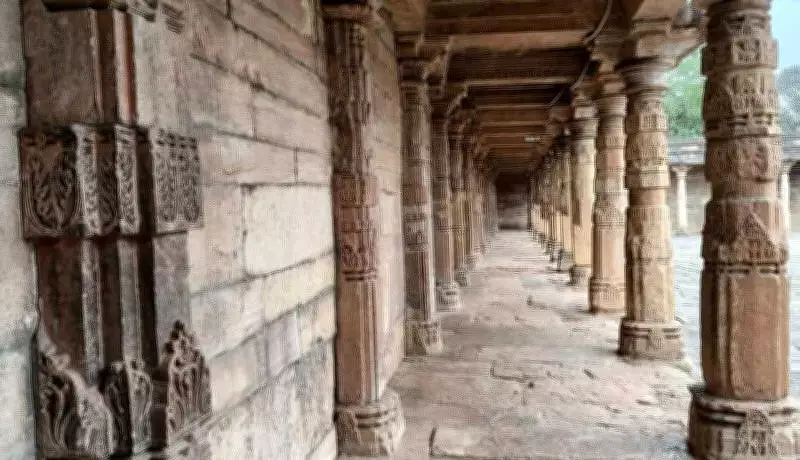
Advocate Gupta began by anchoring the city of Dhar in its historical context, emphasizing that under Raja Bhoj, it was not merely a provincial outpost but a celebrated seat of Sanskrit learning. He argued that the city attracted scholars from Hindu, Jain, and Buddhist traditions, establishing it as a hub of intellectual and spiritual activity. The disputed monument, according to Gupta, functioned as both a working temple and an educational institution long before its conversion into a mosque, with physical vestiges of its earlier identity still discernible to trained observers.
Concrete Evidence and Inscriptions
Among the more concrete pieces of evidence invoked were the so-called 'Sarvabandhi' inscriptions and large stone slabs, which Gupta characterized as pedagogical instruments used to teach Sanskrit grammar to students. When the bench sought documentary corroboration, Gupta turned to the pedestal inscription of the Vagdevi Saraswati idol, currently held in the British Museum in London. Drawing on Archaeological Survey of India (ASI) publications, he submitted that the inscription records the idol as "prasthapitam"—formally and ritually consecrated—during Raja Bhoj's reign. He emphasized that this was not a casual placement but a ceremonial installation within a functioning temple, a distinction carrying considerable legal and historical weight.

Legal Precedents and Architectural Analysis
To fortify the evidentiary standing of historical texts and gazetteers, Gupta relied on the Supreme Court's landmark Ayodhya judgment. He argued that such sources, while not independently establishing title, carry legitimate corroborative value, and courts are entitled to draw on public historical records when piecing together contested origins. Read collectively, he contended, these sources converge on a single conclusion: the structure began as a temple.
Gupta further turned to the Samarangana Sutradhara, an 11th-century treatise on architecture attributed to Raja Bhoj, arguing that the Bhojshala complex does not merely resemble the conventions described in the text. Its physical layout mirrors the treatise's prescriptions with notable precision, from the placement of central Vedic platforms to cardinal-direction orientation and specific proportional measurements.
Archaeological Findings and Unified Construction
Particularly pointed were his references to ASI survey findings, which identified a central brick structure as a vedi or havan kund, with dimensions aligning with those specified in the treatise. He went further, noting that analysis revealed the bricks of this central structure and those of the surrounding foundation were fired from the same kiln. This, he submitted, is evidence of a unified, deliberate original construction rather than accumulated or piecemeal building activity over time, strengthening the argument for the site's origins as a temple and learning center.
The hearings are set to continue on Thursday, with further arguments expected to delve into additional aspects of this complex and historically significant dispute.