

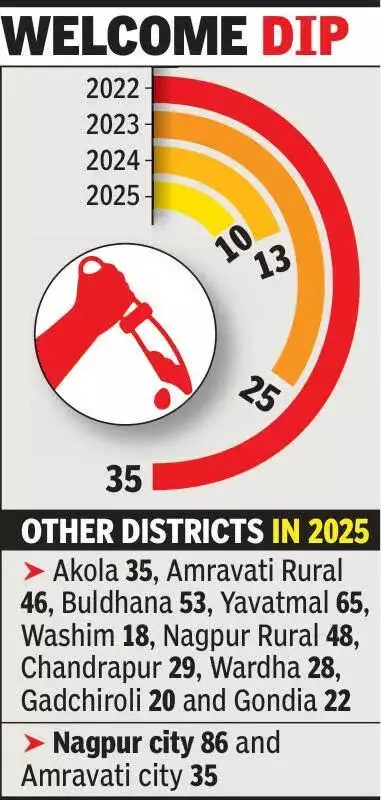
In a remarkable turnaround, Bhandara district in eastern Maharashtra's Vidarbha region has achieved a historic milestone by recording its lowest-ever murder count in 2025. Once notorious for a high crime rate, illegal sand mining, and the shadows of the 2006 Khairlanji massacre, the district registered only 10 murder cases until November, with none reported in December. This is believed to be the lowest annual murder tally for any district or city in Maharashtra's history.
From High Crime to Historic Low: The Numbers Tell the Story
The official data reveals a stark and steady decline in murder cases over recent years. The numbers fell from 35 in 2022 to 25 in 2023, and further down to 13 in 2024, before hitting the unprecedented low of 10 in 2025. Superintendent of Police Noorul Hasan, an IPS officer of the 2015 batch, stated that this is likely the first time Bhandara has reported the state's lowest murder count.
Comparative statistics until November 2025 highlight the scale of this achievement. Several other districts in the region reported significantly higher homicide numbers:

- Yavatmal: 65
- Buldhana: 53
- Nagpur Rural: 48
- Amravati Rural: 46
- Akola: 35
- Chandrapur: 29
- Wardha: 28
- Gondia: 22
- Gadchiroli: 20
- Washim: 18
Major cities like Nagpur (86) and Amravati (35) also recorded substantially more murders than Bhandara.
The Strategy Behind the Success: Intelligence, Prevention, and Technology
SP Noorul Hasan attributed this dramatic decline to a strategic shift towards intelligence-driven, preventive, and technology-backed policing, implemented under the supervision of Nagpur range Inspector General Sandip Patil. A major focus was dismantling organized crime networks, particularly those financing operations through illegal sand mining.
In 2025 alone, police registered 676 cases related to sand mining, marking a 104.8% increase over 2024. This crackdown led to the seizure of assets worth over Rs 104.86 crore and the booking of more than 1,200 accused. Similar rigorous actions were taken against gambling rackets (717 cases), narcotics syndicates under the NDPS Act (79 cases), and illegal tobacco trade (30 cases), effectively choking the funding sources for violent crime.
Preventive measures were significantly intensified. Externment orders rose to 180 in 2025, supported by bond proceedings, strict surveillance of history-sheeters, over 50 weekly combing operations, random nakabandi twice a week, and mandatory nightly patrols with at least two criminal checks. Enforcement under preventive laws was tripled, including the application of the Maharashtra Control of Organised Crime Act (MCOCA) against a gang to neutralize threats early.
Tech Overhaul and Community Engagement for Sustainable Peace
Technology played a pivotal role in the district's policing transformation. An AI-powered Key Performance Indicator (KPI) tool now monitors police stations across 42 parameters. Real-time tracking of 112 police vehicles is enabled through GPS-based geo-technical patrolling. A new conviction monitoring system has also been introduced to improve outcomes in court cases.
Several citizen-centric initiatives were launched in 2025 to build public trust and enable proactive policing. These include:
- Bhandara Police Cyber Bot: One of the country's first platforms for instant cyber assistance.
- Women SOS safety system.
- SEVA application for delivering police services and updates via WhatsApp.
- Crime mapping via a beat information system and a digitized visitor management system.
Internal reforms focused on boosting police morale and accountability. The initiatives featured an FICCI-awarded E-Darbaar grievance redressal platform, the Arogyam app for personnel health monitoring, monthly reviews across all 18 police units, Thana Adhivenshan crime meetings, and weekly Saturday videoconferences based on a 16-point checklist.

Community engagement formed the final pillar of the strategy. Under Project Disha, police mentored over 5,000 students. QR code-based anti-narcotics campaigns, a Cyber Saksharta Mission, and a Digital Cyber Awareness Magazine were deployed to foster long-term crime prevention and strengthen the bond between the police and the public.





