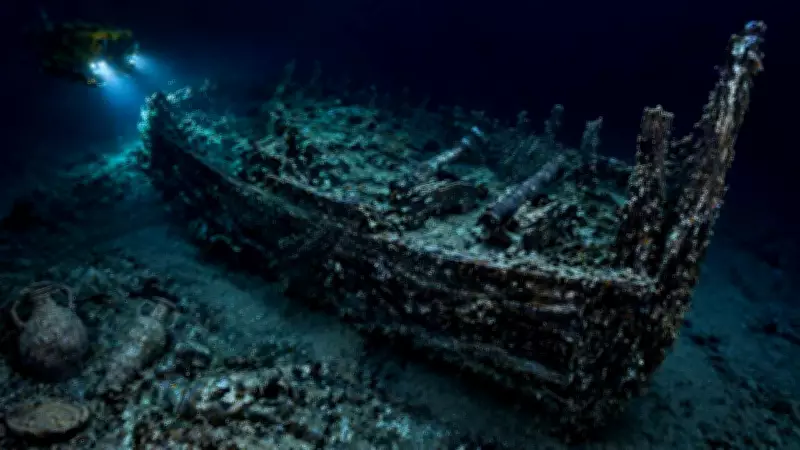
Deep-Sea Exploration Uncovers Ancient Pirate Shipwreck in Mediterranean
In a stunning twist of underwater fate, a marine exploration venture in the Mediterranean Sea has unexpectedly discovered a shipwrecked pirate vessel resting nearly 3,000 feet beneath the surface. This remarkable find occurred during a 2005 search for the historic English warship HMS Sussex, conducted by the renowned Odyssey Marine Exploration team. Instead of locating the anticipated warship, researchers stumbled upon a different wreck that had lain untouched on the ocean floor for over 260 years.
Identification of the Barbary Corsair Vessel
Subsequent analysis revealed that the ship belonged to Algerian pirates who terrorized Mediterranean waters during the 18th century. According to a recent report in Wreckwatch magazine, cited by editor-in-chief Sean Kingsley, this discovery represents one of the first pirate ships of its kind ever found in the region. The vessel has been classified as a tartane—a fast, agile ship type commonly used in coastal areas during that era.
Despite measuring only about forty-five feet in length, the ship carried surprisingly heavy armaments. These included four cannons, multiple swivel guns, and rifles sufficient for a crew of up to twenty individuals. The substantial weaponry clearly indicates the ship was designed for combat rather than trade or fishing. Furthermore, its construction allowed it to masquerade as an innocent fishing boat, enabling corsairs to approach other vessels undetected before launching attacks.

Artefacts Reveal Piracy's Geographic Reach
The artefacts recovered from the shipwreck site paint a vivid picture of the expansive geographic nature of Mediterranean piracy. Archaeologists unearthed glass bottles likely manufactured in Europe, ceramic ware originating from Ottoman Turkey, and various mundane items sourced from Algeria. This mixed composition of artefacts from diverse regions strongly suggests the ship acquired these objects through raiding or capturing vessels at sea, rather than through regular trade activities.
Historical Context of Barbary Corsairs
The Barbary corsairs operated from the sixteenth century through the early nineteenth century, based primarily in North African ports such as Algiers. These were not ordinary pirates—they conducted well-organized attacks that impacted entire coastal settlements across Europe. Their operations extended beyond the Mediterranean into the Atlantic Ocean, where they attacked ships and even coastal communities. The corsairs' practice of taking captives for ransom made them a significant menace to maritime commerce of the period.
Exceptional Preservation in Deep-Sea Conditions
The extreme depth of the shipwreck—approximately 3,000 feet—proved crucial for its preservation. The vessel's bottom remained intact under thick layers of sediment, protected from biological degradation and human interference. While exposed portions of the ship suffered deterioration from marine organisms, the overall wreck stands as one of the best-preserved corsair ships ever discovered, offering invaluable insights into 18th-century shipbuilding techniques.
Dating the Wreck and Understanding Its Final Moments
Researchers estimate the ship was lost sometime during the mid-18th century, based on careful analysis of artefacts retrieved from the wreckage, including bottles and ceramic objects. Having remained undiscovered for centuries, the wreck provides an intact historical snapshot of pirate life and activities. This allows scholars to study pirate movements, operational methods, and daily existence with unprecedented clarity.
Significance for Underwater Archaeology
This discovery provides tangible physical evidence of Barbary corsair activities that have previously been studied primarily through documentary sources. Archaeologists emphasize that such finds bridge critical knowledge gaps by offering concrete proof of historical maritime practices. The excavation findings may illuminate navigation skills, maritime technology, and cultural exchanges of the period. Ultimately, this discovery demonstrates how underwater archaeology can fundamentally reshape our understanding of maritime history, revealing secrets long hidden beneath the waves.