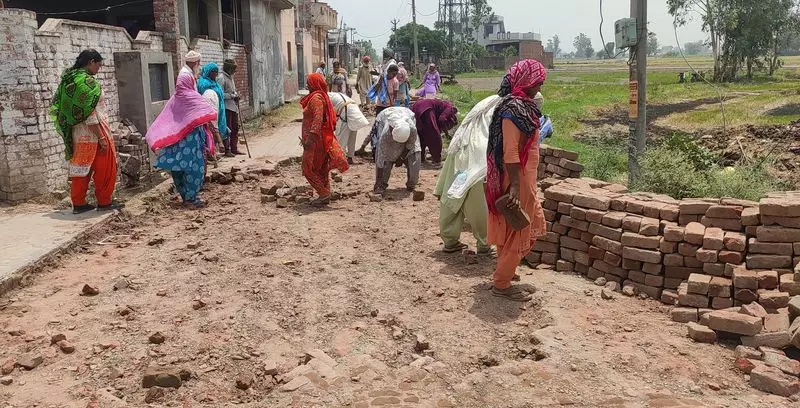
The central government has ignited a fresh political controversy with a proposal to replace the flagship rural employment scheme, the Mahatma Gandhi National Rural Employment Guarantee Act (MGNREGA), with two new initiatives. The proposed schemes are the Vishwakarma Yojana and the Ramayana Circuit, a move that has drawn sharp criticism from opposition parties who are questioning the removal of Mahatma Gandhi's name from the program.
Opposition Rallies Against the Name Change
The proposal came to light during a meeting of the Subject Committee of the Ministry of Rural Development, held on July 10. According to sources, the committee discussed a plan to subsume MGNREGA under two new schemes. The Vishwakarma Yojana is intended to focus on skill development and providing employment to artisans, while the Ramayana Circuit aims to boost tourism and create jobs linked to religious and cultural sites associated with the epic Ramayana.
This potential rebranding has been met with immediate resistance from opposition leaders. Congress leader Jairam Ramesh took to social media to voice his strong disapproval. He accused the government of systematically erasing the legacy of the Father of the Nation. "First, the Rajiv Gandhi National Creche Scheme was renamed. Then, the Indira Gandhi National Old Age Pension Scheme was changed. Now, they are targeting MGNREGA," Ramesh stated. He emphasized that the scheme is not just about the name but about the legal guarantee of 100 days of work it provides to rural households.

The Government's Rationale and Legal Hurdles
While the official minutes or a detailed government statement on the rationale behind the proposal are not fully public, the discussion points towards a strategic shift. The government appears to be aiming at a more targeted approach to rural employment, moving from a broad-based guarantee to schemes with specific thematic focuses—traditional crafts under Vishwakarma and tourism under the Ramayana Circuit.
However, a significant legal obstacle stands in the way. MGNREGA is an Act of Parliament, not merely a government scheme. Therefore, any move to dismantle or fundamentally alter it would require legislative action—amending or repealing the existing law and potentially passing new legislation. This is a complex parliamentary process, especially for a scheme that has become a critical social safety net for millions.
Jairam Ramesh highlighted this very point, noting that the government cannot unilaterally scrap an Act passed by Parliament. The proposal, as it stands, seems to be in an early discussion phase within the ministry's committee.
Broader Implications and Political Backlash
The reaction from the opposition extends beyond the immediate name change. Critics argue that this is part of a larger pattern by the ruling dispensation to distance national programs from figures associated with the Congress party and the Nehru-Gandhi family, as well as from Mahatma Gandhi himself. They contend that MGNREGA, despite its shortcomings, is a legally enforceable right that has provided crucial economic security in rural India, particularly during agricultural lean seasons and economic downturns.
The proposed Vishwakarma Yojana and Ramayana Circuit, while potentially valuable in their own right, do not inherently carry the same universal, rights-based framework. The fear among opponents is that replacing MGNREGA could dilute the entitlement and leave vulnerable populations without a guaranteed fallback option.
As of now, the Centre has not issued an official confirmation or a detailed blueprint for the transition. The proposal remains a topic of intense internal discussion and external debate. The coming days are likely to see increased political sparring, with the opposition framing it as an attack on the legacy of Mahatma Gandhi and the rights of the rural poor, while the government may defend it as a necessary evolution towards more efficient and focused welfare delivery.
The final outcome will depend heavily on the government's political will to navigate the legislative process and the intensity of the public and political pushback it encounters.