Delhi's Construction Workers Remain Unaware of Promised Welfare Benefits
On paper, the welfare framework for Delhi's construction workers offers comprehensive support across multiple aspects of life, including maternity care, pension provisions, housing assistance, healthcare benefits, educational support, and even free daily travel on government buses. However, the reality on the ground reveals a significant disconnect between policy promises and actual awareness among the intended beneficiaries.
Awareness Gap Among Workers
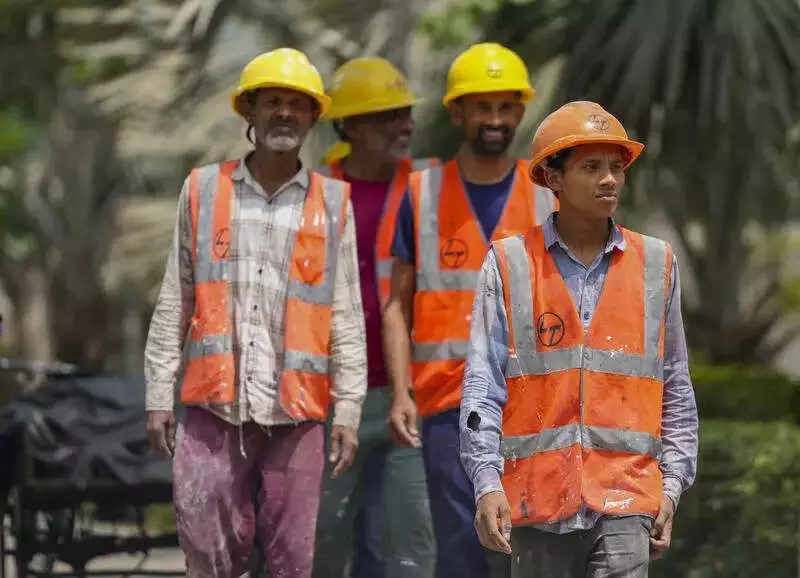
When approached by journalists, many construction workers displayed blank expressions when questioned about these welfare schemes. Bitto, a marble and tile worker from Mangolpuri, was completely unaware that his children qualified for educational assistance under the program. Preeti, a construction worker and mother of two who had received subsistence allowance during recent GRAP-enforced restrictions, responded with confusion, asking, "Yeh kya hota hai?" (What is this?). For numerous workers, understanding eligibility criteria becomes secondary when the primary barrier remains basic awareness that such schemes even exist.
Demographic Profile and Benefit Disbursement
The capital city currently has approximately 2.6 lakh registered construction workers, with women constituting more than half of this workforce. Around 80% of these workers fall within the 31 to 50 age bracket—a critical life stage when maternity care, educational expenses, healthcare needs, and housing support become particularly significant. Despite this demographic reality, welfare benefits reach only a single-digit percentage of eligible workers.

Current financial year data reveals stark numbers:
- Only 818 workers have accessed maternity benefits—though this represents the highest figure in recent years
- Merely 198 beneficiaries have received education assistance
- Just 156 individuals have obtained marriage aid
- Only 30 families have received death or funeral assistance
Pension Challenges and Data Transparency
The pension scenario presents similar concerns. While construction workers become eligible for pension benefits upon reaching 60 years of age, records indicate only 61 pension payments have been processed during the current financial year. Furthermore, no clear public data exists regarding disability pensions, making it difficult to evaluate the reach of this crucial support mechanism designed for workers rendered permanently unfit due to accidents or illness—a particularly vulnerable category within the construction workforce.
Historical Trends and Vanishing Schemes
Year-wise data analysis shows that overall beneficiary numbers peaked at 17,748 during 2022-23, primarily driven by a one-time clearance of over 14,000 pending school education claims. However, disbursements plummeted by more than 90% to just 1,416 in 2023-24, with a slight recovery to 1,723 in 2024-25. Several schemes, including medical assistance and free DTC bus passes, have virtually disappeared from recent payout records, raising questions about implementation consistency.
Systemic Barriers and Worker Experiences
For construction workers, the challenges extend beyond mere awareness to include significant time investments and bureaucratic hurdles. Liyakat Khan, now 65 years old, recounted spending years making rounds of government offices after applying for his pension. Aamir, who applied for benefits following his child's birth, continues waiting for assistance—his child is already five years old.
Thaneshwar Dayal Adigaur, convenor of Nirman Mazdoor Adhikar Abhiyan, emphasizes that "the first problem is awareness. Workers should be informed about the schemes the moment they register. When 2.6 lakh workers are enrolled, but only 1% to 10% receive benefits, something is fundamentally wrong." He further notes that education aid requires extended processing times, pension claims face frequent rejections, and even approved cases become trapped in cycles of repeated resubmissions. Adigaur advocates for clear timelines and SMS updates for workers tracking their claims, suggesting that "if the system functioned on time, beneficiaries would easily run into the thousands."

Official Response and Administrative Challenges
A Delhi Building and Other Construction Workers Welfare Board official acknowledged that "education assistance for around 10,000 beneficiaries for the 2024-25 academic session is now under consideration." The official explained that Standard Operating Procedures are established, but discrepancies require resolution. Pension delays reportedly stem from inconsistencies in registration records and conflicting rules, while education assistance remains subject to conditions such as mandatory 50% attendance requirements.
The official further revealed ongoing efforts to expand health insurance coverage and improve communication, stating that "schools are now being directly conveyed about education schemes. Dedicated teams were deployed last year to improve coordination. We set up camps, too." Regarding free travel benefits on Delhi buses, the official noted the scheme has been affected by regulatory changes, explaining that "applications were received earlier, but a new code has since come into effect."
The situation highlights a critical implementation gap between well-intentioned welfare policies and their practical reach to Delhi's construction workforce, underscoring the need for improved awareness campaigns, streamlined processes, and greater administrative transparency to ensure promised benefits actually reach those they're designed to support.