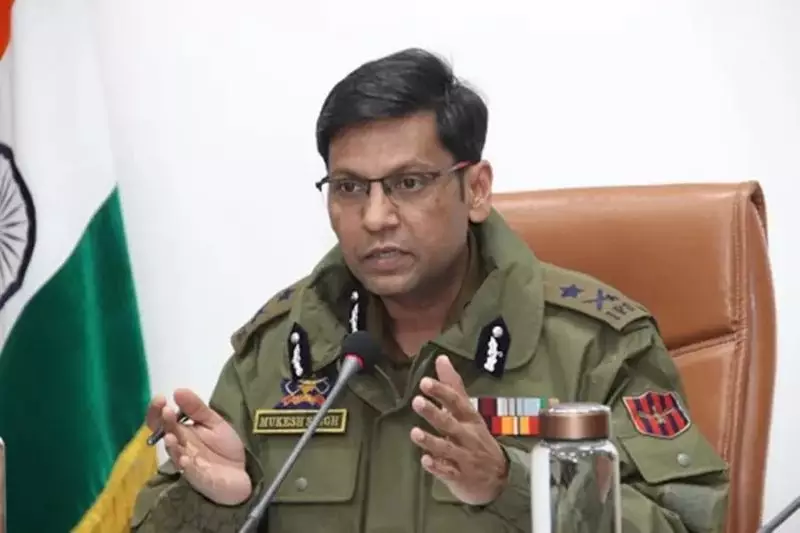
In a significant administrative reshuffle affecting the police leadership of two Union Territories, the central government has appointed senior Indian Police Service (IPS) officer Mukesh Singh as the new Director General of Police (DGP) for Ladakh. The orders, issued by the Ministry of Home Affairs (MHA), came into effect immediately.
Key Appointments and Transfers
The major bureaucratic move sees a chain of postings. Mukesh Singh, a 1996-batch IPS officer of the AGMUT cadre, has been appointed as the police chief of Ladakh. He was previously serving as the Additional Director General of Police (ADGP) for the Jammu zone in Jammu and Kashmir.
Concurrently, S.S. Khandare, a 1995-batch IPS officer, has been posted as the new Director General of Police for Jammu and Kashmir. Khandare, who was serving as the Director General of the Railway Protection Force (RPF), will now helm the police force in the neighbouring Union Territory.
The incumbent Ladakh DGP, B.D. Jamwal, a 1992-batch IPS officer, has been transferred and appointed as the new DGP of Arunachal Pradesh. This completes a triad of high-level police appointments directed by the central government.
Background and Implications of the Reshuffle
These appointments are part of a broader strategy by the Union government to place experienced officers in key strategic positions. Ladakh, a Union Territory carved out of the former state of Jammu and Kashmir in 2019, holds immense strategic importance due to its borders with China and Pakistan. Placing an officer with extensive experience in Jammu and Kashmir, like Mukesh Singh, is seen as a move to leverage his understanding of the region's complex security dynamics.
Similarly, the posting of S.S. Khandare to Jammu and Kashmir brings an officer with a national-level security portfolio to a region that has been a focal point for counter-terrorism and law and order management. His experience with the RPF, which deals with pan-India security on rail networks, adds a different dimension to policing in the UT.
The transfer of B.D. Jamwal to Arunachal Pradesh, another sensitive border state, indicates the government's intent to utilize senior officers' expertise across different frontier regions. All three officers are expected to take charge of their new responsibilities without delay, ensuring a smooth transition of command.
Profiles of the Officers Involved
Mukesh Singh is known for his long tenure in Jammu and Kashmir, where he handled several critical roles. His deep operational knowledge of the region is considered a major asset for his new role in Ladakh.
S.S. Khandare brings with him a wealth of experience from central police organizations. Before leading the RPF, he had served in various capacities in the Central Reserve Police Force (CRPF) and other central agencies.
B.D. Jamwal, during his tenure in Ladakh, oversaw the police force during its initial years as a separate Union Territory. His new assignment in Arunachal Pradesh presents a fresh set of challenges and opportunities in the northeastern part of India.
This reshuffle underscores the continuous evaluation and deployment of top-level police leadership by the Ministry of Home Affairs to address the specific administrative and security needs of India's Union Territories and border states. The moves are closely watched by security analysts, as they often signal the government's priorities in governance and internal security management.