

India's Road Safety Crisis: A Trail of Tragedy and Systemic Failure
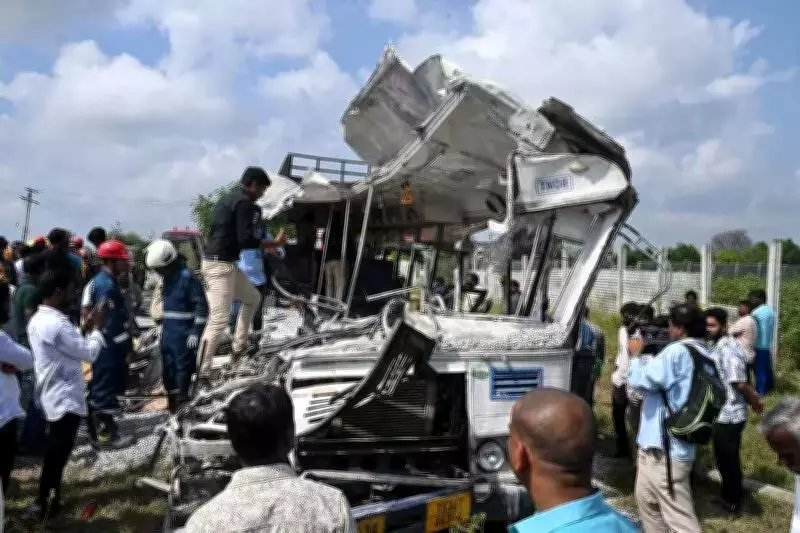
In a devastating series of events at the close of 2025, three separate bus accidents across three Indian states left a bloody trail of 58 fatalities and countless shattered families, highlighting a profound national crisis in road safety. The tragedies unfolded within a span of less than one month, yet predictably, government response has been inadequate, with enforcement drives proving fleeting and ineffective.
The Deadly Trio of Accidents
On October 14, a bus traveling on the Jodhpur–Jaisalmer highway in Rajasthan caught fire, resulting in the deaths of 20 individuals. Merely ten days later, on October 24, another bus in Andhra Pradesh's Kurnool district collided with a drunk biker and subsequently burst into flames, claiming 19 more lives. The grim tally continued on November 4, when a bus smashed into a tipper on the Chevella highway in Telangana, killing an additional 19 people.
This toll of 58 lives in under 30 days should have served as a dire wake-up call for governments across India to implement robust systems to prevent such bloodshed. However, beyond a few initial enforcement drives targeting errant bus companies, meaningful action has been conspicuously absent. The consequence is more tragedy: a fresh accident early Thursday morning in Andhra Pradesh's Markapuram, involving a bus and a tipper, has left another 13 people dead.

Human Stories Behind the Statistics
To comprehend the full impact of these disasters, one must look beyond the cold numbers. Consider the heartbreaking case of three young sisters—Saipriya, Nandini, and Tanusha, aged between 19 and 21—from the small town of Tandur. They were students in Hyderabad, striving to build a future for themselves. A photograph of them, smiling and adorned in jewelry and silk sarees, circulated online after the Chevella accident, symbolizing not just their lost lives but the shattered dreams of an entire family. They were returning to Hyderabad after a break when the crash occurred, reducing them to a mere statistic: 19.
This personal tragedy mirrors a national epidemic. According to the latest National Crime Records Bureau report, India witnessed over 4.4 lakh road accidents in 2023, resulting in 1.73 lakh fatalities. This translates to approximately 475 deaths daily—each representing a life extinguished, a family devastated. To put this in perspective, road accidents in India are on track to kill as many people in three years as the Covid-19 pandemic did over its entire duration, with over 5.33 lakh pandemic-related deaths recorded.
Systemic Failures and Enforcement Gaps
While the pandemic was largely beyond human control, road accidents are not. Experts argue that India possesses some of the best road safety regulations, including the Good Samaritan law, which incentivizes bystanders to aid victims, and requirements for ambulances at toll plazas and well-equipped trauma centers along highways. Yet, enforcement remains critically lacking.
Subroto Das, a pioneer in highway ambulance services, emphasizes that existing laws are sufficient but poorly implemented. Issues such as missing ambulances, inadequate medical equipment, and states neglecting to adopt the Good Samaritan law undermine these measures. Even minor infractions, like unauthorized U-turns or speed bumps, often go unaddressed by governments or maintenance contractors.
Vinod Kanumala, joint secretary of the Indian Alliance of NGOs for Road Safety, points to political connections as a key factor. Many buses and trucks are owned by politicians or their associates, allowing them to evade rules—such as illegal modifications, bypassing speed governors, and transporting commercial cargo illicitly. For instance, the bus in the Kurnool accident was illegally carrying around 100 cell phones in its hold, which likely exacerbated the fire after the collision.

Infrastructure and Driver Training Deficiencies
India's highways have seen significant upgrades to international standards, enabling high-speed travel. However, without proper driver training, these improvements can lead to catastrophic outcomes. The Yamuna Expressway pile-up on December 16 last year, which killed 19 people, exemplifies this. The International Road Federation noted that many drivers are unprepared for concrete surfaces, requiring specific tyre conditions and cautious driving, especially in low visibility.
Despite such warnings, accidents persist. On January 18, a pile-up of 20 vehicles on the Delhi–Lucknow National Highway in Bareilly, caused by a state roadways bus hitting a truck in poor visibility, resulted in one death and 24 injuries. This incident underscores a recurring pattern of negligence and unlearned lessons.
The Path Forward: Enforcement Over New Laws
The solution to India's road safety crisis lies not in drafting new legislation but in rigorously enforcing existing ones. While commuters share responsibility, evidence shows that consistent and firm enforcement can drive behavioral change. Governments must be galvanized by the staggering death toll to ensure that laws are not merely on paper but actively upheld, preventing further loss of life on the nation's roads.





