

Gujarat Power Companies Launch Aggressive Crackdown on Theft and Unpaid Dues
In a major enforcement push, Gujarat's state-run power distribution companies have significantly intensified their drives to recover pending electricity dues and curb rampant power theft. This coordinated effort was ramped up during the closing weeks of the recently concluded financial year, strategically timed ahead of the anticipated peak summer demand when electricity consumption traditionally surges.
Record-Breaking Theft Detection in Saurashtra-Kutch Region
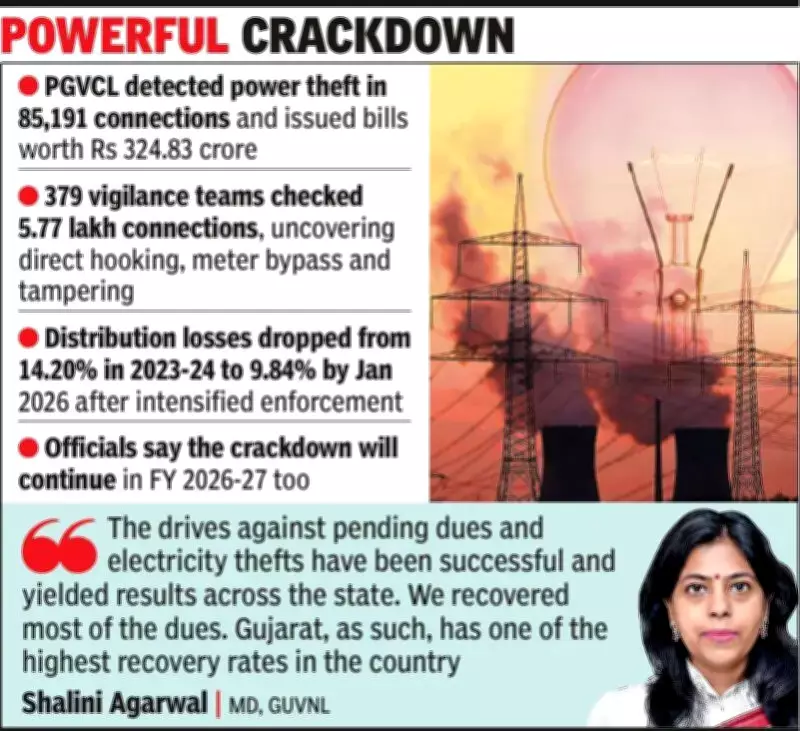
During the financial year 2025–26, the Paschim Gujarat Vij Company Limited (PGVCL) detected power theft in an astonishing more than 85,000 electricity connections across the Saurashtra-Kutch region. The discom issued bills worth a staggering Rs 324.83 crore for these illegal activities. According to company officials, this vigorous campaign helped prevent a substantial loss of 663.87 million units of electricity up until January 2026.
PGVCL mobilized an extensive enforcement apparatus, forming 379 dedicated vigilance teams that were actively supported by police deployment. These specialized teams conducted large-scale inspections, checking a total of 5,77,397 electricity connections. Their efforts led to the identification of 85,191 consumers and non-consumers who were actively involved in various forms of power theft.

Sophisticated Theft Methods Uncovered
Officials discovered multiple sophisticated and crude methods employed to steal electricity. These included:
- Direct hooking (langar) – illegally tapping into power lines
- Bypassing meters using concealed wires
- Tampering with meter seals and service wires
- Unauthorised load extensions beyond sanctioned capacity
- Illegal change of purpose for electricity connections
The crackdown produced remarkable results, with the detected theft value soaring to a record Rs 324.83 crore in 2025–26, compared to Rs 254.25 crore in 2023–24. Consequently, distribution losses dropped significantly by 4.36%, falling from 14.20% in 2023–24 to a historic low of 9.84% by January 2026.
Legal Consequences and Regional Variations
P J Mehta, chief engineer of PGVCL, explained the legal ramifications: "Those found tampering with meters or taking direct connections bypassing meters are booked under Section 135 of the Electricity Act, 2003. Their power supply is immediately disconnected. For first-time offenders, police complaints may be withdrawn if they pay the compounding amount along with pending electricity bills, while repeat offenders face full legal prosecution."
The campaign revealed interesting regional patterns. The Jamnagar circle recorded the highest monetary value of theft at Rs 57.56 crore, while Rajkot Rural reported the highest number of cases, with 10,230 connections caught engaging in illegal activities.
Mehta emphasized the ongoing nature of this initiative: "This campaign will continue into the 2026–27 financial year as well. Our primary aim is to curb electricity theft comprehensively and benefit honest consumers who pay their bills regularly. We also encourage public participation – people can inform us anonymously about power theft instances in their neighborhoods."
Massive Recovery of Pending Dues Across Gujarat
Parallel to the anti-theft operations, Gujarat's power distribution companies launched aggressive recovery drives for pending electricity dues. The Dakshin Gujarat Vij Company Ltd (DGVCL) achieved particularly impressive results, with most consumers clearing payments to avoid disconnection during the hottest part of the year.

During a mega recovery drive launched on March 17, the power utility recovered more than Rs 419 crore in just 10 days. This substantial amount was collected against Rs 465 crore in outstanding dues from nearly 6 lakh consumers. Consumers received clear warnings that failure to clear dues would result in immediate disconnection of their power supply. Once disconnected, they would also have to pay additional penalties and reconnection charges on top of their pending bills.
DGVCL, which has an annual turnover of approximately Rs 30,000 crore and serves nearly 38 lakh consumers, noted that about 80% of its consumer base comprises industrial clients who generally make timely payments. Therefore, recovery drives primarily target residential and commercial consumers, where payment delays are more prevalent.
A DGVCL official explained the timing strategy: "Recovery drives ahead of the summer season prove particularly effective as most consumers cooperate to ensure uninterrupted power during peak heat. While some amounts remain unpaid, mostly from economically challenged areas, our persistent efforts continue to recover such dues as well."
Statewide Disconnection Drives Yield Significant Results
The enforcement momentum extended across Gujarat's power distribution landscape. The Madhya Gujarat Vij Company Ltd (MGVCL) conducted a mega disconnection drive over three critical days – March 13, March 24, and March 27. Individual customers and industries received explicit warnings to settle their dues or face immediate power supply disconnection.
Sources within MGVCL reported: "We recovered Rs 51 crores during this concentrated drive. The majority of our outstanding dues have been successfully recovered through this targeted approach."
Similarly, UGVCL, which supplies power to approximately 45.7 lakh low-tension consumers in North Gujarat, recovered a substantial portion of pending dues during a special drive in March 2026. As of February 2026, around 16.6 lakh consumers owed Rs 171.50 crore. During March alone, 10.6 lakh consumers cleared dues worth Rs 153 crore.
A senior UGVCL official detailed their methodology: "We employ a multi-pronged approach – issuing formal disconnection notices followed by proactive door-to-door recovery campaigns. This comprehensive strategy helps us recover most outstanding arrears effectively."
The coordinated efforts across Gujarat's power distribution companies represent a significant step toward financial sustainability and operational efficiency in the state's electricity sector, particularly as it prepares for increased summer demand.





