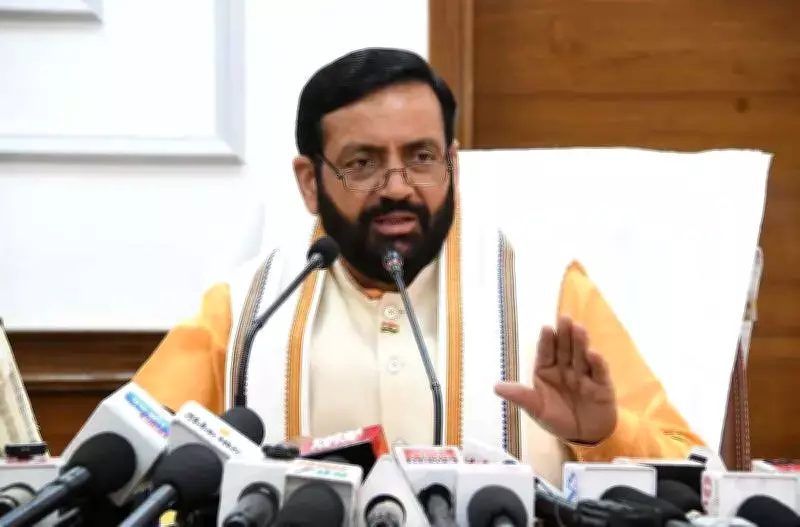
Chandigarh: Haryana chief minister Nayab Singh Saini on Saturday chaired high-level review meetings focusing on long-term water security, AI-driven digital transformation and clean air initiatives. The meetings reviewed progress on the Jal Sanrakshit Haryana project along with programmes related to AI development and air quality improvement.
Jal Sanrakshit Haryana Project Gets World Bank Loan
The World Bank has approved a Rs 4,000-crore loan for the Rs 5,714-crore Jal Sanrakshit Haryana project, aimed at making the state self-reliant in water management and ensuring efficient water utilisation. The project, spread across 15 clusters covering 48.94 lakh acres, will be implemented in phases between 2026 and 2032.
During the review, Saini directed officials to prepare a comprehensive grassroots-level water management plan to ensure equitable distribution of water up to the field level. He also stressed optimum use of treated wastewater, groundwater conservation and development of a real-time digital water management system to monitor water availability, budgeting and usage across Haryana.

Community Participation and Canal Rehabilitation
Saini emphasised community participation and asked that village-level water committees be actively involved in maintaining khaals (water channels), with a dedicated fund supported by both the state and local bodies. The project includes rehabilitation of 678 canals across Haryana, with funding support from the World Bank, the state budget, and NABARD. In addition, 620 khaals will be restored under the MICADA programme, benefiting over 3.18 lakh acres of farmland. About 120 canal-based micro-irrigation projects are also to be upgraded to expand irrigation coverage.
Nearly 2 lakh acres of waterlogged land is to be reclaimed, while water-efficient farming practices such as direct-seeded rice (DSR) on 5 lakh acres and crop diversification on 1.12 lakh acres are to be promoted. To strengthen groundwater recharge, 147 water bodies will be developed across seven districts including Bhiwani, Jind, Kaithal, Mahendragarh, Rewari, Charkhi Dadri and Sirsa. Treated wastewater from major STPs in Jind, Kaithal and Gurgaon's Dhanwapur is also to be reused for irrigation, covering 28,000 acres.
The CM said the World Bank had appreciated Haryana's approach, describing the initiative as a transformational step towards water security and sustainability.
Clean Air and AI Development Projects
Saini also examined the Haryana Clean Air and AI Development projects. Under the Rs 3,647-crore Clean Air Project, nine departments are to work in coordination to improve air quality, including transport, agriculture, urban local bodies, and pollution control authorities. An Arjun SPV is to be formed for implementation, with quarterly reviews planned to ensure progress.
As part of air quality measures, 500 electric buses are to be deployed across major cities including Gurgaon and Faridabad, supported by charging infrastructure and incentives for electric vehicles. On the digital front, the state is to establish a Rs 474-crore AI Development Programme featuring a State AI Data Centre in Panchkula and a Global AI Centre in Gurgaon, he said. The initiative includes AI Sandboxes, a Data Exchange platform, and a Data Lake system aimed at strengthening governance and service delivery. An AI Gurukul is to be launched to train students for industry-ready skills.
Officials present at the meetings included senior administrative and technical officers from the irrigation, agriculture, CRID, and other departments.