Form 1A Medical Certificate: What Drivers Need to Know About Driving Licence Rules in India
Are you in the process of renewing your driving licence or upgrading to an International Driving Permit through the Parivahan portal? The journey often seems straightforward until you encounter a sudden request for a Medical Certificate Form 1A. At this critical juncture, countless drivers across India pause and wonder: What exactly is Form 1A, and where can I obtain it?
Every year, millions of Indian drivers face this hurdle when applying for new licences, renewals, or transport permits. While the Form 1A document itself is simple, confusion frequently arises around who is authorised to issue it. Questions abound: Can a private doctor provide a Form 1A certificate? What are the eligibility criteria for faceless driving licence services? How should the Form 1A be uploaded digitally? Is a digital copy sufficient, or is a physical version necessary? The answers can vary significantly across different Regional Transport Offices (RTOs), leading to widespread misinformation and exploitation by brokers charging exorbitant fees for a basic process.
Understanding the Scale and Importance of Form 1A
India's digital licensing system handles an enormous volume of applications annually, with numbers steadily increasing as more states adopt digital workflows. According to the Ministry of Road Transport and Highways, the National Sarathi and Parivahan platforms maintain records of over 23 crore driving licences and have processed more than 32 crore licence-related transactions nationwide. Within this vast ecosystem, documentation requirements like the Form 1A medical certificate impact a substantial number of applicants each year.

Parul Pandey, COO of MedicalCertificate.in, highlights that lack of clarity surrounding the Form 1A Fitness Certificate is a common issue for drivers. "The Form 1A medical certificate itself is not complicated, but the process of obtaining it often becomes confusing for drivers," Pandey explains. "It requires certification regarding hearing, visibility, and physical capabilities to drive a motor vehicle. Different states follow slightly varied verification practices, and formats may differ. Many applicants are unsure whether an RTO-empanelled doctor is necessary, and some only realise the requirement at the final stage of their Parivahan portal application."
As digital driving licence services expand across major cities like Delhi, Mumbai, Bangalore, Hyderabad, Chennai, Kolkata, Pune, Bhubaneswar, and Gurgaon, the application process has become more streamlined. However, this shift has also made documentation requirements like the Form 1A medical certificate more prominent at crucial stages. For many, the challenge is no longer accessing the service but understanding when Form 1A is required, what format is acceptable, and how to obtain it correctly from a registered medical practitioner.
What Is Form 1A in Driving Licence?
Form 1A is a medical fitness certificate mandated for certain driving licence applications in India. It confirms that the applicant meets basic health standards, including vision, hearing, and physical ability to drive safely. Issued by a government-registered doctor after a health evaluation, this certificate examines eyesight, hearing ability, physical coordination, and overall fitness necessary for safe vehicle operation.
Rooted in the Motor Vehicles Act, 1988, and the Central Motor Vehicles Rules (CMVR), Form 1A ensures that drivers using public roads are medically capable. The check is not an extensive health test; doctors typically assess vision, colour recognition of traffic signals, hearing ability, and physical coordination. Upon completion, the doctor signs the certificate, includes their medical registration number, and attests the applicant's photograph, allowing the RTO to verify the practitioner if needed.
Who Needs Form 1A and When Is It Required?
Form 1A is not required for every licence application. It becomes relevant in specific scenarios where medical confirmation of fitness is necessary. Under the Motor Vehicles framework, the certificate is generally required in the following cases:

- When a person above 40 years of age applies for a new driving licence, as licensing authorities may seek medical fitness confirmation.
- During the renewal of an existing driving licence, especially for older licences or certain categories, where the RTO may request Form 1A as part of documentation.
- When an applicant has a physical disability or medical condition requiring vehicle modifications, to confirm safe operation.
- When applying for an International Driving Permit (IDP), as many authorities require medical fitness confirmation for driving in other countries.
Since this requirement often surfaces mid-way through the licensing workflow on the Parivahan portal, many applicants only then seek a registered doctor to issue the certificate in the correct format.
Key Information Required for Form 1A
The Form 1A document is structured into three main sections:
- Applicant Declaration: This section includes personal details like name, guardian's name, date of birth, address, and identification marks, drawn from the Parivahan portal application. Doctors do not edit this information; applicants must correct any errors on the portal themselves.
- Medical Examination Section: Here, the doctor records observations on health factors affecting driving safety. Key checks include:
- Vision condition and correction with spectacles if needed.
- Colour recognition for traffic signals.
- Distance vision to read a vehicle number plate from 25 metres.
- Hearing ability to detect traffic sounds.
- Night vision in low-light conditions.
- Physical fitness and absence of disabilities affecting vehicle control.
- Doctor's Certification: After evaluation, the doctor certifies medical fitness, providing their name, signature, stamp, and medical registration number for RTO verification. The applicant's photograph is also attested.
If concerns arise, such as uncorrected vision or hearing issues, the doctor may advise addressing these before certification. Providing inaccurate information can lead to problems during licence verification.
State-Specific Rules and Variations
While Form 1A guidelines are broadly consistent across India, issuance, submission, and verification methods can vary by state. These differences often cause confusion, particularly regarding the need for physical certificates, RTO-empanelled doctors, or digital issuance.
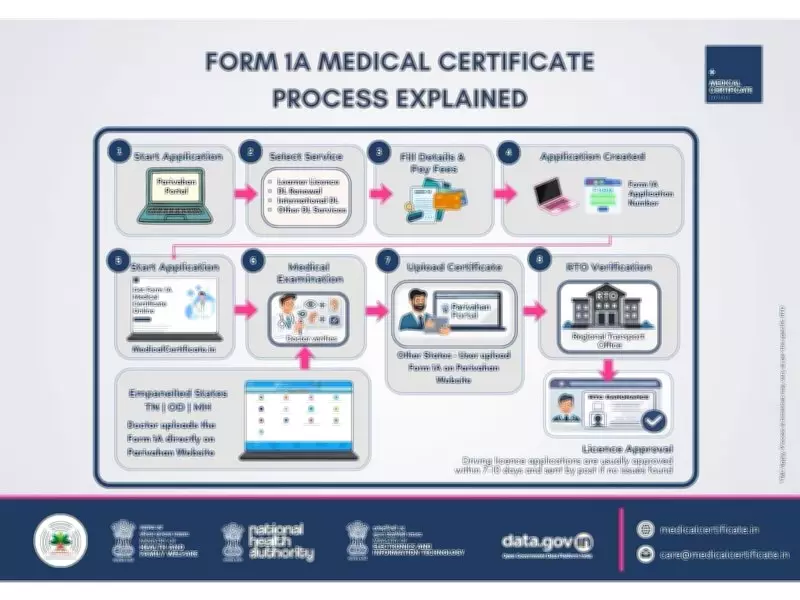
In states like Maharashtra, Tamil Nadu, Odisha, and Chhattisgarh, RTO-empanelled doctors are authorised to issue certificates directly within the licensing system. Here, doctors enter application details, and an OTP verification links the certificate to the correct application. In other states, any registered medical practitioner may issue the certificate, but submission modes—online or offline—affect acceptance. For instance, physical submissions may require attested photographs and signatures, whereas digital certificates are valid for online workflows.
How to Obtain a Form 1A Medical Certificate
Applicants can choose between traditional and online methods:
- Traditional Method: Involves locating an RTO-approved doctor, visiting multiple clinics for vision and hearing tests, and enduring long waits. This process is time-consuming and prone to delays.
- Online Method: Platforms like MedicalCertificate.in offer a streamlined approach. Applicants provide details, complete online vision and hearing self-screening, and receive a digitally verified certificate from a registered medical practitioner within 72 hours. This method is convenient and reduces effort.
To upload Form 1A on the Parivahan portal, log in, navigate to the Document Upload section, and submit a clear scanned copy under 500 KB, including the doctor's name and registration number if prompted.
Special Considerations for International Driving Permits
For International Driving Permit (IDP) applications, many RTOs require a Form 1A medical certificate to confirm fitness for driving abroad. The process mirrors domestic applications, with certificates issued by registered medical practitioners and submitted in Parivahan-accepted formats. In states like Tamil Nadu, Maharashtra, or Odisha, empanelled RTO doctors may upload the form directly.
Simplifying the Process for Drivers
Form 1A is a basic medical declaration ensuring drivers are physically capable of safe vehicle operation. However, mid-application requirements and state-level variations often lead to confusion. Platforms like MedicalCertificate.in address this by structuring certification into a guided workflow, integrating vision and hearing screening with medical evaluation. This approach aligns with Parivahan and RTO requirements, reducing delays and enhancing confidence for applicants renewing licences or applying for IDPs.
As India's driving licence services increasingly digitalise, clarity on documentation like Form 1A is crucial. By leveraging verified medical certification and understanding local rules, drivers can navigate the process efficiently, avoiding unnecessary rejections and ensuring compliance with national standards.