

Delhi Government Launches Comprehensive Summer Water Action Plan 2026-27
With another intense summer season approaching, the Delhi government on Monday officially unveiled its detailed Summer Action Plan for 2026-27. This comprehensive strategy aims to bolster water supply systems, enhance sewer management protocols, accelerate the Yamuna river cleanup initiative, and implement advanced digital tools to improve grievance redressal mechanisms and operational transparency across the capital.
Focus on Peak Production and Distribution Efficiency
Launching the ambitious plan at the Delhi Jal Board (DJB) headquarters in Jhandewalan, Water Minister Parvesh Verma emphasized that maintaining peak water production, addressing distribution gaps, and ensuring accountability in tanker operations would be central priorities. "Supplying clean water and protecting the Yamuna are not just administrative tasks but a shared responsibility that requires collective effort," Verma stated during the announcement ceremony.
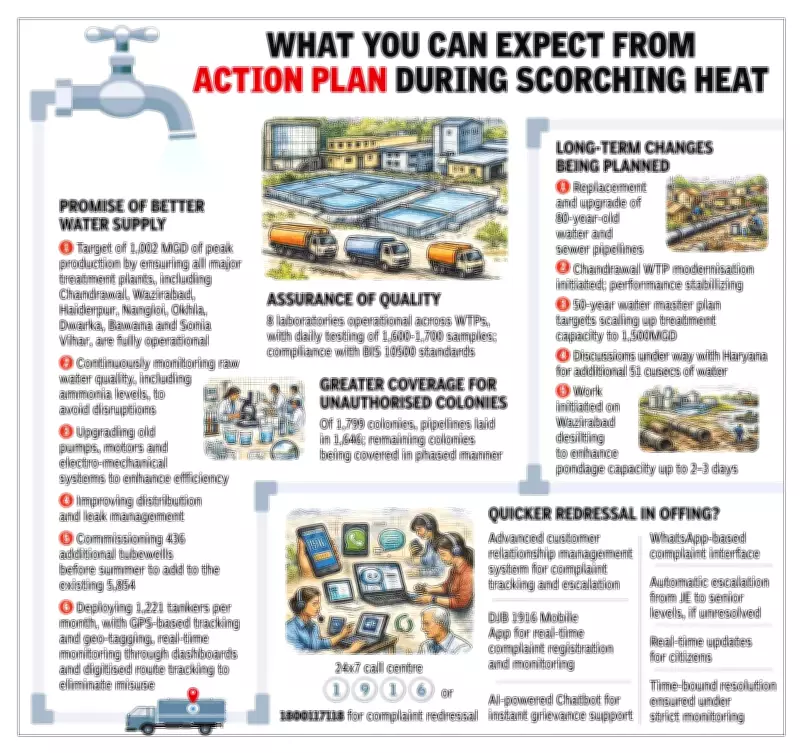
Officials revealed that Delhi aims to sustain a peak water production capacity of 1,002 million gallons per day (MGD) throughout the challenging summer months. All major water treatment plants across the capital are being prepared for optimal operation, including:

- Chandrawal Water Treatment Plant
- Wazirabad Treatment Facility
- Haiderpur Treatment Complex
- Nangloi Water Works
- Okhla Treatment Plant
- Dwarka Water Facility
- Bawana Treatment Center
- Sonia Vihar Water Works
Continuous monitoring of raw water quality parameters, particularly ammonia levels that have previously caused disruptions, will be implemented to prevent operational challenges during peak demand periods.
Infrastructure Expansion and Leak Prevention Measures
To augment water supply in historically water-stressed areas, the Delhi Jal Board plans significant expansion of its tube-well network. The current system of 5,854 tube-well units will be expanded to approximately 6,290 units before peak summer demand sets in. This infrastructure enhancement represents a substantial investment in Delhi's water security framework.
Authorities have undertaken comprehensive annual reservoir cleaning operations, systematic maintenance of underground storage facilities, and thorough servicing of booster pumping stations across the capital. Additionally, intensified leak detection drives will be conducted throughout the distribution network to minimize water losses and improve overall system efficiency.
Technology-Driven Tanker Operations and Quality Surveillance
The controversial tanker supply system is scheduled for a complete technology overhaul under the new action plan. Approximately 1,200 water tankers will be deployed monthly, each equipped with advanced GPS tracking systems, geo-tagging capabilities, and real-time dashboard monitoring. Digitized route mapping and fixed supply point protocols will help curb potential misuse and improve accountability.
"The tanker system is not a permanent solution to Delhi's water challenges. Our concerted effort is to make these operations completely transparent while simultaneously strengthening our permanent pipeline infrastructure," Minister Verma explained during the plan's presentation.
Water quality surveillance mechanisms are being significantly enhanced, with eight dedicated laboratories scheduled to test between 1,600 and 1,700 water samples daily to ensure strict compliance with Bureau of Indian Standards (BIS) norms. DJB officials have committed to maintaining unsatisfactory sample proportions within a narrow 3-5% range while expanding field sampling operations across all zones.
Pipeline Expansion and Sewer Management Initiatives
Substantial progress has been made in extending water pipeline infrastructure to unauthorized colonies across Delhi. Pipelines have been successfully laid in 1,646 of the capital's 1,799 unauthorized colonies, with the remaining areas scheduled for coverage in phased implementation. Officials confirmed that bridging last-mile connectivity gaps will be a particular priority during the upcoming summer season.

On the sewer management front, the action plan emphasizes systematic replacement of aging sewer lines, comprehensive desilting of drainage systems, and strategic deployment of mechanized equipment to tackle persistent blockages. A primary environmental focus remains preventing untreated sewage from flowing into the Yamuna river, which has suffered from severe pollution challenges for decades.
Digital Transformation and Inter-State Cooperation
The Delhi government simultaneously launched several digital initiatives to streamline public grievance mechanisms, including:
- An advanced customer relationship management platform
- The DJB 1916 mobile application for citizen engagement
- An AI-powered chatbot for instant query resolution
- A WhatsApp-based interface for complaint registration
A dedicated 24x7 call center will support this comprehensive digital ecosystem, with automatic escalation protocols that move unresolved issues from junior engineers to senior officials for timely resolution. Additionally, ongoing discussions with neighboring Haryana state authorities for additional raw water allocations are progressing as part of broader inter-state cooperation efforts to address Delhi's water security concerns.





