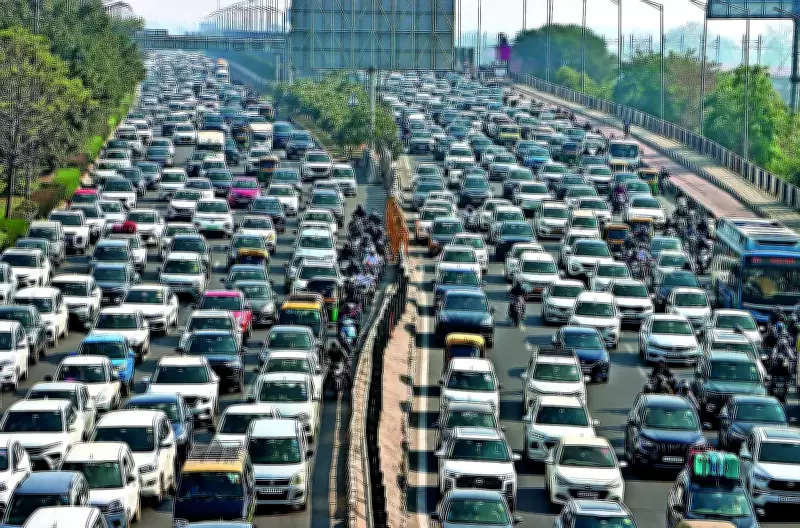
Delhi Unveils Massive 150km Road Infrastructure Plan to Tackle Chronic Traffic Congestion
In a major push to alleviate the capital's notorious traffic woes, the Public Works Department (PWD) has announced an ambitious plan involving nearly 150 kilometers of road infrastructure projects. This comprehensive initiative includes a network of 46 kilometers dedicated to flyovers and underpasses, targeting some of Delhi's most congested stretches.
Key Areas Targeted for Decongestion
The projects are strategically designed to decongest critical hotspots that have long plagued commuters. Among the primary areas identified are:
- ITO Intersection: A major bottleneck in central Delhi.
- Ring Road: A vital artery encircling the city.
- Deshbandhu Gupta Road near Paharganj to Ajmeri Gate: A busy commercial corridor.
- Shadipur Depot: A key transit point.
- NSG Intersection near Terminal 1 of IGI Airport: Crucial for airport access.
Additionally, the plan encompasses elevated corridors from Nanaksar Gurudwara T-point to the Delhi-UP border (Tronica City) and along Shivaji Marg from Zakhira to Karampura. It also includes a railway overbridge at Kirari over the Delhi-Rohtak line and a 20-kilometer corridor from Phirni Road in Najafgarh to NH-48 near Kapashera.

Addressing Daily Gridlock and Improving Connectivity
These stretches experience severe daily traffic snarls, with thousands of vehicles crawling during peak hours, often causing ripple effects on connected roads. The projects aim to streamline traffic flow, ease congestion, significantly cut travel time, and improve average commuting speeds. They will also enhance interstate connectivity towards Haryana and Uttar Pradesh, benefiting lakhs of daily commuters.
PWD Minister Parvesh Verma emphasized the focus on fixing Delhi's worst traffic choke points through a mix of road infrastructure projects. "Our focus is on fixing Delhi's worst traffic choke points through a mix of road infrastructure projects, including new elevated corridors, flyovers, underpasses, and corridor redevelopment plans that together will have a combined length of 150km across the city," he said. "Most of these points witness heavy traffic congestion and there have been growing demands from the public to ease the situation."
Verma assured that efforts are underway to finalize the projects soon so that construction can begin at the earliest, with 46 kilometers specifically covered by flyovers and underpasses.
Feasibility Studies and Specific Project Details
Officials revealed that feasibility studies are currently underway for key projects. One of the largest studies involves a 55-kilometer plan along Mahatma Gandhi Marg (Ring Road), for which a preliminary project report has already been prepared. This report focuses on systemic interventions to address congestion holistically.
The PWD is examining targeted flyover projects at several choke points, including:
- A 3-kilometer flyover on 100 Futa Road/SSN Marg (Anuvrat Marg to DLF Cut).
- A 10.7-kilometer elevated corridor from Kanjhawala Chowk to Mangolpuri.
- A 17.5-kilometer stretch from Keshopur Depot to Haiderpur along Outer Ring Road.
While tenders have been invited for some projects, others, such as the Keshopur-Haiderpur stretch, have recently been awarded. Feasibility studies are also ongoing for a 4.3-kilometer flyover from Sagarpur to Mayapuri Chowk, a 1.3-kilometer elevated structure along Pankha Road in Janakpuri, and a flyover over Trunk Drain-1.
Plans to decongest Mukarba Chowk are under process with the Unified Traffic and Transportation Infrastructure (Planning & Engineering) Centre (UTTIPEC), with some clearances secured and others awaited. Decongestion works in Bawana are in the pipeline, with tenders already invited.

Scientific Approach and Future Deadlines
An official highlighted that the emphasis is on scientific traffic studies and integrated corridor planning rather than piecemeal interventions. "These studies will help identify the most effective engineering solutions — whether flyovers, underpasses, or signal-free corridors — to address congestion hotspots," he explained. The deadlines for these projects will be decided once the feasibility studies are completed, ensuring a data-driven approach to infrastructure development.
This massive road infrastructure plan represents a significant step towards transforming Delhi's traffic landscape, promising smoother commutes and enhanced connectivity for residents and visitors alike.