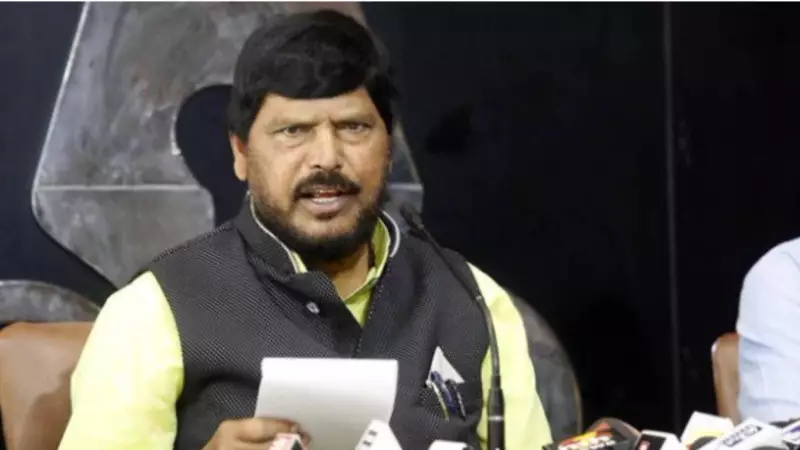
In a significant political development, Union Minister and Republican Party of India (A) president Ramdas Athawale has decided to go solo in the upcoming Brihanmumbai Municipal Corporation (BMC) elections. Expressing deep disappointment with the ruling Bharatiya Janata Party (BJP) and Shiv Sena alliance, Athawale's party has fielded 39 candidates independently across Mumbai.
A Broken Promise Sparks Political Rebellion
The decision, announced on Tuesday, December 30, 2025, comes as a direct protest against what Athawale describes as a breach of trust. The RPI(A) leader revealed that the BJP-Shiv Sena coalition had promised his party a "respectable representation" from their candidate quota for the crucial civic polls.
"We were assured of getting at least 7 to 10 candidates to contest under our banner," Athawale stated, highlighting the unfulfilled commitment. He accused the alliance partners of not holding adequate discussions with the RPI(A) leadership regarding the BMC election strategy, leading to the feeling of being sidelined.

The Dalit Vote Factor in Mumbai's Political Calculus
This move carries substantial weight due to the RPI(A)'s influence among Dalit voters in the city. Athawale's party commands a sizeable Dalit following, historically retaining about 40% of the community's total 11% vote share in Mumbai over several decades.
The Dalit electorate is a decisive force in numerous BMC wards, particularly in areas like Dharavi, Chembur, Mankhurd, Ghatkopar, Bandra, and Sion. By contesting separately, the RPI(A) could potentially split the vote and impact the prospects of BJP-Shiv Sena candidates in these constituencies. Athawale explicitly warned of electoral consequences for the alliance ignoring his organization.
A History of Electoral Struggles and Alliance Dynamics
This rift highlights the ongoing tensions within the coalition. Despite Athawale's current position as the Union Minister of State for Social Justice and his membership in the Rajya Sabha from a BJP quota, his party has faced electoral challenges.
In previous Lok Sabha and Assembly elections, the RPI(A) was not given separate symbolic representation by the BJP. Instead, it was made to accept the BJP's party symbol and candidates. Athawale's Rajya Sabha seat was itself a reward for the RPI(A)'s pre-poll pact with the BJP during the 2014 Maharashtra Assembly polls.
The decision to field 39 candidates independently for the BMC polls marks a clear shift from this past subsumption and signals Athawale's attempt to reassert his party's independent identity and leverage its core voter base.
The BJP-Shiv Sena alliance now faces the challenge of managing this discontent within its broader fold, especially with a key Dalit-centric partner choosing to walk its own path. The outcome of this rebellion will be closely watched as it unfolds in the high-stakes battle for control of India's richest municipal corporation.