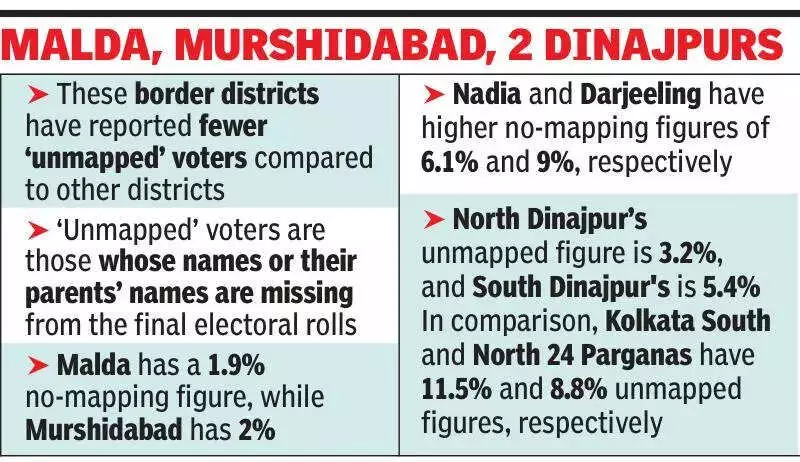
The draft Supplementary Integrated Rolls (SIR) released on Tuesday has placed the border districts of Malda, Murshidabad, and the two Dinajpurs under a revealing statistical lens. These regions, with significant minority voter populations, have reported the least number of 'unmapped' voters compared to other districts in West Bengal, challenging certain political narratives ahead of crucial elections.
Understanding the 'Unmapped' Voter Phenomenon
The Election Commission of India categorizes a voter as 'unmapped' when their name or the names of their parents are missing from the final electoral rolls. These individuals are not disenfranchised; the EC has clarified that all 'unmapped' voters will be eligible for hearings, which will continue until January 15, to rectify their records. The surprisingly low figures in key border districts have thus become a major point of political and administrative scrutiny.
A Comparative Look at the District-Wide Data
The statistics present a compelling picture. Malda recorded a no-mapping figure of just 1.9%, representing 60,261 voters. Neighbouring Murshidabad was slightly higher at 2%, accounting for approximately 1.2 lakh voters. In North Dinajpur, the unmapped figure stood at 3.2%, while South Dinajpur recorded a higher 5.4%.

These numbers stand in stark contrast to other border districts and urban centres. For instance, Nadia has an unmapped voter percentage of 6.1%, and Darjeeling stands at 9%. The figures for Kolkata South and North 24 Parganas are even more pronounced at 11.5% and 8.8%, respectively.
Assembly Constituency Breakdown and Political Reactions
A deeper assembly-wise study shows that in Murshidabad and Malda, the highest concentration of unmapped voters was in Bhagwangola at 2.6%. Other constituencies like Lalgola, Shamsherganj, Raninagar, and Domkal reported figures below 1.5%. Notably, Hariharpara had one of the lowest rates in the state at 0.6%.
Political science professor Sayoni Chowdhury, who analyses SIR data, pointed out a significant trend. "Assembly constituencies dominated by minorities like Sujapur, Mothabari, Ratua, Malatipur, Chanchal, or Harishchandrapur show no significant deletion in comparison with those dominated by the majority community," she explained.
This observation is bolstered by deletion data. In Malda, the highest number of deletions (23,953) came from English Bazaar, which has a mixed population. Majority-dominated Gazole and Habibpur saw 16,996 and 16,375 deletions, respectively. In contrast, minority-dominated Mothabari had 9,914 deleted voters.
The data has ignited a war of words between major political parties. Rahim Bakshi, Malda's Trinamool Congress president, asserted that the draft rolls have exposed the truth, countering what he called the BJP's malicious campaign and fear-mongering around infiltration. Trinamool insiders further claimed that in Gazole and Habibpur, a large share of the deleted voters belong to the Hindu Namasudra or Matua community.
The BJP, however, remains unconvinced. Malda BJP president Ajoy Ganguly countered, stating, "This list is not final. There are more names to be deleted." BJP observer for the area, Shakharav Sarkar, echoed this sentiment. Meanwhile, Naru Gopal Mukherjee, chairman of Berhampore municipality, claimed the data proves fake narratives wrong "once and for all."
Historical Context and the Road Ahead
Adding historical perspective, retired teacher and history researcher Md Ataur Rahman from Malda noted, "Minorities in this part of the world have their presence dating back to the 14th century before Sher Shah. No wonder many of them can produce land records dating back 100 years." This statement underscores the deep-rooted presence of communities in the region.
As the Election Commission continues its hearings until the January 15 deadline, the final electoral roll will be keenly watched. The current draft data from these sensitive border districts has already provided substantial fodder for analysis, challenging preconceived notions and setting the stage for a fiercely contested electoral battle where every voter record will be paramount.