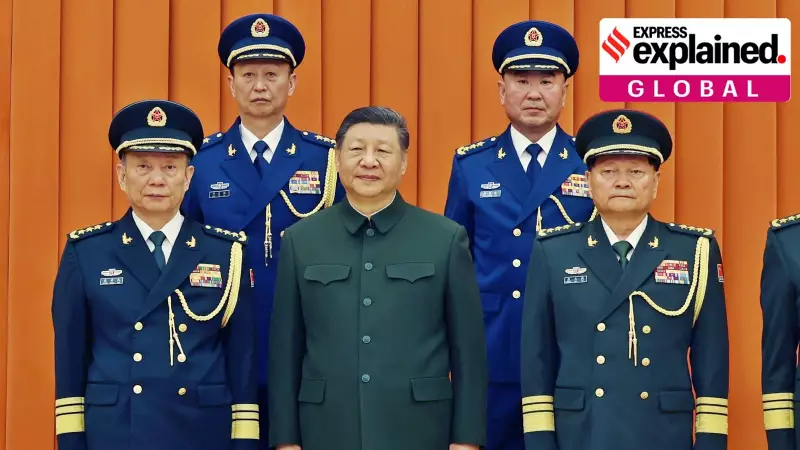
The United States Department of Defense has unveiled its comprehensive annual assessment of China's military and security developments, painting a detailed picture of Beijing's strategic ambitions, internal challenges, and regional posturing. The 2025 report, mandated for the US Congress, underscores China's broadening definition of its "core interests," ongoing modernisation drives, and the complex dynamics of its relationships with neighbours like India and global powers.
Expanding Core Interests and Regional Friction Points
A central finding of the Pentagon report is the explicit expansion of China's non-negotiable "core interests." Beyond the Chinese Communist Party's control and national economic development, Beijing now firmly includes the defence and expansion of its sovereignty and territorial claims within this crucial framework. Crucially, the report states this term covers Taiwan, disputes in the South China Sea and Senkaku Islands, and the northeastern Indian state of Arunachal Pradesh.
Regarding the Line of Actual Control (LAC) with India, the document notes the October 2024 announcement of an agreement to disengage from remaining standoff sites, just ahead of a meeting between President Xi Jinping and Prime Minister Narendra Modi at the BRICS Summit. While this signalled a move towards normalisation, the assessment is cautious. It suggests China likely aims to stabilise ties with India to prevent deeper US-India collaboration, but notes that mutual distrust and other issues continue to limit the bilateral relationship.

The 2027 Timeline and PLA's Stated Goals
The report dedicates significant attention to the People's Liberation Army's (PLA) modernisation timeline. It highlights China's pursuit of "2027 goals," by which the PLA is expected to achieve "strategic decisive victory" over Taiwan, "strategic counterbalance" against the US, and "strategic deterrence and control" over other regional nations. This implies China expects to be capable of fighting and winning a war over Taiwan by the end of 2027, a date that also marks the PLA's centenary.
However, the Pentagon offers a nuanced view, indicating that as of 2024, China's leadership probably remained uncertain about the PLA's readiness to successfully seize Taiwan while countering potential US involvement. This uncertainty may push Beijing towards exploring non-military methods to compel Taiwan's capitulation.
Internal Purges and the Quest for Loyalty
President Xi Jinping's sweeping anti-corruption campaign within the military ranks receives detailed analysis. The report mentions the firing of two PLA Rocket Force (PLARF) commanders, deputy commanders, and a top engineer, all linked to nuclear weapons development. Notable cases include the removal of Defence Minister General Li Shangfu in October 2023, likely over corruption in weapons procurement, and the presumed suspension of the Central Military Commission's Vice Chairman, Gen He Weidong.
These purges, the report argues, are "very likely creating reverberations within China's nuclear forces" and raising questions about readiness. The replacement of rocket force officials with officers from the navy and air force is seen as reflecting Xi's preference for loyal outsiders to meet critical modernisation milestones. While potentially disruptive in the short term, the campaign could pave the way for a more proficient PLA in the long run by tackling systemic corruption.
Military Budget, Technology, and Global Relations
On capabilities and spending, the report reveals that China's actual 2024 defence expenditure was likely between $304 billion and $377 billion, significantly higher than the officially announced $231 billion budget. This underscores a rapid military build-up since Xi Jinping's first full year in 2013, with the announced budget nearly doubling since then.
Technologically, China is accelerating development in military AI, biotechnology, hypersonic missiles, and unmanned systems. It noted the sea trials of China's third aircraft carrier, the Fujian, commissioned in November 2025, and ongoing efforts to develop a sixth-generation combat aircraft.

In terms of international relations, the report comments on the state of US-China ties under the second Trump administration, noting efforts to widen military-to-military communications. However, it criticises China's tendency to cancel such engagements as a punitive tool. The document also mentions China's military sales to partners like Pakistan and Russia, reinforcing its role as a global defence supplier. The overarching US objective, as stated, is to deny any country the ability to dominate the Indo-Pacific region or its allies.