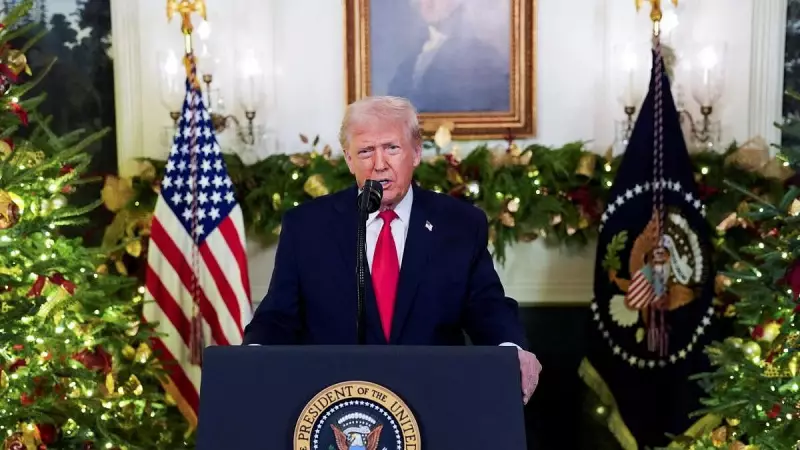
In a significant move for global geopolitics, outgoing US President Donald Trump has given his final approval to a crucial annual defence policy bill. The legislation explicitly advocates for a substantial strengthening of America's strategic partnership with India, including through the framework of the Quadrilateral Security Dialogue, commonly known as the Quad.
Key Provisions for India in the National Defense Authorization Act
The National Defense Authorization Act (NDAA) for Fiscal Year 2021 was signed into law by President Trump on January 1, 2021. This act, which authorises a massive $740.5 billion in defence spending, goes beyond mere budgetary allocations. It carries specific policy directives aimed at countering Chinese influence in the Indo-Pacific region, with India identified as a pivotal partner in this endeavour.
The law mandates the US Secretary of Defense, in consultation with the Secretary of State, to develop and implement a comprehensive strategy for deepening defence cooperation with India. This strategy is required to focus on several critical areas:

- Enhancing interoperability between the militaries of the two nations.
- Expanding the scope and frequency of joint military exercises.
- Pursuing greater cooperation in the realm of defence technology and trade.
- Supporting India's role as a Major Defense Partner of the United States.
Explicit Endorsement of the Quad Framework
A particularly noteworthy aspect of the NDAA is its clear legislative backing for the Quad, which comprises the United States, India, Japan, and Australia. The act formally recognises the importance of this grouping for maintaining a free, open, inclusive, and rules-based order in the Indo-Pacific.
The legislation directs the US administration to bolster engagement with the Quad. It encourages increased cooperation on a wide spectrum of issues, including but not limited to maritime security, humanitarian assistance, disaster relief, and counter-terrorism. This marks a significant step in institutionalising the Quad, moving it from a diplomatic dialogue to a platform with recognised strategic heft in US law.
Strategic Implications and the China Context
The provisions within the NDAA are widely viewed as part of a broader American strategy to build a network of alliances and partnerships to balance China's growing assertiveness in the Indo-Pacific. By legally mandating a deeper defence partnership with India and endorsing the Quad, the US Congress and the outgoing Trump administration have sent a strong, bipartisan signal of long-term commitment to the region.
For India, this legislative action provides a robust foundation for its defence and strategic ties with the United States, irrespective of administrative changes in Washington. It underscores India's central role in Washington's Indo-Pacific vision and offers a framework for accelerated collaboration in defence technology, intelligence sharing, and capacity building. The explicit mention of the Quad also validates India's proactive engagement in the grouping, which has gained considerable momentum in recent years.
The signing of the NDAA concludes a period of tension between President Trump and Congress, who had overridden his veto to pass the bill. Despite his objections on other matters, the enactment of this law solidifies a key foreign policy priority that enjoys support across the American political spectrum: a stronger alliance with India and its partners to ensure stability in the Indo-Pacific.