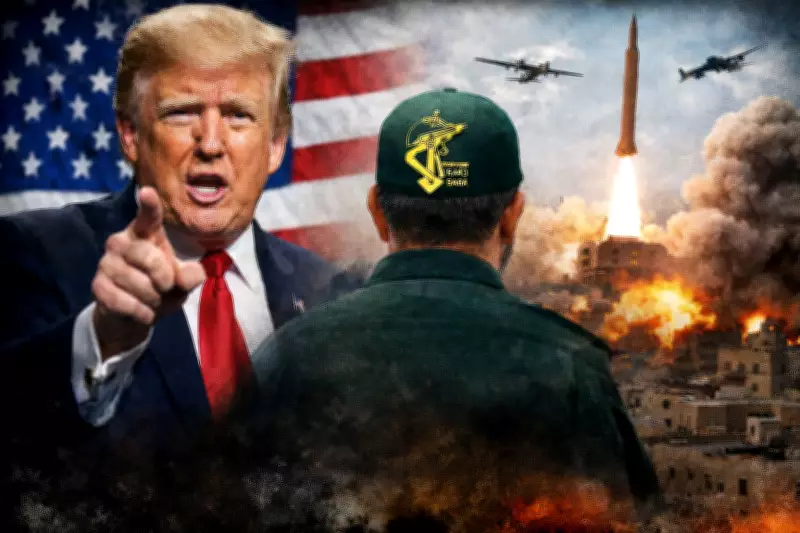
Trump's Bold Claim After Khamenei's Death in Operation Epic Fury
In the wake of the US-led military operation that resulted in the death of Iran's Supreme Leader Ayatollah Ali Khamenei, former President Donald Trump has made a provocative statement regarding past threats to his life. Speaking just two days after the event, Trump declared, "I got him before he got me. They tried twice, I got him first," directly linking his remarks to what he described as Iranian plots to assassinate him.
Intelligence Assessments and Historical Context
According to reports from ABC News, Trump's comments reference US intelligence assessments from 2024 that allegedly uncovered an Iranian-linked assassination plot. The former president has previously asserted that "Iran tried to interfere in the 2020 and 2024 elections to stop Trump." This historical context raises critical questions within security circles about Iran's capabilities and intentions regarding targeting US leadership.
Assessing the Threat: Military Capabilities and Limitations
The fundamental question security experts are examining is whether Iran, particularly through its Islamic Revolutionary Guard Corps, possesses the operational capacity to successfully target a current or former US President. A direct state-sponsored attack on American soil would constitute an act of war, inviting immediate and overwhelming retaliation across multiple domains.

Military analysts note several key limitations:
- Iran lacks operational intercontinental ballistic missiles capable of reliably striking deep within the continental United States
- Even if such missiles existed, penetrating US early warning systems and missile defense networks would present extraordinary challenges
- The US homeland benefits from layered radar coverage, ground-based interceptors, and comprehensive aerospace monitoring
- Any incoming long-range missile would be detected within minutes of launch
Presidential Protection Systems and Protocols
The protection of US Presidents represents one of the most sophisticated security operations in the world. The United States Secret Service leads this effort, supported by military and intelligence agencies with extensive resources and protocols.
Aerial protection measures include:
- Permanently restricted airspace over Washington D.C. when the President is present
- Temporary Flight Restrictions implemented wherever the President travels
- Real-time monitoring by NORAD with rapid fighter jet response capabilities
- Air Force One's hardened aircraft design with secure communications and defensive countermeasures
- Deployment of missile defense systems like Patriot and THAAD in high-threat overseas environments
Asymmetric Threats and Covert Operations
While direct military strikes appear highly improbable, security experts identify more plausible threats through asymmetric methods. These include:
- Low-cost drone operations that could be used for harassment or symbolic retaliation
- Cyber operations targeting infrastructure or communications
- Proxy networks that could facilitate covert actions
The United States has significantly expanded counter-drone systems around sensitive sites, incorporating radar detection, radio frequency jamming, and kinetic interception options. During presidential events, venues undergo thorough sweeps, perimeters receive enhanced security, and counter-assault teams maintain constant readiness.
Historical Precedents and Recent Incidents
Historical patterns suggest that threats to US presidents more frequently originate from individuals or small cells rather than foreign military operations. In 2024 alone, Trump survived two alleged assassination attempts:
- A shooting incident during a campaign rally
- An armed threat while golfing in Florida
Months later, US authorities charged Farhad Shakeri, described by the Justice Department as an "Iranian asset," in connection with an alleged IRGC-linked plot to assassinate Trump. Iran has consistently denied these charges, but the incidents highlight the persistent nature of covert threats.

Strategic Calculations and Geopolitical Implications
For Iran, attempting a direct attack on a US President would represent crossing a significant red line with unpredictable and potentially catastrophic consequences. Even during periods of intense confrontation, states typically avoid actions that would guarantee full-scale war.
Trump has described Khamenei as "one of the most evil people in history" and wrote that his death represents "Justice for the people of Iran, but for all Great Americans, and those people from many Countries throughout the World, that have been killed or mutilated by Khamenei and his gang of bloodthirsty THUGS." Such rhetoric undoubtedly escalates tensions between the nations.
Comprehensive Protection: Layers of Security
While no protection system can guarantee absolute security, the President of the United States benefits from multiple overlapping security measures:
- Layered air defense systems with rapid response capabilities
- Continuous real-time intelligence monitoring and threat assessment
- Hardened transportation with advanced defensive technologies
- Constant Secret Service protection with extensive training and resources
- Military assets positioned for immediate response to emerging threats
Security analysts conclude that while asymmetric threats require constant vigilance, a successful state-directed aerial strike on a US President remains extraordinarily unlikely given current protection systems and geopolitical realities. The combination of technological advantages, intelligence capabilities, and strategic deterrence creates significant barriers to such operations.