

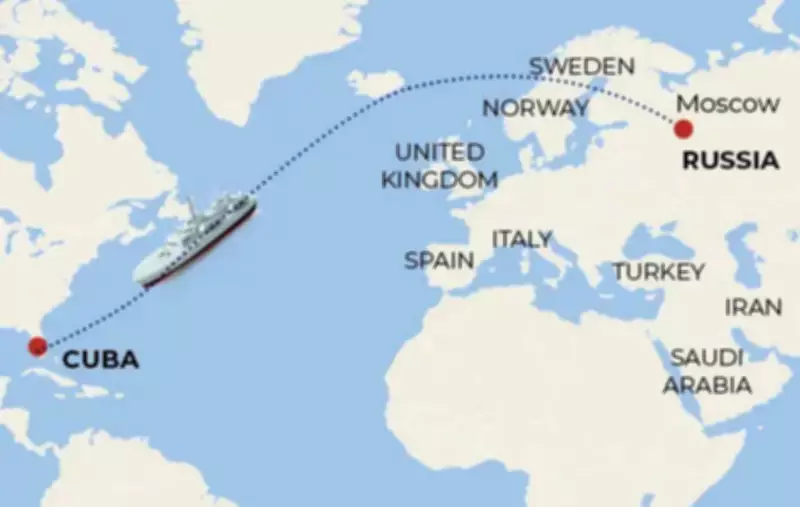
Russian Tanker Approaches Cuba, Defying US Oil Blockade in High-Stakes Standoff
A Russian-flagged tanker, the Anatoly Kolodkin, is currently advancing toward Cuba with an estimated 730,000 barrels of crude oil on board. This development occurs as the United States intensifies its de facto oil blockade against the island nation, setting the stage for a potential geopolitical confrontation. Washington is actively considering its options, including the possibility of interception, while Moscow demonstrates defiance by ensuring the shipment remains highly visible. What might have been a routine energy delivery has transformed into a significant international standoff, raising critical questions about enforcement mechanisms, escalation risks, and underlying intentions.
Cuba's Deepening Energy Crisis and Russia's Strategic Move
The situation unfolds against the backdrop of Cuba's severe energy crisis, exacerbated by the collapse of Venezuelan oil support and stringent American restrictions. Russia's intervention, though insufficient to resolve the crisis entirely, serves as a direct challenge to the US blockade. More importantly, it tests the limits of American resolve within its own hemisphere. The imagery is strikingly reminiscent of historical confrontations, with a Russian vessel steadily moving toward Cuban waters under close surveillance by the United States. Over six decades after the Cuban Missile Crisis brought the world to the brink of nuclear war, Cuba once again finds itself at the center of a geopolitical showdown between Washington and Moscow. This time, the flashpoint involves oil tankers, economic sanctions, and strategic signaling, underscoring that while the tools of confrontation may evolve, the island's enduring strategic significance remains unchanged.
The Kolodkin's Journey as Political Theatre
The journey of the Anatoly Kolodkin transcends mere logistics; it is a carefully orchestrated piece of political theatre designed for maximum visibility. Briefly escorted by a Russian warship through the English Channel and tracked by Western naval forces, the tanker has already fulfilled its role as a symbolic signal. Whether it successfully docks in Cuba may ultimately be less significant than its function in probing the boundaries of American enforcement. As Lawrence Gumbiner, former US envoy to Havana, noted, "Russia loves to poke us in the eye." This assessment highlights that the tanker's mission is not primarily about alleviating Cuba's economic woes but about testing Washington's red lines and strategic patience.

Echoes of 1962 with Modern Implications
The parallels with the 1962 Cuban Missile Crisis are undeniable, though the stakes and instruments have shifted. During that historic confrontation, Soviet ships carrying nuclear missiles approached Cuba while the US Navy enforced a naval quarantine, leading to a high-stakes standoff between John F. Kennedy and Nikita Khrushchev. Today, the cargo consists of crude oil rather than warheads, and the enforcement mechanism is a sanctions regime backed by implied maritime power. Instead of an ideological clash between capitalism and communism, the current conflict revolves around spheres of influence, strategic leverage, and geopolitical messaging. However, the underlying dynamic remains consistent: Cuba serves as a critical pressure point in US-Russia relations. In 1962, it was a Soviet forward base; in the present context, it represents a strategic foothold for Vladimir Putin, utilized for intelligence gathering, influence projection, and bargaining power.

Why Cuba Continues to Command Geopolitical Attention
Cuba's geopolitical importance stems largely from its geographical proximity, lying just 90 miles off the coast of Florida. This location makes it uniquely valuable for any external power seeking leverage against the United States. For Russia, Cuba offers multiple advantages: it functions as a listening post, with the reopened Lourdes signals intelligence facility enabling Moscow to monitor communications across the Gulf of Mexico; it acts as a symbolic ally, reinforcing Russia's narrative as a defender of states resisting US pressure, particularly in the Global South; and it serves as a bargaining chip, allowing Moscow to challenge US dominance in its own hemisphere as a counter to American actions in Eastern Europe and Ukraine. For the United States, Cuba is viewed not merely as a neighbor but as a potential platform for adversarial influence, with concerns extending beyond Russia to include broader alignments involving China and Iran gaining a foothold near US shores.
The Collapsing Energy System and Symbolic Relief
The immediate catalyst for this crisis is Cuba's deepening energy emergency. For years, Venezuela supplied the island with heavily subsidized oil, often exceeding 100,000 barrels per day, which sustained Cuba's electricity grid, transportation, and basic economic functions. The sudden disruption of these supplies has left Cuba in a precarious state, with reports indicating a lack of significant fuel shipments for months, frequent power outages, slowed public transport, and strained tourism revenues. Cuba requires approximately 100,000 barrels of oil daily to function effectively. The Kolodkin's cargo, while substantial, would only cover a fraction of this demand for a limited period. Analysts describe the shipment as symbolic rather than transformative—it cannot resolve Cuba's structural crisis but can disrupt Washington's strategy and demonstrate that the blockade is not impermeable.
Strategic Signaling and Calculated Risks
At its core, the movement of Russian tankers toward Cuba is an exercise in calculated signaling. By deploying a Russian-flagged vessel that is openly tracked and briefly escorted by naval assets, Moscow makes its intentions transparent rather than covert. The message is deliberate: Russia is willing to test the limits of American enforcement in its own backyard, forcing Washington into uncomfortable choices. This represents a classic play in geopolitical brinkmanship, where the shipment's impact is modest but its symbolic value is high. If the United States intercepts the tanker, it risks escalating a sanctions dispute into a direct state-to-state confrontation. If it refrains, it may create space for further challenges, gradually normalizing breaches of its blockade. For Vladimir Putin, the calculus is relatively low-cost, as even a failed delivery exposes the limits of US control and diverts attention. For Washington, every response carries weight, influencing perceptions of strength and credibility across multiple global theatres.
The Broader Geopolitical Chessboard
The tensions around Cuba are not isolated but part of a larger strategic contest unfolding across regions such as Ukraine and the Middle East. For Russia, moving toward Cuba signals that geopolitical pressure will not go unanswered, projecting influence into the Western Hemisphere to stretch the strategic map and force Washington to consider threats closer to home. For the United States, perceived weakness in enforcing its position on Cuba could undermine credibility in other arenas, while an aggressive response risks escalating tensions amid existing complex engagements. This interplay transforms Cuba into a lever in wider negotiations, where actions in one theatre influence calculations in another, making the Caribbean a pressure point within a broader geopolitical chessboard.
The Trump Doctrine and Hemispheric Control
Central to the American response is a doctrine under Donald Trump that reasserts US dominance in the Western Hemisphere, akin to a modern reinterpretation of the Monroe Doctrine, aiming to push external powers like Russia and China out of Latin America. Cuba has emerged as a critical test case in this strategy, which involves imposing a strict oil blockade while allowing limited fuel flows to Cuba's private sector to weaken the state and empower non-state actors. Secretary of State Marco Rubio has framed this approach as supporting private Cubans rather than the government. However, the strategy's limits are evident, as permitted fuel shipments remain a fraction of Cuba's daily needs, exacerbating humanitarian strains and drawing warnings from international bodies like the United Nations. The stakes extend beyond Cuba, with success reinforcing US authority and failure exposing the limits of American power through an ineffective blockade or overreach that triggers instability.
The Risk of Escalation and Miscalculation
The danger in the current standoff lies in the potential for a chain of reactions to spiral out of control. Intercepting a Russian-flagged tanker like the Anatoly Kolodkin could be interpreted in Moscow as a direct challenge to its sovereignty, risking broader diplomatic or military responses. Conversely, allowing the shipment to pass unchallenged could weaken the blockade's credibility and encourage further breaches by Russia or China. This delicate balance is complicated by overlapping global tensions, where even a symbolic confrontation in the Caribbean can carry disproportionate consequences. The real threat is miscalculation—a series of calculated moves that leave little room for de-escalation, echoing historical crises where margins for error were dangerously thin.
A Familiar Island in a New Crisis
While the contours have changed, the core reality persists: Cuba, situated just off the US coastline, continues to magnify great power rivalry. Once a battleground of ideology, it is now a theatre of economic coercion and geopolitical messaging, with risks of misstep or miscalculation potentially transforming a controlled standoff into a wider confrontation. In this evolving crisis, Cuba is not merely a bystander but once again the stage on which larger global tensions are being tested—a familiar island confronting a new yet equally precarious moment.





