In a significant diplomatic event, the ambassadors of the Quadrilateral Security Dialogue (Quad) nations convened for a rare and publicly announced meeting in the Chinese capital. The gathering, involving top envoys from the United States, India, Australia, and Japan, underscores the continued cohesion of the grouping despite Beijing's longstanding opposition.
A Symbolic Gathering at the US Embassy
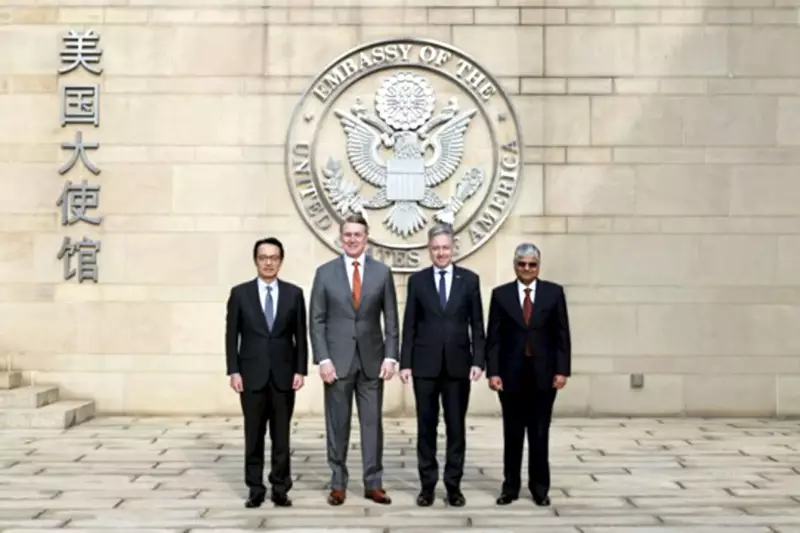
The meeting was hosted on Tuesday at the premises of the US Embassy in Beijing. American Ambassador to China, David Perdue, shared the news on social media platform X, along with a photograph of the four diplomats. The image featured Indian Ambassador to China, Pradeep Kumar Rawat, alongside his counterparts from the other Quad countries.
In his post, Ambassador Perdue emphasized the constructive role of the Quad. "The Quadrilateral Security Dialogue (Quad) is a force for good in maintaining a free and open Indo-Pacific region," he stated. He further expressed his pleasure at meeting with the fellow ambassadors in Beijing, noting that "the relations among the four countries—the United States, Australia, India, and Japan—continue to be stable and strong." As of now, the Indian Embassy in Beijing has not issued an official statement regarding this diplomatic engagement.

China's Stance and Historical Criticism
China, which has been a vocal critic of the Quad format over the years, had not issued an immediate reaction to this specific meeting at the time of reporting. However, Beijing's position on such groupings is well-documented and consistently negative.
In past statements reacting to Quad meetings, Chinese officials have articulated strong opposition. The Chinese government has repeatedly stated that it is against countries forming exclusive cliques, engaging in bloc politics, or fostering group confrontation. This perspective was reiterated earlier this year in January.
Following a meeting of Quad Foreign Ministers, Chinese Foreign Ministry spokesperson Mao Ning articulated Beijing's stance clearly. "China believes that cooperation between countries should not target any third party," she said. She warned that such alliances are counterproductive, adding, "Engaging in group politics and bloc confrontation will not bring lasting peace and security, and is not conducive to peace and stability in the Asia-Pacific and the world as a whole."
Implications for Regional Diplomacy
The public nature of this ambassadorial meeting in Beijing itself sends a potent message. It highlights the Quad's commitment to its principles and its transparency, even within the territory of a nation that views it with suspicion. The event reinforces the stability of ties among the four member nations, a point explicitly made by Ambassador Perdue.
For India, a key player in the Quad and a neighbor with a complex relationship with China, such diplomacy is part of a broader strategic engagement. The meeting demonstrates India's active participation in shaping the Indo-Pacific architecture while managing its direct bilateral dynamics with Beijing. The lack of an immediate Chinese reaction may suggest a period of assessment, but the fundamental divergence in views on multilateral security partnerships in the region remains a defining feature of the geopolitical landscape.