Prime Minister Narendra Modi's official visit to Jordan was marked by a significant personal gesture from the royal family and substantive discussions aimed at deepening economic collaboration. The visit, part of a three-nation tour, focused on transforming historic trust into future growth opportunities.
A Royal Gesture: Crown Prince Takes the Wheel
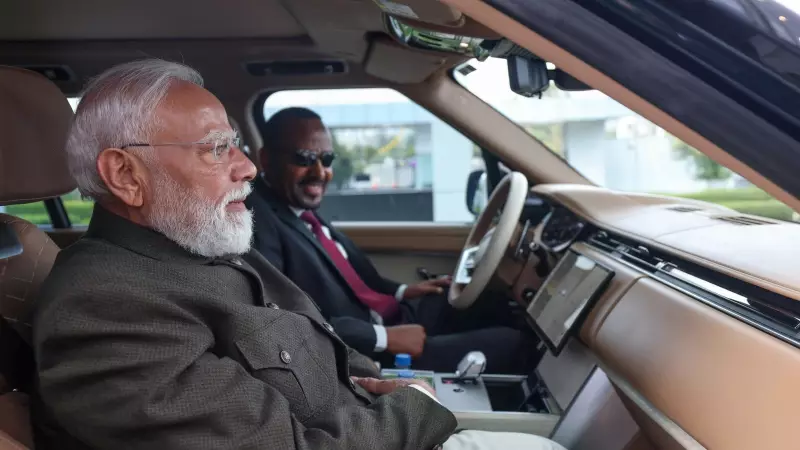
In a special display of warmth and respect, Jordanian Crown Prince Al Hussein bin Abdullah II personally drove Prime Minister Narendra Modi to the Jordan Museum in Amman. This act highlighted the close personal rapport between the leadership of the two nations. Following the visit, PM Modi took to social media platform X to express his gratitude.
He stated he was "grateful" to Al-Hussein for showcasing different facets of Jordan's rich history and culture during the museum tour. The Prime Minister noted their extensive interaction, adding that the Crown Prince's "passion towards Jordan's progress is clearly visible." Modi also praised Al-Hussein's remarkable contributions to youth development, sports, space, innovation, and the welfare of persons with disabilities.

India-Jordan Business Forum: A Call for Collaborative Growth
Earlier, Prime Minister Modi and King Abdullah II of Jordan jointly addressed the India-Jordan Business Forum. In his address, Modi positioned the India-Jordan relationship as unique, where "historic trust and future economic opportunities converge." He revealed that his discussions with the King centered on transforming geography into opportunity and opportunity into growth.
Modi highlighted Jordan's strategic role as a bridge facilitating cooperation between regions. He informed the forum that King Abdullah II had explained how Indian companies could access markets in the United States, Canada, and other nations through Jordan. The Prime Minister urged Indian business leaders present to fully leverage these pathways.
Making a direct pitch to Jordanian investors, Modi said, "You can become partners in India's rapid growth and secure strong returns on your investments." He outlined several key sectors for collaboration, emphasizing mutual benefits.
Key Sectors for Bilateral Collaboration
Digital Public Infrastructure & IT: PM Modi offered India's experience in building inclusive digital frameworks like UPI, Aadhaar, and DigiLocker, which are now global benchmarks. He discussed aligning these with Jordan's systems and proposed connecting startups in fintech, health-tech, and agri-tech to build a shared ecosystem linking ideas with capital.
Pharma and Medical Devices: Modi pointed to significant opportunities, suggesting that if Indian companies manufacture medicines and medical devices in Jordan, it would benefit the local population while positioning Jordan as a reliable hub for West Asia and Africa. "Whether it is generics, vaccines, Ayurveda, or wellness, India brings trust and Jordan brings reach," he stated.
Agriculture: Noting India's extensive experience in farming under dry conditions, the Prime Minister proposed collaboration on precision farming, micro-irrigation, and developing cold chains and food parks. He cited existing joint ventures in fertilizers as a model for expansion into other areas.
The joint statement issued after the visit notably focused on bilateral areas, without references to broader regional issues, indicating a concentrated effort on mutual economic goals.
Strategic Partnership Forged with Ethiopia
Following his engagements in Jordan, Prime Minister Modi traveled to Ethiopia on the second leg of his tour. In a key diplomatic outcome, India and Ethiopia elevated their bilateral relations to a Strategic Partnership. PM Modi held wide-ranging talks with Ethiopian Prime Minister Abiy Ahmed Ali, who had personally received him at the airport in Addis Ababa.
Modi, on his maiden bilateral visit to the African nation, stated that this elevation would provide "new energy and new depth" to the ties between the two countries. The move underscores India's focused approach to strengthening partnerships across regions, blending diplomatic warmth with concrete economic proposals.