The passing of three-time Bangladesh Prime Minister Khaleda Zia on December 26, 2025, marks the end of an era for a leader whose life was intrinsically linked to India, both through personal history and a complex, often turbulent political relationship. Zia, a pivotal figure in South Asian politics, navigated a path that oscillated between cautious engagement and staunch opposition to her nation's powerful neighbour.
Roots in Undivided India: A Personal Connection
Begum Khaleda Zia's origins are firmly planted in the soil of undivided India. She was born on August 15, 1946, in Dinajpur district to parents Iskandar Ali Majumdar and Taiyaba Majumdar. Her father ran a tea business in Jalpaiguri, a city in northern West Bengal that was then part of the Bengal Province of British India. The family's ancestral home was in the Feni district, now in Bangladesh's Chattogram division. Intriguingly, her nomination for the February 12, 2026, elections was filed from the Feni-1 constituency just a day before her death.
Her mother, Taiyaba, was also born in Chandbari village in Uttar Dinajpur district, in present-day West Bengal. Following the Partition of 1947, the family relocated to Dinajpur, which later became part of independent Bangladesh. Thus, while her birthplace is in modern Indian territory, she became a citizen of Bangladesh, embodying the shared yet divided history of the subcontinent.

A Political Stance Forged in Opposition
Khaleda Zia's political ascent in the late 1980s and early 1990s was built on a platform of sovereignty-first nationalism, deliberately contrasting with the Awami League's historically close ties with India. Her Bangladesh Nationalist Party (BNP), which she joined in 1982 after the assassination of her husband, President Ziaur Rahman, framed a hardline stance against New Delhi as a defence of national independence.
During her election campaigns, BNP leaders warned that an Awami League government would leave Bangladesh "shackled" to Indian domination. Key points of contention included her government's refusal to grant land transit rights to India's northeastern states, citing sovereignty concerns, and a firm stance on the long-standing Farakka dam water-sharing dispute. This narrative positioned resistance to Indian requests as essential for protecting Bangladesh's interests.
The Nuances of Engagement and Estrangement
Despite her tough rhetoric, Zia's relationship with India was not one of uniform hostility. After becoming Prime Minister for the first time in 1991, she attempted to normalise ties. In 1992, she visited India and signed a joint statement with Prime Minister P.V. Narasimha Rao for an equitable water-sharing arrangement. However, domestic pressure from Sheikh Hasina's Awami League, which criticised the move, pushed her onto the backfoot.
Relations deteriorated significantly during her second term (2001-2006), reaching what many analysts called their lowest point since the restoration of democracy. India accused Dhaka of harbouring insurgent groups from its Northeast, like ULFA and NDFB, and connectivity projects stalled. Zia also opposed renewing the historic 1972 India-Bangladesh Treaty of Friendship, calling it a constraint on sovereignty.
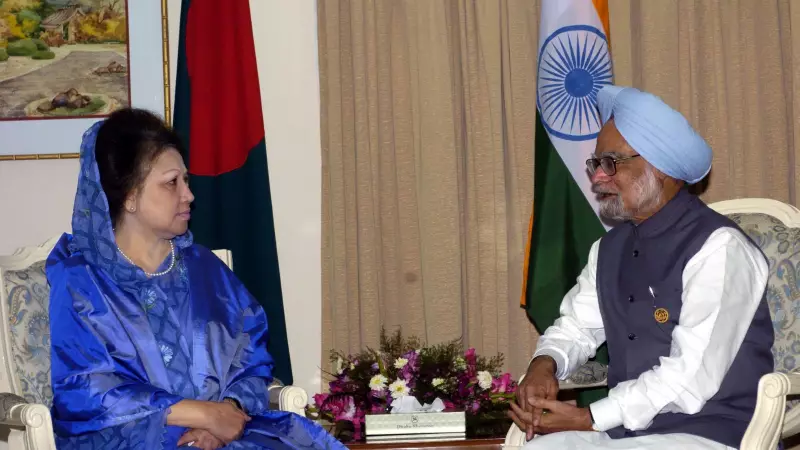
Yet, engagement continued at the highest levels. In March 2006, she paid a state visit to New Delhi, meeting Prime Minister Manmohan Singh. They discussed water-sharing, border management, and trade, signing a revised trade agreement and a pact on combating drug smuggling. Even out of power, she criticised Sheikh Hasina's deals with India, like the Rampal power plant near the Sundarbans, but also had a "warm meeting" with Prime Minister Narendra Modi in 2015 during his Dhaka visit.

Legacy and the Road Ahead
Khaleda Zia's death closes a chapter defined by a love-hate dynamic with India. Prime Minister Modi, mourning her passing, expressed hope that "her vision and legacy will continue to guide our partnership." The leadership of the BNP is now likely to pass to her son, Tarique Rahman, a frontrunner for the prime ministerial post who recently returned from exile. While he has spoken of building an "inclusive Bangladesh," the party's future policy towards India remains officially undefined.
Her story is a testament to the intricate dance of diplomacy, history, and domestic politics that defines India-Bangladesh relations. From her roots in Jalpaiguri to the pinnacle of power in Dhaka, Khaleda Zia's life mirrored the enduring and complicated bonds between the two neighbouring nations.