Iran's Supreme Leader Killed in Joint US-Israel Airstrike on Tehran
On February 28, 2026, a devastating joint airstrike conducted by the United States and Israel targeted Tehran, resulting in the death of Iran's Supreme Leader, Ali Khamenei. The 86-year-old leader, who had governed the Islamic Republic since 1989, was reportedly killed when the strike hit his office compound with significant force. For several hours following the attack, global headlines were filled with confusion, speculation, and official denials from Iranian authorities.
Initial Confusion and Official Confirmation
Initial claims about the attack came from former US President Donald Trump and Israeli Prime Minister Benjamin Netanyahu, but these were quickly denied by Iranian officials. However, as the day progressed, Iranian state media confirmed what many had struggled to believe: Supreme Leader Ali Khamenei was dead. Satellite imagery circulating shortly after the strike revealed extensive structural damage to the targeted compound in Tehran.
Beyond the geopolitical shock lies profound human loss. According to official reports, several members of Khamenei's immediate family were also killed in the same attack. While exact names have not been officially released, reports indicate a daughter, a grandchild, a daughter-in-law, and a son-in-law perished alongside the Supreme Leader.

National Mourning and Public Response
Iran has declared a 40-day national mourning period and announced a seven-day public holiday in response to the leader's death. Across the country, black banners have been raised as millions of Iranians grapple with the loss of a figure who shaped the nation's political and religious direction for nearly four decades.
The Private Family of a Public Figure
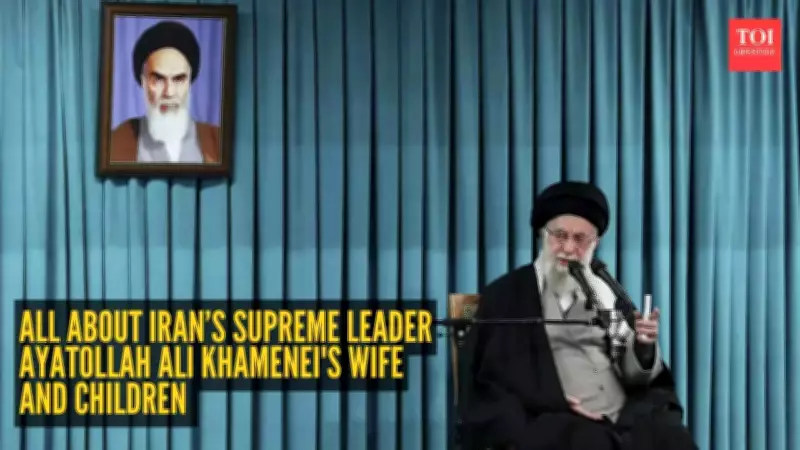
Despite leading one of the world's most scrutinized governments, Ali Khamenei's personal life remained remarkably shielded from public view. He had six children: four sons named Mostafa, Mojtaba, Masoud, and Meysam, and two daughters named Boshra and Hoda. Unlike the families of many global leaders, they rarely appeared in public or held visible political roles.
Mojtaba Khamenei: The Influential Son
The name that frequently surfaced in political discussions was Mojtaba Khamenei. Often described by analysts as the most influential among the siblings, Mojtaba was long viewed as a potential successor or at least a powerful behind-the-scenes figure. He married the daughter of prominent Iranian politician Gholam-Ali Haddad-Adel, strengthening his ties within Iran's political elite.
Over the years, persistent reports indicated his close relationships with the Revolutionary Guard and senior clerical networks. Some accounts even suggested he participated in the Iran-Iraq War during his youth. However, following the airstrike that killed his father, Alireza Arafi was appointed to Iran's leadership council, though some unconfirmed interim reports suggest he too may have been killed in fresh strikes against the regime.
Other Family Members
Masoud Khamenei, another son, also married into a politically connected family reportedly linked to politician Mohsen Kharazi but maintained a far lower public profile. The remaining children largely stayed away from public life altogether. Beyond his immediate family, Khamenei had three brothers including Mohammad and Hadi, and four sisters. One sister, Badri, reportedly went into exile during the political upheavals of the 1980s.
Khamenei's Wife: A Life Away from the Spotlight
Khamenei's wife, Mansoureh Khojasteh Bagherzadeh, lived largely outside the public eye. Born in 1947 into a respected merchant family, she married him in 1964. Her father, Mohammad Esmaeil Khojasteh Bagherzadeh, was known as a successful businessman.
Throughout decades of political turbulence including the years before the 1979 revolution when Khamenei was detained under the Shah's regime she is said to have quietly supported him. Unlike many political spouses, she did not assume public responsibilities or a formal role. Her life, like much of the family's, unfolded away from cameras and public speeches.

Regional Implications and What Comes Next
Khamenei's death marks the end of an era for Iran. Since 1989, he stood at the top of Iran's political and religious hierarchy, shaping domestic policy, foreign relations, and the country's ideological direction. Now, Iran faces a critical moment of transition with questions of internal stability and regional consequences intensifying.
The Middle East was already navigating fragile tensions even before this strike. This development adds another unpredictable chapter to regional dynamics. While political narratives dominate headlines in such moments, behind them are families, relationships, and private grief. Whatever one's stance on Iran's politics, the loss of several family members in one strike adds a profound layer of sorrow to a volatile situation.
What unfolds in the coming days will not only determine Iran's political future but could also reshape the balance of power across the region with the world watching closely. History sometimes shifts gradually, but at other times, it turns in a single night.