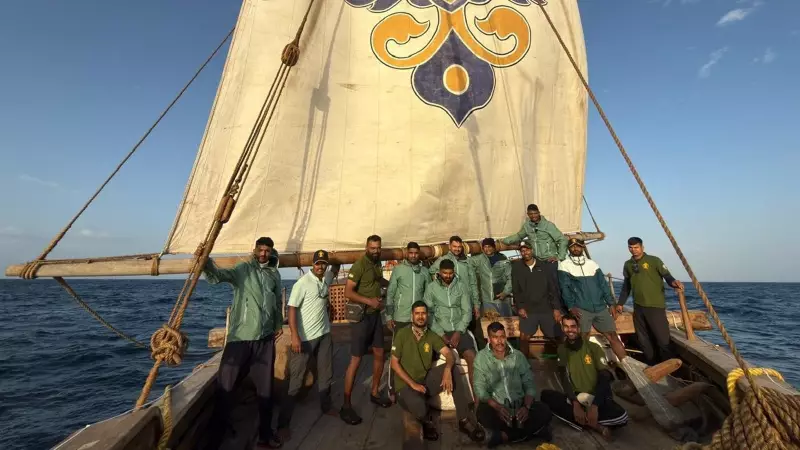
The historic maiden voyage of the Indian Navy Sailing Vessel (INSV) Kaundinya, a ship built using ancient techniques, encountered a challenging start but has now found its bearing towards Muscat, Oman. The vessel, which set sail from Porbandar on Monday, January 4, 2026, has already covered over 200 nautical miles (370 km) towards its destination after battling uncooperative weather in its initial days.
A Challenging Start to a Historic Journey
The voyage commenced on a difficult note as the crew faced "inconducive" winds during the first 48 hours. These were followed by strong tidal currents that repeatedly pushed the unique vessel off its intended path. A crew member described the sea state as ranging between 3 to 4, leading to severe rolling of the ship, sometimes tilting as much as 50 degrees. The winds initially forced the ship north, then south, and later westerly winds combined with currents drove it towards the Gulf of Kutch.
The situation turned favourable on Thursday, the fourth day of the expedition. The sea calmed, and the arrival of steady northeasterly winds finally set the INSV Kaundinya firmly on course for Muscat. The crew, comprising four officers, 13 naval sailors, and economist Sanjeev Sanyal, welcomed this change after a turbulent beginning to their journey retracing ancient maritime trade routes.

The Unique Vessel and Its Crew
INSV Kaundinya is no ordinary ship. It is a "stitched" sail ship, meticulously recreated based on a fifth-century CE vessel depicted in the paintings of the Ajanta Caves. Constructed by traditional artisans and shipwrights from Kerala, it employs ancient techniques using coconut fibre stitching, wooden joinery, coir rope, and natural resins. Its propulsion comes solely from cotton square sails and trailing oars, as it lacks a modern rudder or engine.
This design presents unique challenges. The crew explained that unlike modern yachts, they can only sail with winds coming from behind. The absence of a deep keel causes continuous, severe rolling, leading to seasickness. Even basic tasks like hoisting the heavy cotton sails using wooden pulleys and coir ropes require immense manual effort. Cdr Vikas Sheoran, an experienced navigator, serves as the skipper, while Cdr Y Hemanth Kumar, the naval architect who steered the project from conception in 2021, is the Officer-in-Charge.
Encounters and Traditions on the High Seas
The voyage has already seen memorable incidents. When the ship drifted near the sensitive area of Sir Creek, it was followed by Indian fishing vessels for over 90 minutes. The fisherfolk later informed the crew they were being vigilant for national security, an act the sailors found deeply heartening.
Amidst the challenges, the crew upheld maritime traditions. They welcomed the New Year by blowing a manual fog horn twelve times at midnight and shared a hot meal of rice and dal, considered a luxury on the rolling ship. Economist Sanjeev Sanyal, a member of the Prime Minister’s Economic Advisory Council who first proposed the project, has been sharing updates on social media platform X, detailing the struggles with westerly winds and the relief brought by the northeasterlies.
The ship is named after the legendary Indian mariner Kaundinya, who, according to lore, sailed to Southeast Asia around 2,000 years ago. His story involves a pirate attack, a beached ship, and a pivotal meeting with a warrior queen named Soma, leading to the establishment of the Funan kingdom. The current voyage symbolically reconnects with this legacy of ancient maritime exploration and cultural exchange across the Indian Ocean, aiming to reach Muscat and celebrate the enduring historical links between India and Oman.