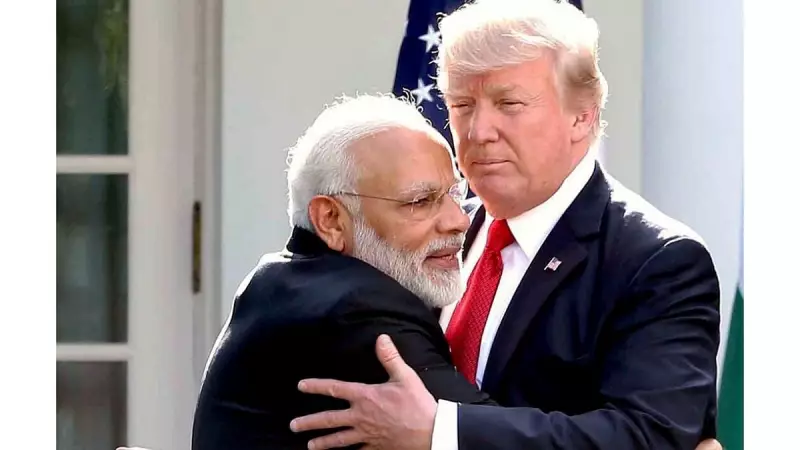
India's strategic calculus to position itself at the forefront of a united front against China appears to be facing significant headwinds, according to a recent analysis. The opinion, penned by former diplomat M K Bhadrakumar, suggests that the Narendra Modi government's efforts to leverage the Quadrilateral Security Dialogue (Quad) have been an exercise in futility in the face of a renewed America First foreign policy under former US President Donald Trump.
The Core Argument: A Misalignment of Priorities
The central thesis of the analysis is a stark warning for Indian foreign policy makers. It posits that the fundamental premise of building India's strategic posture around the Quad—a grouping that includes the United States, Japan, Australia, and India—is flawed when the anchor nation, the US, is perceived to be retrenching into a transactional, unilateralist stance. The America First doctrine, a hallmark of Trump's previous tenure and a potential feature of a future administration, prioritizes direct bilateral deals over multilateral alliances where burdens are shared.
Bhadrakumar's piece implies that under such a framework, the United States' commitment to a collective security architecture in the Indo-Pacific, aimed at countering Chinese influence, cannot be taken for granted. This creates a precarious situation for India, which has invested considerable diplomatic capital in the Quad initiative. The analysis was published on 17 December 2025, at 06:25 IST, offering a timely critique amid global geopolitical recalibrations.
India's Strategic Dilemma and the China Factor
The opinion highlights the inherent challenge for New Delhi. On one hand, there is a clear and growing strategic competition with China, marked by border tensions and competing regional visions. The Quad offered a platform to amplify India's voice and security concerns on a multilateral stage with powerful partners. However, the piece argues that this positioning may have been overly optimistic.
The crux of the problem, as presented, is that America First could translate into Washington demanding clearer, immediate returns from its partnerships. For India, this might mean pressure on trade deficits, specific defense purchases, or taking more overt stances that could directly provoke China, potentially at a cost to India's own complex and multifaceted relationship with its neighbor. The analysis suggests that the Modi government's foreign policy may need a recalibration, moving from a primary reliance on quadrilateral cooperation to a more nuanced, independent, and diversified set of bilateral relationships.
Implications for Regional Geopolitics
The potential weakening of the Quad's cohesion, as suggested by the opinion, has wider ramifications. It could create a power vacuum in the Indo-Pacific, encouraging more assertive behavior from Beijing. Other regional players like Japan and Australia, who also rely on US security guarantees, would be forced to reconsider their own strategic postures.
For India, the path forward becomes more complex. The analysis serves as a cautionary note that in a world where great powers are increasingly inward-looking, middle powers like India must craft foreign policies that are resilient, flexible, and not overly dependent on the consistency of any single partner's international outlook. The era of assuming unwavering allied support in multilateral forums may be giving way to a more volatile and transactional global order.
Ultimately, the piece by M K Bhadrakumar frames India's current strategic position as one of being last in line behind America's domestic priorities. It calls for a hard-nosed reassessment of whether the anti-China front, as envisioned through the Quad, remains a viable cornerstone of Indian foreign policy in the evolving geopolitical landscape shaped by figures like Donald Trump.