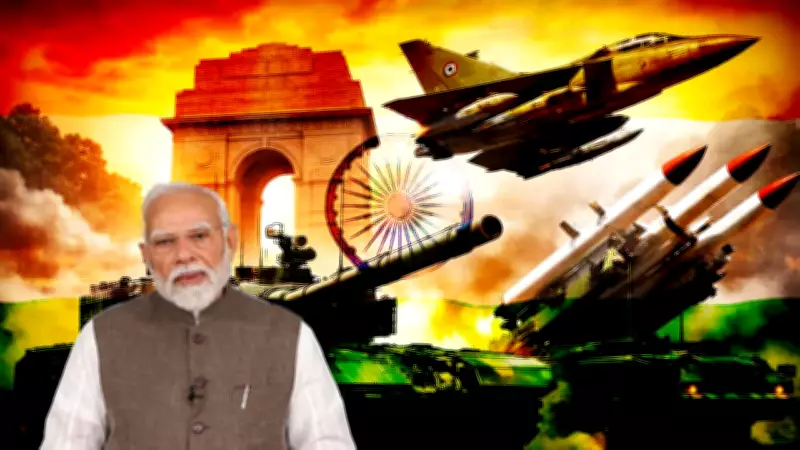
India's Strategic Pivot in Defense Procurement Revealed in Global Arms Report
According to the latest Trends in International Arms Transfers report from the Stockholm International Peace Research Institute (SIPRI), India has emerged as the world's second-largest importer of arms and military hardware between 2021 and 2025. This significant position accounts for 8.2 percent of global arms imports during this period.
Contextualizing India's Ranking in Global Arms Trade
While Ukraine, engaged in a full-scale conventional war, imported more weapons, India's ranking as the largest arms importer among nations not actively involved in major conflict highlights its unique strategic position. The report indicates that India's imports actually decreased by 4 percent compared to previous periods, partly due to growing domestic production capabilities, though implementation delays remain a persistent challenge.
The Dramatic Shift in Supplier Relationships
The most revealing aspect of the report concerns India's changing supplier relationships. Russia, while remaining the single largest source at 40 percent of imports, has seen its share decline sharply from 51 percent in 2016-20 and 70 percent in 2011-15. This represents a deliberate and phased migration away from historical Soviet-era dependency that has characterized India's defense procurement for decades.

The space vacated by Moscow has been filled primarily by France at 29 percent and Israel at 15 percent, both nations now structurally anchoring what analysts describe as India's Western procurement pivot. This diversification represents a fundamental reorientation of India's defense acquisition strategy with long-term implications for geopolitical alignments.
Strategic Drivers: The China-Pakistan Security Calculus
The SIPRI report identifies China as India's primary long-term security concern, with tensions along the Line of Actual Control remaining elevated since the 2020 border clashes. Simultaneously, Pakistan has climbed dramatically from tenth to fifth among the world's largest arms recipients, with imports growing by 66 percent during the reporting period.
China supplies approximately 80 percent of Pakistan's military hardware, creating what defense analysts describe as a coordinated threat environment that India must navigate. This dual challenge from northern and western borders represents the fundamental strategic driver behind India's continued arms procurement despite efforts to boost domestic production.
The Self-Reliance Gap: India's Aatmanirbharta Challenge
Perhaps the most instructive comparison emerges when examining China's own defense industrial development. Beijing has reduced its arms imports by a remarkable 72 percent and now ranks only 21st globally, having successfully built the domestic capability that India is still attempting to replicate through its Aatmanirbharta (self-reliance) initiative.
The gap between China's achieved self-reliance and India's ambitious but still-developing domestic defense industry represents what analysts describe as the clearest measure of how far India must progress to achieve strategic autonomy in defense manufacturing. This disparity highlights both the urgency and complexity of India's defense modernization efforts.
Broader Implications for Regional Security Architecture
India's continued high level of arms imports, combined with its strategic supplier diversification, reflects broader shifts in the regional security architecture. The report underscores how traditional alliances are being reconfigured, with Western suppliers gaining prominence in India's defense ecosystem even as the country maintains important relationships with traditional partners.
This procurement pattern suggests India is preparing for a complex security environment where it must simultaneously address conventional threats, asymmetric challenges, and technological disruptions while building domestic industrial capacity—a balancing act that will define its defense posture for years to come.