

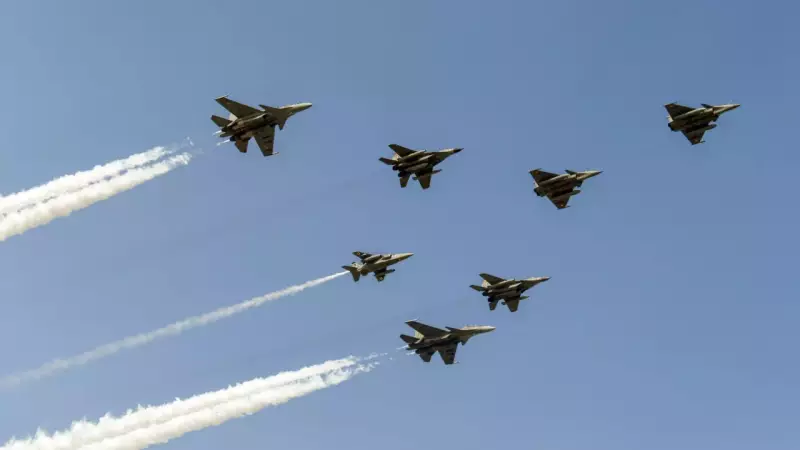
Operation Sindoor 2025: India's Air Power Showcases Precision and Coordination
India's air power was demonstrated with remarkable effectiveness during Operation Sindoor in May 2025, when precision strikes on terror infrastructure across the western border showcased unprecedented reach, coordination, and operational capability in contested environments. Against the backdrop of regional tensions, this operation signaled not merely tactical success but highlighted the growing technological and organizational maturity of the Indian Air Force (IAF).
CHPM Report: IAF as a 'Giant in the Making'
A new assessment by the Switzerland-based Centre for Military History and Perspective Studies (CHPM) argues that such missions reflect a deeper transformation within the IAF. The report describes the Indian Air Force as "a giant in the making", emphasizing that while it ranks as the world's fourth-largest air force by size, its significance increasingly lies in capability rather than sheer numbers.
Operation Sindoor served as a practical demonstration of this evolution. Following the Pahalgam attack that killed 26 civilians, India launched precision strikes against terror infrastructure in Pakistan and Pakistan-occupied Kashmir. The mission, executed in minutes rather than hours, involved:

- Employment of precision-guided munitions against nine identified targets
- Facilities linked to Jaish-e-Mohammed and Lashkar-e-Taiba
- Successful bypassing of layered air defenses
Indian officials characterized the action as "measured" and "non-escalatory", yet militarily it demonstrated the ability to project calibrated force deep across international borders.
Technological Backbone: Integrated Command Systems
According to CHPM, such operations are enabled not only by advanced aircraft and weapons but by sophisticated networked command systems. The IAF's Integrated Air Command, Control and Communication System (IACCCS) serves as a critical backbone that:
- Fuses data from multiple sensors to create a real-time air picture
- Integrates fully with Army and Navy air defense networks
- Provides redundant and hardened architecture for decentralized yet coordinated responses
This system represents a hallmark of modern air warfare, allowing for enhanced planning, electronic warfare support, and stand-off strike capability.
Evolution of India's Combat Fleet
The report traces the IAF's transformation from the late Cold War era, when it relied heavily on aging platforms like MiG-21 variants, to today's mixed high-end fleet. Key developments include:
- Indigenization efforts achieving over 70% local content for platforms like Su-30MKI and Hawk trainers
- Tejas Light Combat Aircraft entering squadron service after decades of development
- Advanced Mark-1A variant with AESA radar on order in substantial numbers
India's strategic partnerships have diversified its capabilities:
- Russia contributes through Su-30MKI, legacy fleet upgrades, and S-400 air defense systems
- France provides Rafale fighters with Meteor missiles and SCALP cruise missiles
- Israel supplies precision munitions, radars, and UAV fleet components
- US and UK contribute transport aircraft, trainers, and other critical systems
The resulting combat fleet of approximately 650 aircraft includes:
- Su-30MKI, Rafale, and Tejas fighters
- Upgraded Mirage 2000, MiG-29, and Jaguar jets
- Advanced missiles like R-77, MICA, Derby, Meteor, SCALP, and BrahMos
- Airborne early warning through A-50 Phalcon and indigenous Netra platforms
- Aerial refueling capability
Comprehensive Air Defense and Joint Operations
Beyond aircraft, CHPM emphasizes India's substantial investment in ground-based air defense systems that create a layered shield:
- Akash, Barak-8, Spyder, QRSAM, and S-400 systems
- Upgraded anti-aircraft guns and electronic warfare systems
- Electronic intelligence and jamming capabilities
Institutional reforms further strengthen India's air power:

- Creation of the Chief of Defence Staff and Department of Military Affairs
- Establishment of joint logistics nodes
- Movement toward integrated theatre commands
- Regular tri-service exercises and technology-driven training programs
The Road Ahead: From Regional Force to Sophisticated Air Arm
With a more homogeneous high-end fleet, indigenous missile development, robust command networks, and growing jointness, the Indian Air Force is evolving from a large regional force into a technologically sophisticated air arm. The CHPM report concludes that this "giant in the making" is rapidly increasing its influence on the Asian balance of power, with Operation Sindoor serving as a clear demonstration of this transformative journey.





