

Vayu Shakti 2026: India's Aerial Defence Blueprint Unveiled in Rajasthan
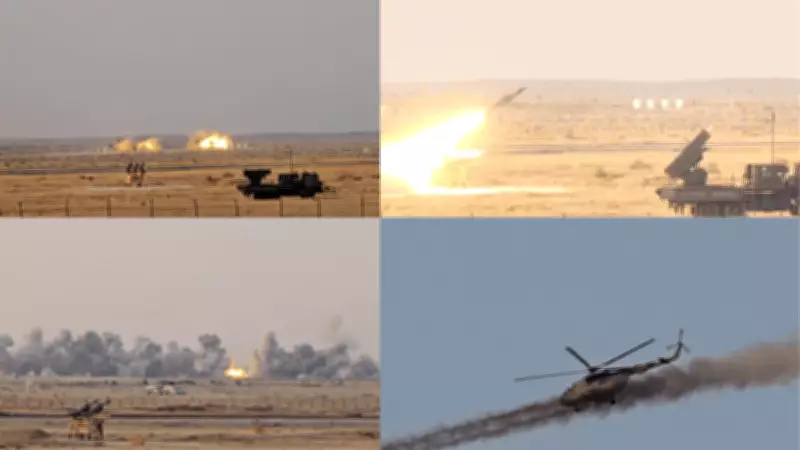
In the expansive Pokhran Air-to-Ground Range within Rajasthan's Thar desert, the Indian Air Force (IAF) conducted the Vayu Shakti 2026 exercise, a powerful demonstration of its evolving combat capabilities. Held under the presence of President Droupadi Murmu, Defence Minister Rajnath Singh, and top military officials, this event transcended a mere ceremonial display of firepower. It served as a strategic message on India's readiness, integration of forces, and deterrence posture in the face of regional threats.
Simulated Combat Scenarios and Operational Insights
The exercise spanned from day to dusk and into night, recreating near-realistic combat conditions across a three-kilometre layout. Simulated targets included enemy runways, radar clusters, bunkers, fuel depots, armoured convoys, command-and-control centres, and terror camps. This sequence mirrored operational templates from Operation Sindoor, offering curated insights into how the IAF plans, coordinates, and executes precision strikes in live conflict scenarios.
A detailed presentation on Operation Sindoor initiated the exercise, followed by synchronised fighter strikes, suppression of enemy air defence (SEAD) missions, decoy manoeuvres, loitering profiles, and rapid reinforcement drills. The night phase highlighted low-visibility targeting, integrated helicopter-fighter coordination, and surface-to-air missile engagements, including the firing of an Akash missile.

S-400 'Sudarshan': The Long-Range Game-Changer
The centrepiece of public attention was the S-400 'Sudarshan' long-range air defence system, a platform credited by the IAF with achieving one of the longest-range intercepts in military history and playing a decisive role during Operation Sindoor. Originating from Russia and developed by Almaz-Antey, the S-400 was inducted under a 2018 agreement and represents the outermost layer of India's air defence grid.
Capable of detecting aerial threats up to 600 km and engaging them at distances up to 400 km, the S-400's multi-layered interception ability sets it apart. A single battery can fire long-range interceptors (up to 400 km), medium-range missiles (around 250 km), and shorter-range engagement missiles (120 km and below), creating a tailored response based on target type, speed, and altitude.
During Operation Sindoor, the S-400 reportedly engaged hostile aerial assets approximately 300 km inside adversary territory, extending India's defensive envelope deep beyond its borders. This capability compels adversary aircraft to operate at safer distances, reduces surprise air strike probabilities, and enhances protection of key airbases, command centres, and metropolitan regions. In a two-front threat scenario involving Pakistan and China, the S-400 provides wide-area protection, capability against high-altitude aircraft and ballistic threats, early engagement of cruise missiles, and psychological deterrent impact. However, its effectiveness relies on integration with India's Integrated Air Command and Control System (IACCS), long-range radars, and airborne early warning platforms.
Akash Missile System: Indigenous Medium-Range Defence
The Akash missile system, developed by the Defence Research and Development Organisation (DRDO) and produced by Bharat Dynamics Limited, forms the core of India's indigenous medium-range surface-to-air missile shield. With an operational range of 25–30 kilometres in initial variants, Akash can intercept fighter aircraft, helicopters, cruise missiles, and unmanned aerial vehicles.
Its command-and-control network, anchored by the Rajendra phased-array radar, enables tracking of multiple targets simultaneously and guiding several missiles in quick succession, critical for coordinated or saturation attacks. Akash's mobility, mounted on wheeled and tracked platforms, allows rapid deployment to protect forward airbases, mechanised formations, and vital installations. The newer Akash-NG variant enhances effectiveness with improved active seekers, better accuracy, greater resistance to electronic countermeasures, and an extended engagement envelope.

Barak Missile Family: Bridging Land and Sea Defence
The Barak-8 missile family, developed jointly by DRDO and Israel Aerospace Industries, bridges land-based and maritime air defence. The Medium-Range Surface-to-Air Missile (MR-SAM) variant, deployed by the IAF and Indian Army, defends airbases and strategic assets with an engagement range over 70 kilometres. Equipped with an active radar seeker and vertical launch capability, it engages targets in a 360-degree envelope.
The naval version, LR-SAM, protects Indian Navy destroyers and aircraft carriers from anti-ship missiles and hostile aircraft, integrated with shipborne radars and combat management systems for rapid response in high-threat environments.
Air Power Integration: Fighters, Helicopters, and Transport Fleet
Vayu Shakti 2026 showcased the IAF's seamless integration of fighters, attack helicopters, special forces, and transport aircraft into a networked combat framework. Frontline fighters like the Sukhoi Su-30MKI executed precision strikes on simulated terror camps and high-value ground targets, while the SEPECAT Jaguar performed deep-penetration attacks on runways and hardened bunkers. The Dassault Mirage 2000 demonstrated synchronised multi-aircraft strike missions.
Rotary-wing platforms added tactical depth: the indigenously developed HAL Prachand showcased agility in high-threat zones, the Boeing AH-64 Apache reinforced close air support capability, and the Mil Mi-17 enabled slithering operations by Garud commandos. The transport and logistics backbone was highlighted by the Airbus C-295, demonstrating rapid troop induction and reinforcement operations.
Key Aircraft Profiles
Sukhoi Su-30MKI: This twin-engine, long-range fighter forms the backbone of the IAF's air superiority and multi-role strike capability, with thrust-vectoring engines, heavy payload capacity, and aerial refuelling capability for reach across vast operational theatres.
Dassault Mirage 2000: Known for precision and reliability, this aircraft excels in high-altitude and cross-border strike roles, armed with laser-guided bombs and advanced air-to-air missiles for surgical strikes.
SEPECAT Jaguar: A dedicated deep-penetration strike aircraft designed for ground-attack missions, it flies under radar coverage to strike strategic infrastructure like airfields and fuel depots.
HAL Prachand: India's indigenous Light Combat Helicopter, designed for high-altitude warfare, provides close air support and battlefield interdiction with stealth features and advanced avionics.
Boeing AH-64 Apache: An advanced attack helicopter with Longbow radar, it detects and engages multiple ground targets in adverse conditions, armed with Hellfire missiles and rockets.
Mil Mi-17: A versatile medium-lift helicopter used for troop transport, logistics, and special operations, adaptable to diverse terrains from deserts to high-altitude regions.
Airbus C-295: A modern tactical transport aircraft for short take-off and landing operations, supporting troop transport, cargo movement, and medical evacuation from forward areas.
Vayu Shakti 2026 was not merely an exercise; it was a layered demonstration of India's aerial strategy, blending imported high-end systems, indigenous missile shields, network-centric warfare, and multi-platform air operations to reinforce defence against regional adversaries.





