

Indian Navy's Future Strategy: Carriers, Submarines, and Indo-Pacific Power Projection
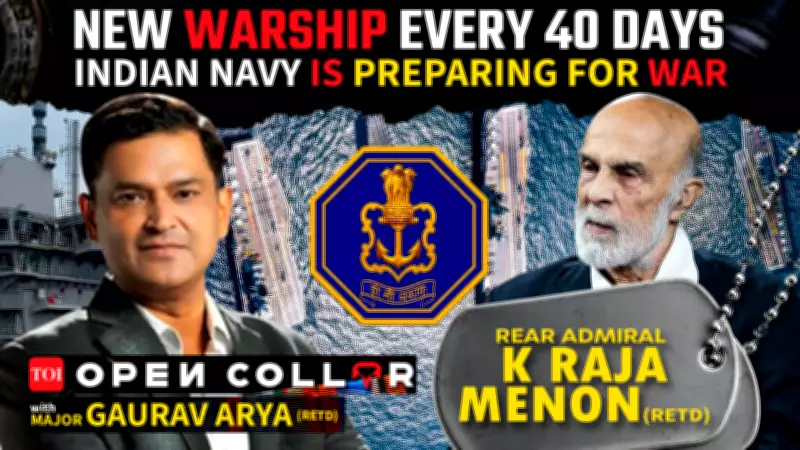
In a detailed discussion on the OPEN COLLAR series, Major Gaurav Arya engages with Rear Admiral Roger Menon (Retd.) to explore the Indian Navy's strategic direction amidst growing maritime competition in the Indo-Pacific region. This conversation sheds light on key aspects of naval modernization and India's role in securing its oceanic interests.
Evolving Naval Doctrine and Indigenous Capabilities
The dialogue emphasizes the Indian Navy's shift towards a more robust and self-reliant force. Rear Admiral Menon highlights the importance of indigenous warship construction, which is pivotal for reducing dependency on foreign suppliers and enhancing operational readiness. The development of nuclear-powered submarines is also discussed as a critical component for long-range deterrence and underwater dominance.
Aircraft carriers remain a cornerstone of India's naval strategy, despite debates over their relevance in modern warfare. The admiral explains that carriers provide unmatched power projection capabilities, allowing India to assert influence across the Indian Ocean and beyond. This is particularly vital as China expands its maritime footprint, creating a need for India to maintain a credible deterrent.

Debunking Myths: Hypersonic Missiles and Drones
The conversation addresses common misconceptions about naval warfare technologies. While hypersonic missiles and drones are often touted as game-changers, Rear Admiral Menon argues that their impact is sometimes overstated. Instead, he stresses the significance of electronic warfare and integrated combat ecosystems, where coordination between various platforms—such as ships, submarines, and aircraft—matters more than any single weapon system.
This integrated approach ensures that the Indian Navy can effectively counter threats in a multi-domain environment, from cyber attacks to physical engagements. The focus is on creating a seamless network that enhances situational awareness and response times.
Geopolitical Imperatives: Control of the Indian Ocean
Geography plays a crucial role in India's naval strategy. The Indian Ocean is not just a body of water but a strategic highway for global trade and energy supplies. Rear Admiral Menon underscores why controlling this region is central to India's national security. With China's increasing presence through initiatives like the Belt and Road, India must bolster its maritime capabilities to safeguard its interests and maintain regional stability.
In this context, the discussion touches on why India does not require a separate Marine Corps akin to the United States. The admiral points out that the Indian Navy's existing amphibious and special forces units are sufficient for coastal operations, and resources are better allocated to enhancing core naval strengths like sea control and deterrence.
Future Outlook: Capacity, Deterrence, and Strategic Leverage
Looking ahead, the episode places naval modernization within the broader framework of great-power rivalry. As China continues its maritime expansion, India's ability to project power through advanced carriers, submarines, and drones will define its strategic leverage in the coming decades. Capacity-building—through both hardware acquisitions and skill development—is essential for maintaining a credible deterrent.
Sea control, or the ability to dominate key maritime zones, is identified as a priority for ensuring India's economic and security interests. By investing in cutting-edge technologies and fostering innovation, the Indian Navy aims to stay ahead in an increasingly contested Indo-Pacific. This forward-looking approach is vital for India's aspirations as a leading maritime power in the 21st century.






