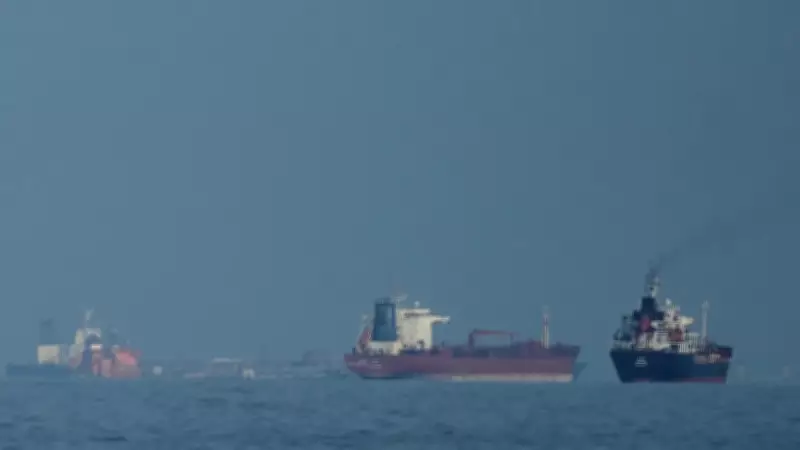
Iran's Conflicting Signals Spark Chaos in Vital Oil Shipping Lane
Confusion emanating from Tehran on Saturday forced a sudden retreat of Indian crude oil tankers from the Strait of Hormuz, a critical global energy chokepoint. According to a Bloomberg report, mixed signals from the Iranian regime created deep uncertainty, compelling fully laden vessels to make abrupt U-turns as inconclusive US–Iran negotiations continued to simmer in the background.
Shipowners Wary as Safety Concerns Mount
The ambiguous stance from Iranian authorities has left international shipowners increasingly wary about the safety and operational status of passage through the strategically vital strait. Alongside Indian vessels, several Greek tankers also reversed course earlier in the day, highlighting the widespread apprehension gripping the shipping industry.
In a separate and alarming incident reported by Reuters, at least two merchant ships came under direct gunfire while attempting to transit the troubled waterway on Saturday. This escalation underscores the volatile security environment that has severely constrained traffic along one of the world's busiest oil routes for over seven weeks.

Heightened Tensions and a Fragile Ceasefire
The prolonged period of heightened tensions was initially triggered by US President Donald Trump's "Operation Epic Fury" against Iran and Tehran's subsequent retaliatory measures. Hopes for partial relief had briefly emerged following the announcement of a 10-day ceasefire window, linked to parallel de-escalation efforts involving Israel and Lebanon. This temporary truce, which Trump also claimed credit for halting multiple conflicts, prompted some cautious vessel operators to attempt passage.
One such vessel was the FPMC C Lord, a very large crude carrier transporting Qatari and Saudi crude. It was observed sailing south of Iran's Larak island and heading toward the Gulf of Oman around midday on Saturday, with its declared destination being Fujairah in the United Arab Emirates.
Conflicting Iranian Statements Deepen Uncertainty
On Friday, Iranian Foreign Minister Abbas Araghchi had stated that the Strait of Hormuz was "completely open" to commercial shipping for the duration of the 10-day ceasefire between Israel and Hezbollah in Lebanon. This announcement offered a glimmer of major relief to global shipowners and energy markets.
However, the situation quickly grew murky. Iran's semi-official Fars news agency later countered, reporting that the passage would remain closed if a US naval blockade continued. Adding to the confusion, shipowners operating in the Persian Gulf have reported receiving radio advisories instructing vessels to seek explicit permission before attempting to cross the strait.
State-run Nour News added another layer of ambiguity on Saturday, stating that the waterway was "under strict management and control by the armed forces", but stopped short of explicitly confirming whether the strait had been shut down again.
Traffic in Disarray as Vessels Hesitate and Idle
Amid this cloud of uncertainty, hesitation remained palpably evident. Greek and Indian crude tankers made those abrupt U-turns early on Saturday after initially sailing northeast toward Hormuz from waters off Dubai. Several vessels are now idling near Iran's Qeshm island, close to where they reversed course, while another has not transmitted its geolocation for several hours, raising further concerns.
A handful of other oil carriers, including three liquefied petroleum gas carriers and an oil products tanker—some of which are under US sanctions—were observed proceeding east into the Gulf of Oman earlier in the day, with a Pakistan-flagged tanker following closely behind. Several liquefied natural gas carriers are also reportedly approaching the strait, navigating the same uncertain waters.
The ongoing standoff and conflicting communications from Tehran continue to pose a significant threat to the stability of global energy supplies, with the world's oil markets watching the Strait of Hormuz with heightened anxiety.