Former Military and Diplomatic Leaders Chart India's Foreign Policy Course at National Seminar
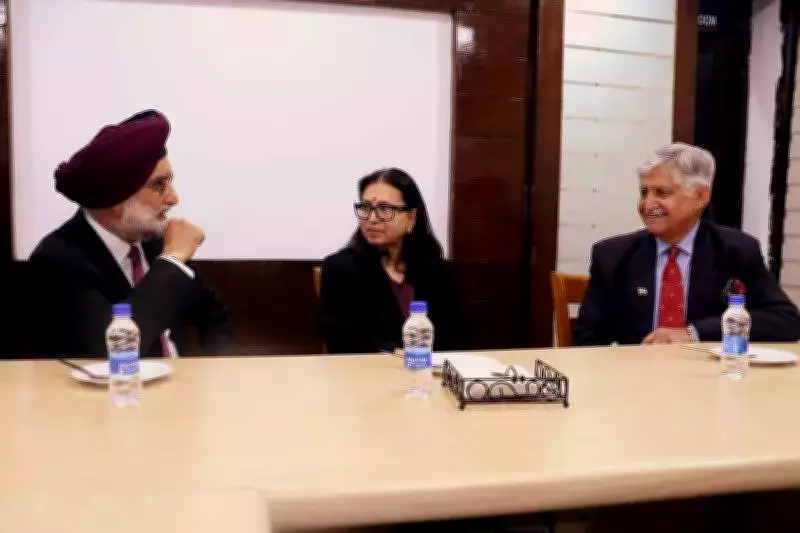
Chandigarh: The inaugural session of a significant two-day national seminar focusing on "Mapping India's Foreign Policy in the Emerging Geo-Political Dynamics" witnessed high-profile addresses from former Chief of Army Staff General Ved Prakash Malik and former Ambassador Taranjit Singh Sandhu. This pivotal event was meticulously organized by the Department of Defence and National Security Studies at Panjab University, in close collaboration with the prestigious Indian Council of World Affairs (ICWA).
Setting the Stage for Strategic Dialogue
Prof Jaskaran Singh Waraich, the esteemed chairperson of the hosting department, warmly welcomed the distinguished guests and expertly introduced the seminar's central theme. He underscored the urgent necessity to critically assess and recalibrate India's foreign policy framework in response to the rapidly shifting global power equations and emerging multipolar dynamics. Dr Teshu Singh, a dedicated research fellow at ICWA, further enriched the discourse by speaking passionately about the critical importance of forging stronger, more robust linkages between academic research and practical policy formulation. This synergy is deemed essential for effectively analyzing India's expanding and increasingly complex global engagements and strategic partnerships.
Insights from a Former Military Strategist
In his compelling address, General Ved Prakash Malik delivered a powerful message centered on national security integration. He emphasized unequivocally that India's defence preparedness and military capabilities must be seamlessly and strategically aligned with the nation's burgeoning economic strength and its overarching foreign policy objectives. General Malik issued a clarion call for more effective and institutionalized civil-military coordination, highlighting this as a non-negotiable prerequisite as India confidently assumes wider regional and global responsibilities on the world stage.

Diplomatic Perspectives on a Reconfiguring World
Former Ambassador Taranjit Singh Sandhu, delivering the keynote address, provided a nuanced diplomatic perspective. He authoritatively described India as a key and indispensable partner for the United States, particularly in the crucial mission of ensuring long-term stability and security across the vast Indo-Pacific region. Ambassador Sandhu offered a thought-provoking analysis, suggesting that contemporary international relations are not being weakened but are undergoing a fundamental and profound reconfiguration. He strongly underlined the imperative for sustained, long-term investment in institutional capacity building, advanced manufacturing capabilities, and cutting-edge technological innovation to secure India's future global standing.
Academic and Bureaucratic Convergence on Policy Pragmatism
Panjab University Vice-Chancellor Prof Renu Vig contributed a significant academic viewpoint, observing that India's foreign policy is demonstrably transitioning from its historical ideological framework of non-alignment towards a more pragmatic, interest-driven, and strategically flexible approach. The seminar's first technical session, ably chaired by Prof Paru Bal Sidhu and co-chaired by Prof Monica Munjial Singh, featured insightful presentations from a panel of experts including Col D Padma Kumar Pillay, SC (retd), former IAS officer Manoj Kumar, Maj Gen P S Bhatti, VSM, and Dr Manojot Kaur. Their discussions delved deeply into critical areas such as:
- The strategic utilization of diaspora diplomacy for soft power projection.
- Enhancing defence engagement with global partners.
- Shaping positive regional narratives to support foreign policy goals.
Deep Dive into Defence and Diplomatic Recalibration
The second technical session, chaired by Prof Kamal Kinger and co-chaired by Prof Kumool Abbi, assembled another formidable panel of specialists. This group, featuring Air Cmde Kamal Bagga (retd), Lt Gen Jagbir Singh Cheema (retd), Maj Gen J S Nanda (retd), and Prof Karori Singh, engaged in a comprehensive and detailed examination of several pressing themes:

- The paramount national objective of achieving greater defence self-reliance (Atmanirbharta) in manufacturing.
- Analyzing recent political and strategic developments in neighboring Bangladesh and their implications.
- India's ongoing diplomatic recalibrations and strategic positioning within an emerging, complex multipolar world order.
The seminar successfully served as a vital platform for synthesizing perspectives from military, diplomatic, academic, and bureaucratic spheres, collectively mapping the contours of India's foreign policy trajectory amidst unprecedented global change.