

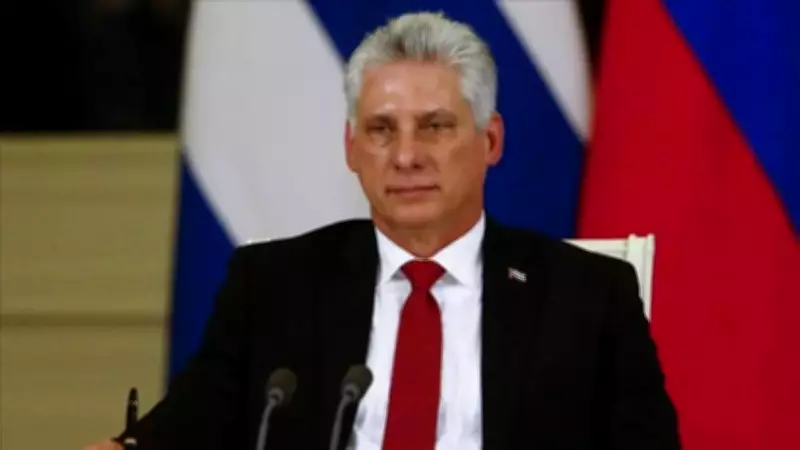
Cuban President Condemns US Tariffs on Oil Suppliers as Economic Strangulation
Cuban President Miguel Diaz-Canel delivered a forceful condemnation on Saturday against the United States for its latest imposition of tariffs targeting countries that supply oil to Cuba. He characterized the decision as a deliberate attempt to choke the island nation's economy, framing it as an aggressive escalation in US foreign policy.
Accusations of Economic Blockade and Foreign Policy Aggression
In a series of posts on the social media platform X, Diaz-Canel accused the Trump administration of employing force as a primary tool in its international relations strategy. He asserted that the US is overstepping by attempting to dictate which nations Cuba is permitted to engage in trade with. "We condemn in the strongest terms the new escalation by the United States government against Cuba in its determination to impose an absolute blockade on fuel supplies to our country," the President stated emphatically.
He further elaborated that Washington is unjustly claiming "the right to dictate to sovereign states which nations they may trade with." This move, according to Diaz-Canel, represents a dangerous precedent in global diplomacy, undermining the autonomy of independent nations.

Cuba's Defiant Response and US Executive Order
Despite the mounting economic pressure, President Diaz-Canel declared that Cuba would respond with resilience and conviction. "With firmness, equanimity, and confidence that reason is absolutely on our side," he affirmed, signaling Havana's unwavering stance. He concluded one of his social media messages with the rallying cry: "Homeland or Death! We shall overcome!" This statement underscores the ideological resolve of the Cuban leadership in the face of external challenges.
The President's comments were a direct reaction to an executive order signed by US President Donald Trump, which warns of imposing fresh tariffs on countries involved in selling or providing oil to Cuba. This order empowers the US government to levy additional duties on imports originating from nations connected to such oil supplies to the Caribbean island.
Legal Basis and Accusations from Washington
Issued under the authority of the International Emergency Economic Powers Act, the US executive order formally designates Cuba as an "extraordinary threat" to American national security. It further accuses the Cuban government of providing support to hostile states and various groups, thereby justifying the stringent economic measures.
Diaz-Canel dismissed these justifications as a "mendacious and empty pretext," arguing that the true objective is to "strangle the Cuban economy" by targeting its crucial oil trade partners. He had previously cautioned that this decision reflects a perilous and aggressive approach in US foreign policy, one that could have destabilizing effects beyond bilateral relations.
The escalating tension highlights the ongoing geopolitical friction between the United States and Cuba, with economic tools being leveraged in a complex diplomatic struggle. The situation continues to evolve, drawing attention from international observers concerned about trade sovereignty and economic coercion in global affairs.






