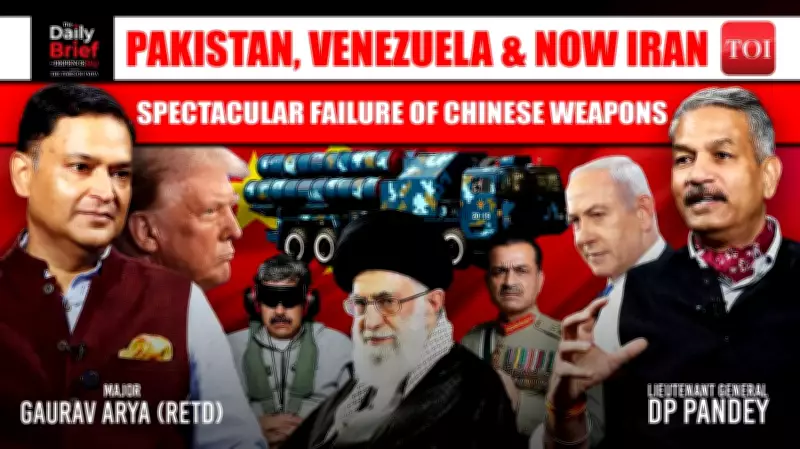
Global Setback for Chinese Defense Technology: Failures Across Multiple Fronts
In a recent episode of The Daily Brief by DefenceHQ, Major Gaurav Arya engaged in a detailed discussion with retired Lieutenant General DP Pandey, focusing on the escalating tensions in the Middle East and their implications for Chinese defense systems. The conversation revealed significant vulnerabilities in Chinese-made air defense networks, particularly in Iran, Pakistan, and Venezuela, marking a global blow to Beijing's military export ambitions.
Exposing Iranian Air Defense Vulnerabilities
The analysis centered on how recent coordinated strikes by the United States and Israel have starkly exposed weaknesses in Iranian air defense infrastructure. Lt. Gen. Pandey highlighted the critical limitations of the HQ-9 and S-300 missile systems, which form the backbone of Iran's defensive capabilities. These systems, despite their advanced specifications, have demonstrated operational failures when confronted with sophisticated Western military technology.
The discussion emphasized the role of Afghan-based attacks on strategic installations like the Nur Khan airbase, which further compromised Iranian defense postures. This multi-front pressure has revealed not just technical shortcomings but also strategic gaps in how these systems are integrated and operated.

The Interplay of Modern Warfare Elements
Major Arya and Lt. Gen. Pandey delved into the complex interplay of various elements that define contemporary conflicts. They examined how technology, human resources, and cyber warfare converge to create new battlefronts. The use of swarms, precision missiles, and unmanned aerial vehicles (drones) has fundamentally altered defense dynamics, allowing adversaries like Israel and the United States to penetrate what were once considered robust defense networks.
The experts pointed out that the effectiveness of these penetration tactics underscores a broader trend: traditional air defense systems, including those supplied by China, are struggling to adapt to rapidly evolving offensive technologies. This mismatch has led to repeated failures in real-world scenarios, raising questions about the reliability of Chinese defense exports.
Strategic Implications and Regional Stability
The conversation extended beyond technical analysis to explore the broader strategic consequences. Lt. Gen. Pandey assessed the impact of international sanctions on Iran's ability to maintain and upgrade its defense systems. He noted that sanctions have crippled Tehran's capacity to respond effectively, leaving its air defense networks increasingly obsolete and vulnerable.
Furthermore, the demonstration of American military power, including the deployment of assets like B-2 stealth bombers and the Gerald R. Ford aircraft carrier, has sent a clear message about US dominance in the region. This show of force not only highlights the limitations of Chinese defense technology but also escalates risks of broader conflict.
Risks of Escalation and Proxy Involvement
Major Arya and Lt. Gen. Pandey warned of the potential for escalation, with proxy groups becoming increasingly involved in the conflict. They discussed how these dynamics could spill over into South Asia, affecting regional stability. The failures of Chinese defense systems in Iran, coupled with similar issues reported in Pakistan and Venezuela, suggest a pattern that could influence global defense partnerships and alliances.
The analysis concluded that these developments represent a significant strategic setback for China, as its defense exports face scrutiny and skepticism from potential buyers worldwide. The repeated failures in high-stakes environments undermine Beijing's claims of technological parity with Western powers and could reshape the global defense market in the coming years.