The closing weeks of 2025 present India with a complex dual security challenge, stemming from a major technological leap by China and escalating political violence in neighbouring Bangladesh. These parallel developments are testing New Delhi's strategic calculus on both its eastern and northern fronts.
China's "Manhattan Project": A Semiconductor Game-Changer
According to a Reuters report, China has developed a prototype extreme ultraviolet (EUV) lithography machine within a high-security laboratory in Shenzhen. This factory-sized system, dubbed China's "Manhattan Project," is capable of producing the world's most advanced semiconductor chips. Such chips are the backbone of artificial intelligence systems, modern smartphones, and next-generation military platforms.
The development signals a potential dismantling of the West's near-monopoly on cutting-edge chip production. For years, analysts believed China lagged behind the United States and its allies by at least a decade in this critical domain. This assumption now requires urgent reassessment.

China reportedly achieved this by recruiting engineers of Chinese origin who previously worked for ASML, the Dutch company that is the sole global producer of EUV machines. Over nearly six years, these engineers reverse-engineered the technology. China assembled its machine using components salvaged from older ASML systems and parts sourced through second-hand markets and intermediaries, masking the end buyer's identity.
While the Chinese EUV machine is still undergoing testing and faces challenges in reliability and scalability, its mere creation marks a stunning shift. A 2024 study by the Australian Strategic Policy Institute highlighted this trend, noting that while the US led in 60 of 64 critical technologies in 2003-2007, it now leads in just seven. China, which led in only three technologies during that earlier period, now tops 57 of the 64 technologies.
This breakthrough comes despite sustained US pressure on ASML to restrict sales of its most sophisticated machines to China. The technological balance of power in the Indo-Pacific is being fundamentally rebalanced.
Bangladesh in Turmoil: A Strategic Drift from India
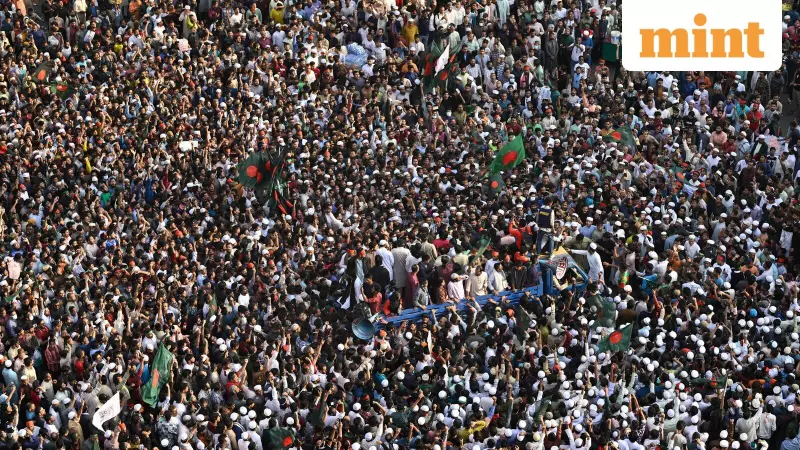
Simultaneously, India's eastern neighbour, Bangladesh, has been plunged into a fresh cycle of violent unrest. The trigger was the shooting of 32-year-old student leader Sharif Osman Hadi, a spokesperson for the Inquilab Mancha (Platform for Revolution), in Dhaka last week. Hadi was launching his campaign for the elections scheduled for 12 February 2025.
Suspicions that the assailant may belong to a group linked to the ousted Sheikh Hasina's Awami League and could have fled to India have inflamed anti-India sentiments. Threats have been issued against the Indian embassy in Dhaka and its consulates, with protesters attempting to storm one consulate before being pushed back by security.
The incident has intensified pressure on the interim government led by Muhammad Yunus to apprehend the culprit. The administration is also grappling with reviving the economy and pursuing the extradition of former Prime Minister Sheikh Hasina from India. Hasina fled to India after being ousted and, according to External Affairs Minister S. Jaishankar, can remain there "for as long as she wished." Her continued public statements from India are viewed as unfriendly by Dhaka, further straining bilateral ties.
A recent Indian parliamentary standing committee report starkly warned that from a model friendship, Bangladesh now poses one of India's "greatest strategic challenges since 1971." The report cited rising extremism, attacks on minorities, and Dhaka's growing drift towards China and Pakistan as key concerns.
Converging Pressures on India's Strategic Horizon
These two developments create a pincer-like pressure on India's foreign and security policy. On one flank, China's relentless advance in foundational technologies like semiconductor manufacturing enhances its comprehensive national power, with direct implications for the military and economic balance in Asia.

On the other flank, instability in Bangladesh, a crucial neighbour with deep cultural and economic links to India's eastern and northeastern states, threatens regional security. The potential for the space to be filled by other powers like China or Pakistan adds a layer of complexity.
As 2025 draws to a close, India's strategic establishment faces the twin tasks of navigating a rapidly shifting technological landscape dominated by a competitive China and managing an increasingly volatile and strategically sensitive relationship with Bangladesh. The outcomes will significantly influence India's security and geopolitical standing in the coming years.